
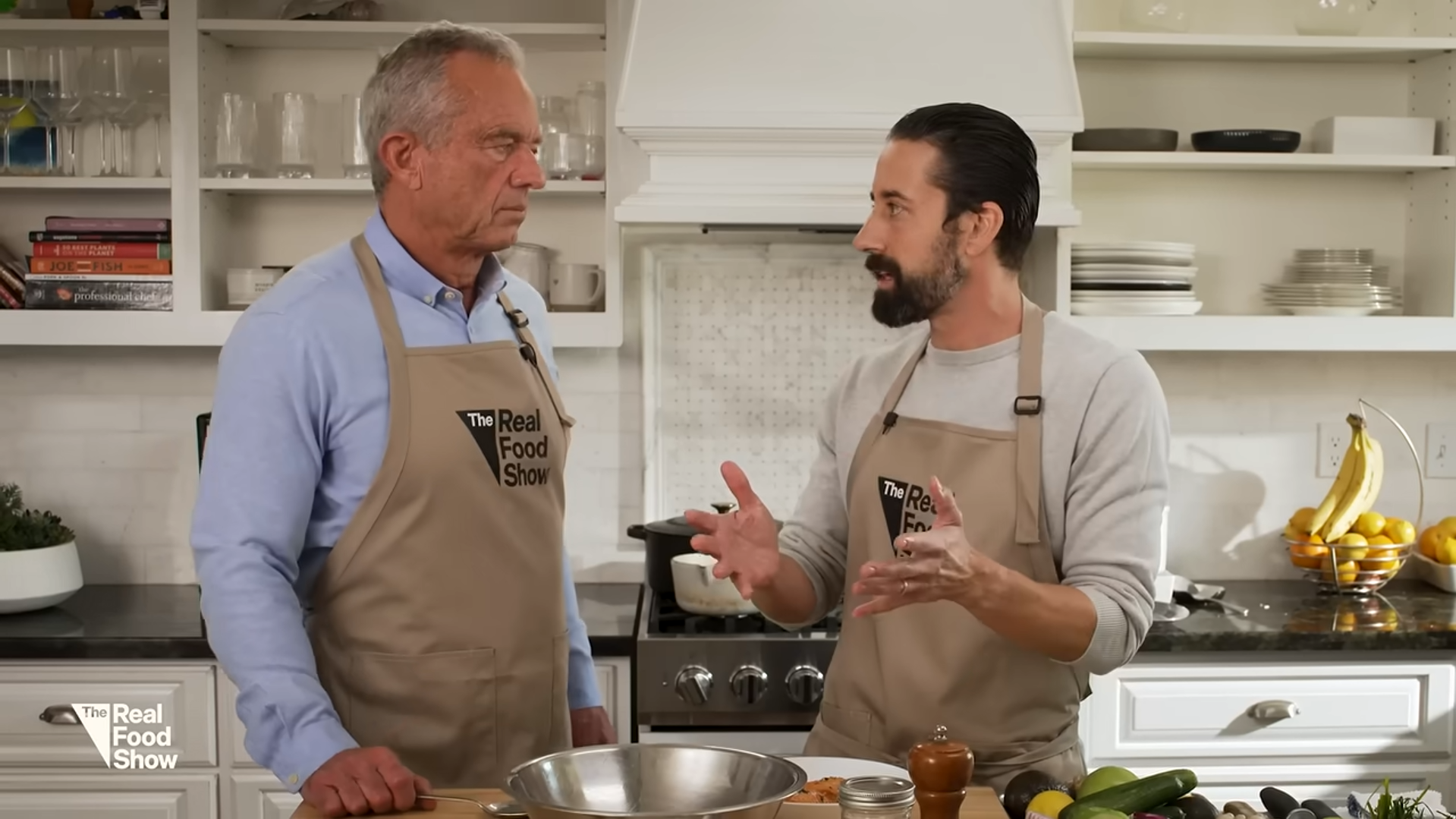
I find it intriguing that conservatives are pushing to normalize caring about nutrition, framing it as something worth caring about. Yet I keep returning to the same thought: this isn’t something that belongs to the government.
We’re now three episodes into The Real Food Show, a YouTube cooking class steered by Health and Human Services (HHS) Secretary Robert F. Kennedy Jr. And I’ve found myself hooked.
Don’t get me wrong: in theory, I dislike it. The state stepping into the realm of making cooking programs feels inappropriate. And this one is riddled with propaganda—there are thanks to President Donald Trump for the new U.S. dietary guidelines, and casual nods to things like fisheries regulation or an executive order on regenerative agriculture. Even if you can ignore the ick factor of HHS attempting to slip political content to viewers the way some parents hide broccoli in muffins, this just makes the show worse. As a cultural or entertainment product, it would be better off without stray references to the Magnuson-Stevenson Act.
Besides, RFK Jr.’s presence, hosting each episode alongside a well-known chef, doesn’t add much. He spends most of each episode whisking eggs or performing some other kitchen-helper task while the guest chef speaks. Then he pops in intermittently with propaganda while elbows-deep in chickpea salad.
Still, it’s propaganda I happen to largely agree with. Some former dietary guidelines were problematic, and they were frequently shaped by corporate and agricultural interests. You should eat eggs. Fiber benefits gut health. Eating protein with meals matters, even if the message has drifted a bit from scientists’ lips to the grocery aisle (protein Doritos, anyone?).
And do you know how long I’ve been ranting to anyone inclined to listen—which, admittedly, isn’t many people—about Americans’ skewed omega-6 to omega-3 ratio? Answer: since roughly fifteen years ago, when I first read Susan Allport’s The Queen of Fats, an early-turned-ahead-of-its-time book published in 2008 that challenged the conventional wisdom about saturated fats and the root causes of American disease.
Today, this dietary tenet has become part of the canon within the Trump administration’s HHS. And that’s neat.
Yet it’s also puzzling.
Not long ago, even talking about nutrition at all—and especially things like nutritional yeast, the microbiome, or cooking with apple cider vinegar (all mentioned on The Real Food Show)—carried a liberal-coded aura. Republicans mocked former President Barack Obama as a hopelessly out-of-touch elitist for mentioning arugula. They ridiculed Michelle Obama and complained that she was meddling in people’s private lives when she urged Americans to eat more vegetables and take walks.
Obama-era government nutrition guidance wasn’t flawless. For instance, it carried a late–20th-century fear of fats, and some of it rested on questionable science aimed at nudging people toward healthier choices.
But conservatives weren’t simply arguing about whether skim milk or whole milk was better, or where apples should go in school cafeterias. They cast the very notion of government giving dietary or health advice as nanny-state meddling, and they made a big show of sipping giant sodas and munching junk food. They linked manliness with meatiness and freedom with ignoring healthy eating altogether.
Now, a Republican administration is trying to teach people how to prepare an arugula salad with a homemade dressing. They’re demonstrating how to substitute tuna in tuna salad with chickpeas and urging people to obtain eggs from regenerative farms.
The shift is fascinating. (I explored the topic in depth last summer in Trad Wives and Tallow Fries: How the Wellness Wars Flipped Health and Food Politics Upside Down.) And, on one level, it’s laudable as well. If government authorities are going to weigh in on food politics—and in some respects, they can’t avoid doing so, in areas like school meals or the Supplemental Nutrition Assistance Program—then I’d rather they align with good health than with something less constructive.
RFK Jr. and his allies are attempting to recalibrate the political charge surrounding healthy eating and the broader narrative about caring for nutrition. That could have value in general, and specifically when it comes to reaching conservatives who are unlikely to be persuaded by the standard left-leaning politicians who promote healthy living.
Besides, hosting a cooking show is a more palatable approach than imposing sin taxes on sugary drinks or enacting bans on certain foods.
And the underlying premise is appealing: recipes that are nutritious yet tasty, easy to pull off quickly and on a budget, using basic kitchen tools, paired with small bites of nutrition science that illuminate why the ingredients matter. It lands as smart without feeling pretentious, and even a touch folksy. And it feels accessible—I left with a desire to cook this food and with a sense that I could do it, which isn’t the case with many cooking programs.
To be honest, I’m a bit torn. I’m convinced that more people eating real food and learning about nutrition is a good thing. Yet I know how government machinery operates—and how these efforts tend to expand beyond voluntary, individual action. Once authorities decide to steer American diets, the reach rarely stays confined to advocacy alone.
I also worry about myopia within the Make America Healthy Again (MAHA) movement, where RFK Jr. serves as a noticeable figurehead. Some MAHA proponents seem so fixated on moving away from earlier nutrition guidance that they embrace unproven fads or demonize substances—such as seed oils—where the evidence remains mixed.
Look, I’ve been skeptical of seed oils for a long time (tied to that omega-3/omega-6 balance I mentioned). If I’m wrong about that—and I very well could be—it affects only me and my household. When the government issues dietary guidance, or promotes particular ingredients over others, the implications extend far beyond one kitchen.
So, yes, you could oppose the show on fiscal grounds (are our tax dollars funding this?) or from a philosophical stance—“this isn’t the proper role of government.” For me, the primary concern is practical: What if RFK Jr. and his cooking crew are wrong?
When you put advice under the imprimatur of the federal government, many people may treat it as indisputable truth. Yet dietary guidance has been wrong before, and it will be wrong again. It might even be wrong right now.
And even if they happen to be right, there remains the question of whether a show like The Real Food Show can genuinely alter habits.
The inaugural episode, aired on July 30, has registered more than 309,000 views at the time of writing—not a viral smash, but comparable to the audience of some popular Food Network programs. Yet the second episode, posted three weeks later, has only 159,000 views, suggesting perhaps fading interest. And what matters most from a public health standpoint isn’t just whether people are watching but whether anyone is actually preparing these recipes and applying the advice in real life.
There isn’t strong evidence that teaching people to cook nutritious meals translates into improved health outcomes in the short term. If in-person instruction doesn’t shift outcomes much, what are the odds that a YouTube series will?
“There is a specific gap between the evidence base and what HHS has built,” notes Dorothy Brooks at Medical Daily. There hasn’t been any indication from HHS about how they intend to evaluate the program. “Nothing in the [HHS] announcement suggests the series will be measured for reach or impact,” Brooks points out.
Without explicit goals and benchmarks, the project hovers between being a boondoggle and a vanity venture.
Still, it’s an entertaining project. And there are far worse ways RFK Jr. could spend his time, as well as far worse avenues the federal government could pursue to promote public health. I’ll continue watching, and I might even try some of these recipes. But I’ll do so with a generous pinch of (sustainably sourced) skepticism.
