
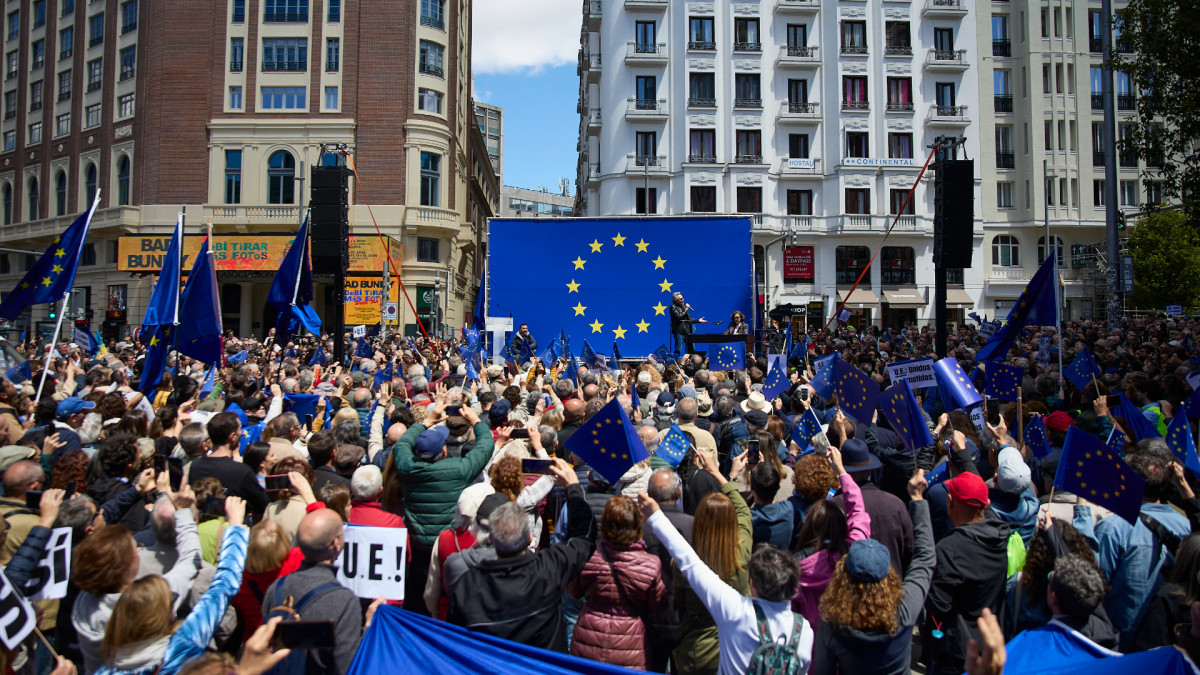
However, in the last decade, a series of crises have been affecting and potentially transforming the vision Spaniards have of Europe, a phenomenon that has been transversal and has touched almost the entire ideological spectrum in Spain, from left to right. In surveys, Spaniards’ trust in the Union has returned to levels seen before this period of crisis. But beneath the surface of the polls, each political family has accumulated in the last few years pending accounts and resentments of different kinds with Europe. In most cases, that is not turning into an anti-European discourse, because Spanish society remains deeply pro-European: it simply modifies the discourse held about the Union.
“Each political family has accumulated in the last few years pending accounts and resentments of different kinds with Europe”
Some of these crises have been cross-cutting. Although the adjustments imposed by the troika affected politically more the left-wing discourse, the treatment by some European leaders and media outlets in other member states toward Spain has had horizontal negative effects. Calling pigs to Portugal, Italy, Greece and Spain has not paid off for the European Union. After the very negative impact of the financial crisis and its subsequent political and economic management, Europe’s image enjoyed a few years of respite in Spain. Until nearly a decade ago.
Many of the subsequent crises have hit in an uneven manner. Thus, the crisis unleashed in 2017 following the illegal Catalan independence referendum provoked a strong impact on Catalan independence factions, who were hoping for backing from European institutions that they actually did not receive. In turn, conservative sectors expected a more forceful response of support for Spain than what some European leaders offered, who were critical of the police’s use of force during October 1. Everyone accumulated pending accounts in those days of 2017.
The subsequent flight by Carles Puigdemont, former president of the Generalitat, to Belgium opened another wound. The Belgian judiciary’s refusals to extradite the independence leader sought in Spain by the Supreme Court, but also the rulings of Germany or Italy, were a shock for a large portion of Spanish voters. In general, the procés has left many fissures in the vision of Europe, both on the right and in the independence movement. Decisions by the Court of Justice of the European Union (CJEU), which have often ruled in favor of the interests of the independence leaders, have also provoked sting and criticism.
“In general, the ‘procés’ has left many cracks in the vision of Europe, both in the right and in the independence movement”
That sequence of crises linked to the procés culminated with the amnesty law. The European Commission’s refusal to intervene publicly in the process, despite having set red lines for the Government during the drafting of the law, and the recent decision of the CJEU have also provoked strong criticism in conservative sectors, who feel Brussels has been too weak with the government of Pedro Sánchez. They also reproach the Commission for what they see as a double standard with the rule of law in Spain.
The left has had its own share of disappointments. One of the most important has to do with the stance of the European Union and many European political figures regarding the Gaza war unleashed by Israel after Hamas’s terrorist attacks of October 7, 2023. The paralysis of institutions and the positions of some figures such as Ursula von der Leyen, president of the European Commission, in a society that overwhelmingly demanded measures against Israel, take their toll. The Spanish government itself, which since Sánchez arrived at the Moncloa in 2018 has shown itself fully aligned with European institutions, has been particularly critical of the Commission, of Von der Leyen and of other European leaders for the lack of measures against the Netanyahu government.
Another, very recent, has been the Ceuta crisis. The criticisms of some European leaders and the letter in which twenty-two heads of government sent to Von der Leyen addressing the situation and threatening to take measures available within Schengen, thus signaling in a not-so-oblique way border restrictions, have produced a sense of loneliness. In its initial communications, the president of the Commission did not show solidarity with Spain or Ceuta, focusing solely on the risk that illegal immigrants had entered European soil. The Government did not hide its anger. In another letter sent to Von der Leyen and also to António Costa, president of the European Council, Sánchez was very critical of European leaders who had attacked Madrid for its management of the crisis.
“The criticisms of some European leaders and the letter that twenty-two heads of government sent to Von der Leyen […] have produced a sense of loneliness”
These various disappointments with Europe occur, in many cases, on the basis of the pro-European sentiment of Spanish society and how each social group rates that pro-European stance. Europe is a standard, at times an ideal inherited from past generations and decades, and it is against that image that the left and the right compare the daily reality.
