
In July 2023, an administrative decree signed in New Delhi overnight wiped out 40% of the world’s rice trade. India, the planet’s largest exporter, banned the sale of non-basmati white rice without warning or a transition period, which sustained the food supply for dozens of African and Asian countries. Rice prices jumped by between 15% and 20% within weeks, and Indian exports to sub-Saharan Africa fell by 43% in the following months.
It was not an isolated episode: in 2022 alone, thirty-two countries had already imposed seventy-seven distinct restrictions on food exports, just months after Indonesia halted its own palm oil exports and Russia tied the export of Ukrainian grain through the Black Sea to its war interests. The whole world had begun treating food as an asset to be protected, rationed and, when convenient, wielded as leverage.
This is the key point that disappears when the debate on food geopolitics is reduced to a bilateral duel between Washington and Beijing. What is happening is a much broader, multipolar reordering of the global food system, in which China is, without doubt, the actor with the most muscle and the most carefully designed strategy, but by no means the only one redrawing the board.
“What is happening is a much broader, multipolar reordering of the global food system”
The FAO itself confirmed this in its July 2026 cereals report: import demand is contracting across Asia, while Europe and Latin America are emerging as regions where appetite for imports remains or even grows. It is a shift of the center of gravity that goes beyond another chapter of the rivalry between two superpowers.
Within that reordering, however, it is worth pausing on China because it illustrates more clearly than any other actor where the game is heading. The capital Beijing allocates to soy is almost 85% of the soy it consumes and its annual food bill touches $215 billion, the highest in the world. On paper, it is the most vulnerable country in the system, but, as Caitlin Welsh and Brian Hart explain in Foreign Affairs, it has turned that vulnerability into an advantage: it built reserves that concentrate 44% of the world’s stored wheat, 53% of the rice and 59% of the maize.
It also bought seed technology —the 2017 acquisition of Syngenta by ChemChina for $43 billion remains the largest foreign purchase in Chinese history— to treat agricultural genetics the way semiconductors are treated and diversified suppliers at a pace that punctures any narrative of passive dependence. The share of Brazil’s agricultural exports to China rose from 8% in 2005 to 33% in 2025; Australia’s from 10% to 22%; and Thailand’s from 9% to 24%.
It also opens new pathways: in April 2026, a cargo ship departed from an Argentine port loaded with corn bound for China, breaking fifteen years of commercial silence between the two countries on that product.
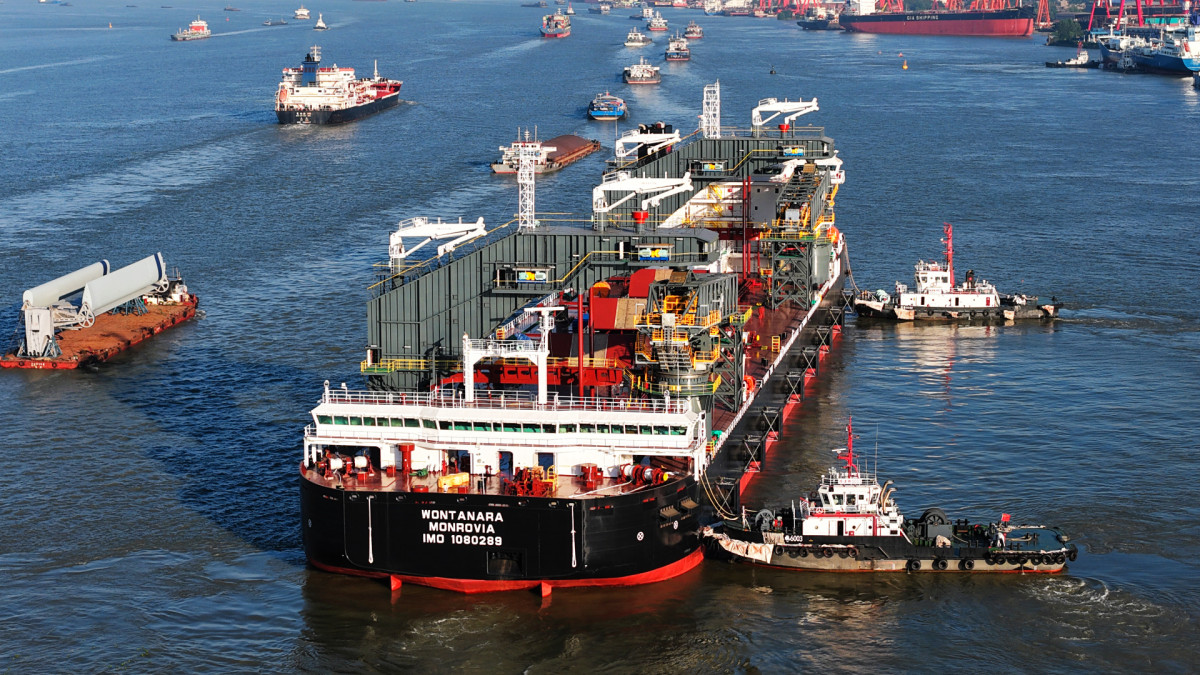
That capacity would not have advanced so far without the fusion of food trade and maritime logistics. COFCO, the Chinese state-owned agri-food trader, now operates in almost 40 countries with the capacity to move 180 million tonnes between warehouses, ports and railways. In 2023, COSCO Shipping paid $810 million for a 5.8% stake in COFCO Fortune, with a stated objective: “to safeguard the security of global food supply chains.”
The same operator that moves electronics and cars around the world is, at the same time, the logistical arm of a national food strategy. Thus, the pattern continues: China concentrates between 80% and 100% of the world’s production of certain vitamins and essential amino acids for animal feed, an input that the American livestock industry itself recognizes as its blind spot.
It is proof that, in this new board, power does not reside solely in producing more grain, but in controlling the nodes — seeds, reserves, ports, inputs — through which that grain must necessarily pass. Even the United States and the European Union, which for decades defended free agricultural trade as doctrine, have begun to speak softly about their own strategic reserves and reducing reliance on single suppliers, though still without the coherence or funding that China has been building for a decade.
“The power does not reside solely in producing more grain, but in controlling the nodes through which that grain must necessarily pass”
That control of nodes has not remained in theory: it has already been used as a political coercion instrument, and not only by China. Beijing has applied twenty-six episodes of agricultural trade coercion since 2010, five of them in 2025 alone. Since 2024 it has cost the European Union nearly $4 billion in exports of pork, dairy, brandy and cognac, in retaliation for the antidumping tariffs Brussels imposed on Chinese electric vehicles — a dispute that had nothing to do with food, but which ended up striking the European agri-food sector.
The same pattern was applied against Australia in 2020, when Canberra asked for an investigation into the origin of COVID-19 and Beijing responded with more than $4 billion in blocked Australian agricultural exports. And in 2026 Beijing repeated the same move against Canada, which had imposed its own tariffs on Chinese electric vehicles: the response came again via agriculture, not industry.
But this impulse is not exclusively Chinese. India, by curbing rice in 2023, prioritized its internal stability over its supply commitments to more than 140 client countries, and that unilateral gesture triggered a domino effect that pushed other rice exporters, such as Vietnam or Pakistan, to gain market share while they studied imposing their own restrictions for fear of depleting reserves.
What these episodes share is the underlying lesson: any government with enough weight in the production or logistics of a strategic food can turn that weight into political influence, and more and more governments are willing to do so, from New Delhi to Jakarta, from Moscow to Beijing.
Spain is more exposed than the aggregated trade statistics suggest because its vulnerability lies not in final consumption but in the intermediate link that converts imported commodities into animal protein. The country maintains a strong livestock specialization —pork, poultry and intensive beef— built on a feed formulation that requires ongoing inputs of high-quality protein, especially soy and soybean meal. Spain imports around six million tonnes of soy and its derivatives annually for this purpose.
It is not a dependency that can be substituted overnight: replacing soybean meal with rapeseed, sunflower, peas, beans, dried distillers grains with solubles (DDGS) or other by-products requires reformulating rations by species and production stage, ensuring homogeneous volumes, adjusting facilities and accepting, in some cases, poorer feed conversion or higher costs.
Adding to this is a timing problem: feed mills, integrators and farms operate with limited inventories and a rigid daily demand. They cannot halt the flow without impacting animal health and productivity. Therefore, the risk is not so much that Spain runs out of soy, but that a sustained rise in freight, port disruption, or a poor South American harvest squeezes margins across the chain before the consumer notices the problem.
“The risk is not so much that Spain runs out of soy, but that a disruption squeezes margins across the entire chain before the consumer notices the problem”
The logistics network adds another layer: COSCO owns 51% of Noatum Ports, which includes terminals in Valencia and Bilbao and dry ports in Madrid and Zaragoza, and in 2026 it was granted a fifty-year concession for a new terminal in Tarragona. These infrastructures remain under Spanish and European jurisdiction.
The problem is not to attribute to a foreign operator a power it does not legally have, but to recognize that Spain has tied a significant portion of its maritime-rail connectivity to a state-run logistics network of another power, without systematically incorporating that fact into its assessment of agro-food risk.
For the European Union, the challenge is deeper and different: it is about a gap between its agricultural production capacity and its tangible autonomy to sustain it. The EU is relatively self-sufficient in low-protein feeds, but imports 74% of high-protein feeds and 94% of the soy protein it uses.
In 2024-2025, imports of vegetable proteins amounted to about 13.4 million tonnes and required roughly 13 million hectares located outside European territory. That outsourced agricultural area exposes the Union not only to prices and freight costs, but also to deforestation, water stress, regulatory changes in producing countries and conflicts among its own objectives, including food security, farm income, decarbonization, biodiversity protection and open trade.
But protein dependence is only part of a broader vulnerability. European agriculture needs nitrogen-based fertilizers, whose production likewise depends on cheap gas. While trying to reduce energy exposure to Moscow, the EU still imported 4.4 million tonnes of Russian fertilizers in 2024, 30% of its imports, worth €1.5 billion.
Brussels has responded with gradual tariffs on Russian and Belarusian fertilizers, but that shows the contradiction: reducing geopolitical dependence can raise production costs for farmers if there is no ready industrial, energy and logistics alternative. The European question, therefore, is not about choosing between openness or self-sufficiency — two overly general concepts — but to build operational resilience by diversifying sources, increasing European protein crops, restoring the capacity to produce low-carbon fertilizers, and creating reserves or response mechanisms for inputs whose failure halts the entire chain.
This 2026 we have seen just how far oil and gas supply chains can, in a matter of days, move from being an abstract technical concern to constraining prices, business decisions and political leverage. The lesson should also serve bulk shippers.
Perhaps in the coming years we will discover, with the repetitive logic of Groundhog Day in global chaos, that oil routes were not the only ones prone to blockages, price hikes or leverage: routes carrying Brazilian soy, Argentine corn, Black Sea wheat or fertilizers could also be susceptible.
“Reducing a geopolitical dependency can raise farmers’ production costs if there is no ready industrial, energy and logistical alternative”
A ship loaded with crude at anchor disturbs the energy bill, but a ship loaded with soy or grain tightens feed costs, squeezes the profitability of livestock operations and, ultimately, raises the price of the shopping basket. Europe is learning, crisis by crisis, the various faces of strategic autonomy; let’s hope the food episode is less traumatic than defense or energy.
Europe’s Communities understood it from the start. When they launched the Common Agricultural Policy in 1962, with the continent still scarred by hunger and postwar rationing, they were not designing just another sector policy: they were building an infrastructure of self-preservation.The Treaty of Rome placed among the CAP’s objectives the stabilization of markets, ensuring the availability of supplies and delivering them to consumers at reasonable prices. Napoleon is credited with the phrase “armies march on their stomachs”; to that I would add that it is on them that nations, economies and political unions march.
Europe was born from the conviction that it could not build peace, prosperity or sovereignty on the uncertainty of its provisioning. The great irony is that, while India, Indonesia, Russia or China resume treating food as a matter of national security, the Union seems to have forgotten that guaranteeing food is the prerequisite for any other policy to exist.
