
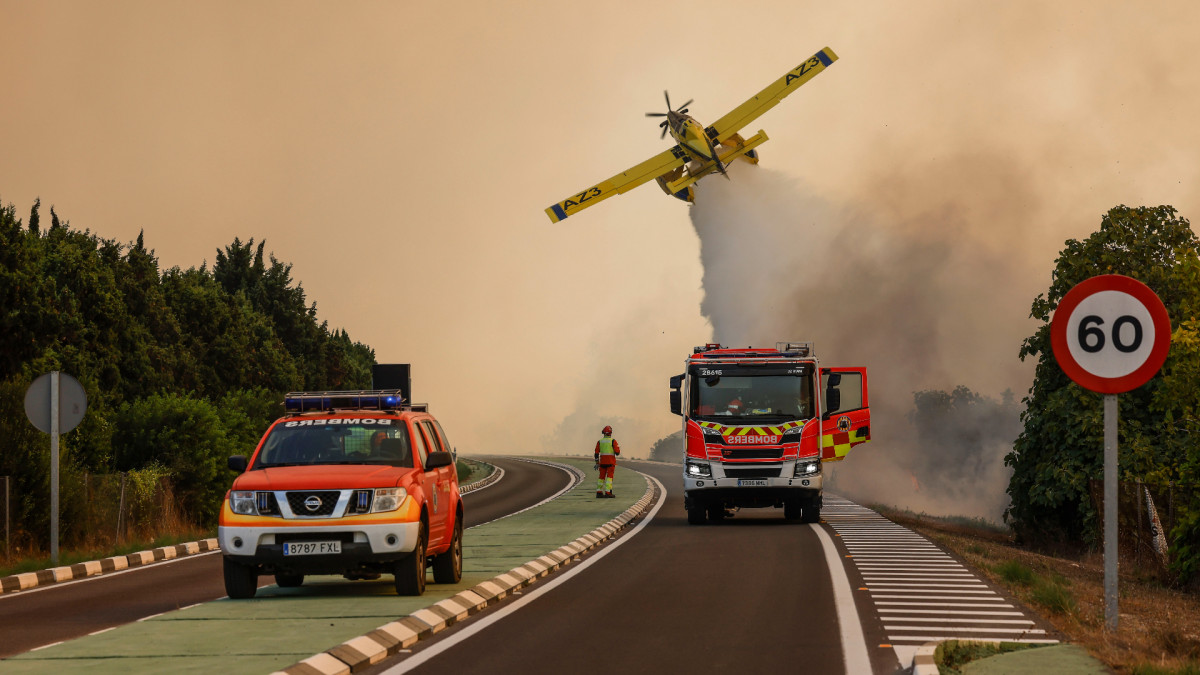
In Spain and France, forest fires have ravaged tens of thousands of hectares this summer, forcing mass evacuations and triggering serious episodes of air pollution. Europe has endured several consecutive heat waves since June, with significant consequences for health services, agriculture, transport, and tourism.
The human cost is staggering. The French public health agency estimates that 5,764 additional deaths occurred during the first heat wave. In Spain, the government has tallied more than 3,800 deaths attributable to heat since the start of 2026.
Every fire has an immediate trigger, whether negligence, an accident, poor land management, or even an intentional act. Yet extreme temperatures, dry soils, and the neglect of rural areas make a simple spark easily turn into a catastrophe.
We are not facing exceptional and isolated phenomena, but a new European climate reality. Because in this scenario we no longer speak of national emergencies. Smoke crosses borders, while heat disrupts the functioning of interconnected power grids, rail lines, and supply chains. And drought, for its part, affects food production and water availability across the single market. When several countries require aircraft, firefighters, or medical assistance simultaneously, a system based mainly on national resources and voluntary solidarity can quickly reach its limits.
“No estamos ante fenómenos excepcionales y aislados, sino ante una nueva realidad climática europea”
Europe is not prepared for a world warming beyond 2 °C. The European Environment Agency has identified 36 major climate risks to health, food, water, ecosystems, infrastructure, and financial stability. Several of them have already reached critical levels. The EU’s climate policy has rightly focused on reducing emissions, but adaptation still lacks political weight, institutional leadership, and predictable funding comparable.
The upcoming European Framework for Climate Resilience and Risk Management, which the European Commission plans to present in the second half of 2026, offers the opportunity to change course. However, it will not be enough to approve another strategic document. Europe needs a European Climate Emergency Pact that treats adaptation as an essential security responsibility and links prevention, preparedness, emergency response, recovery, and social solidarity.
Regarding national approaches, they show useful progress but also persistent limitations. France’s third National Plan for Climate Change Adaptation sets out a science-based roadmap to prepare the country for a warming of approximately 2.7 °C by 2050 and 4 °C by the end of the century. However, it remains mainly a government plan rather than a binding social contract backed by stable long-term funding.
Spain is attempting a more participatory approach by proposing an Estado Pact against the Climate Emergency, developed with the involvement of 1,300 stakeholders and structured around 15 priorities and 80 measures. However, the opposition parties’ refusal to join the pact shows that adaptation is trapped in political polarization. The European challenge is to combine French scientific planning, Spanish regional dialogue, and the European Union’s coordination capacity.
First, adaptation must be addressed with the same seriousness as defense, internal security, and public health. This does not mean pitting priorities against one another, but applying the same rigor: regular threat assessments, clearly defined responsibilities, multiannual budgets, strategic reserves, joint exercises, and protection of critical infrastructures. A hospital paralyzed by heat, a rail line closed by a fire, or a town without access to drinking water are safety failures, not merely environmental problems.
“La adaptación debe abordarse con la misma seriedad que la defensa, la seguridad interior y la salud pública”
The European Commission estimates that the Union, its member states, and the private sector will need to invest around €70 billion annually in climate adaptation through 2050. However, adaptation funding remains fragmented among cohesion policy, agricultural funds, civil protection, national budgets, and private insurance.
The upcoming long-term European Union budget should include a clearly identifiable allocation for resilience, backed by a stable share of revenues from the Emissions Trading System and by access to financing from the European Investment Bank. Additionally, EU-funded infrastructures should be designed to keep operating under credible future climate scenarios, applying the principle of ‘resilience by design’.
Second, Europe needs to improve its civil protection capacity to intervene when several national systems are under simultaneous pressure. The cross-border deployment of aerial resources and firefighters in France and Spain demonstrates how European solidarity works in practice. However, mechanisms like rescEU must stop being temporary strategic reserves and become permanent European capacities, equipped with adequate personnel, common equipment, regional centers, joint training, and a reliable command structure.
“Mecanismos como rescEU deben dejar de ser reservas estratégicas temporales para convertirse en capacidades europeas permanentes”
Military capacities should also be able to mobilize in support of civil protection services, and always under their authority. Spain’s Military Emergency Unit and France’s civil protection military formations demonstrate how the armed forces can provide specialized capabilities in air transport, engineering, communications, mapping, field hospitals, and logistics.
When a crisis exceeds the EU’s capabilities, emergency coordination mechanisms and NATO’s logistical means could offer additional support. Their intervention should remain under civilian leadership and reinforce —not replace— the firefighters, health services, and local emergency teams.
Third, Europe needs a fair system to share climate risks. Companies and infrastructure operators must assess their exposure to a world warming beyond 2°C, publish credible adaptation plans, protect their workers, and avoid investments that create foreseeable future costs and liabilities. Citizens also bear responsibilities, from complying with fire prevention rules to participating in community preparedness. But appealing to individual responsibility cannot become an excuse to shift costs onto those with the least means to bear them.
“Apelar a la responsabilidad individual no puede convertirse en una excuse para trasladar los costes a quienes tienen menor capacidad para asumirlos”
Low-income households, farmers, small businesses, and rural municipalities cannot finance the structural transformations required by adaptation on their own. A European climate protection mechanism should combine private insurance, national public-private cooperation systems, and European reinsurance backing for extreme disasters. Access to solidarity funds should reward preventive measures, while subsidies and technical assistance should be prioritized for the most vulnerable communities.
Finally, adaptation must be designed with the actors, sectors, and territories that need transformation. Perhaps the best example is tourism. European destinations depend on coasts, forests, mountains, water resources, and transport systems that are particularly vulnerable. Resilience cannot be limited to installing more air conditioning units in hotels. Accommodations, restaurants, transport operators, seasonal workers, residents, and municipalities must rethink destinations together: diversifying seasons and activities, protecting workers from heat, managing water demand, transforming mobility, and halting investments incompatible with resource constraints.
“La resiliencia no puede limitarse a instalar más aparatos de aire acondicionado en los hoteles”
This transformation must constitute an inclusive and just transition. Protecting only large infrastructures, the wealthiest destinations, or large companies shifts risks onto precarious workers, small businesses, and the most disadvantaged rural areas. Local knowledge must be incorporated into decisions from the outset.
The benefits must also be shared. Adaptation can create jobs, improve health, and make our regions more livable. When public investment increases land value or tourist incomes, a portion of that value should be returned to the community and help fund protection for those most exposed.
Adaptation is not a substitute for mitigation. Every fraction of a degree of warming we manage to avoid will reduce future losses and preserve more options. But Europe can no longer delay protecting populations from warming that is already here.
Climate preparedness must become a permanent European priority, built in partnership with the affected communities and sectors and guided by a principle of solidarity and shared responsibility.
