
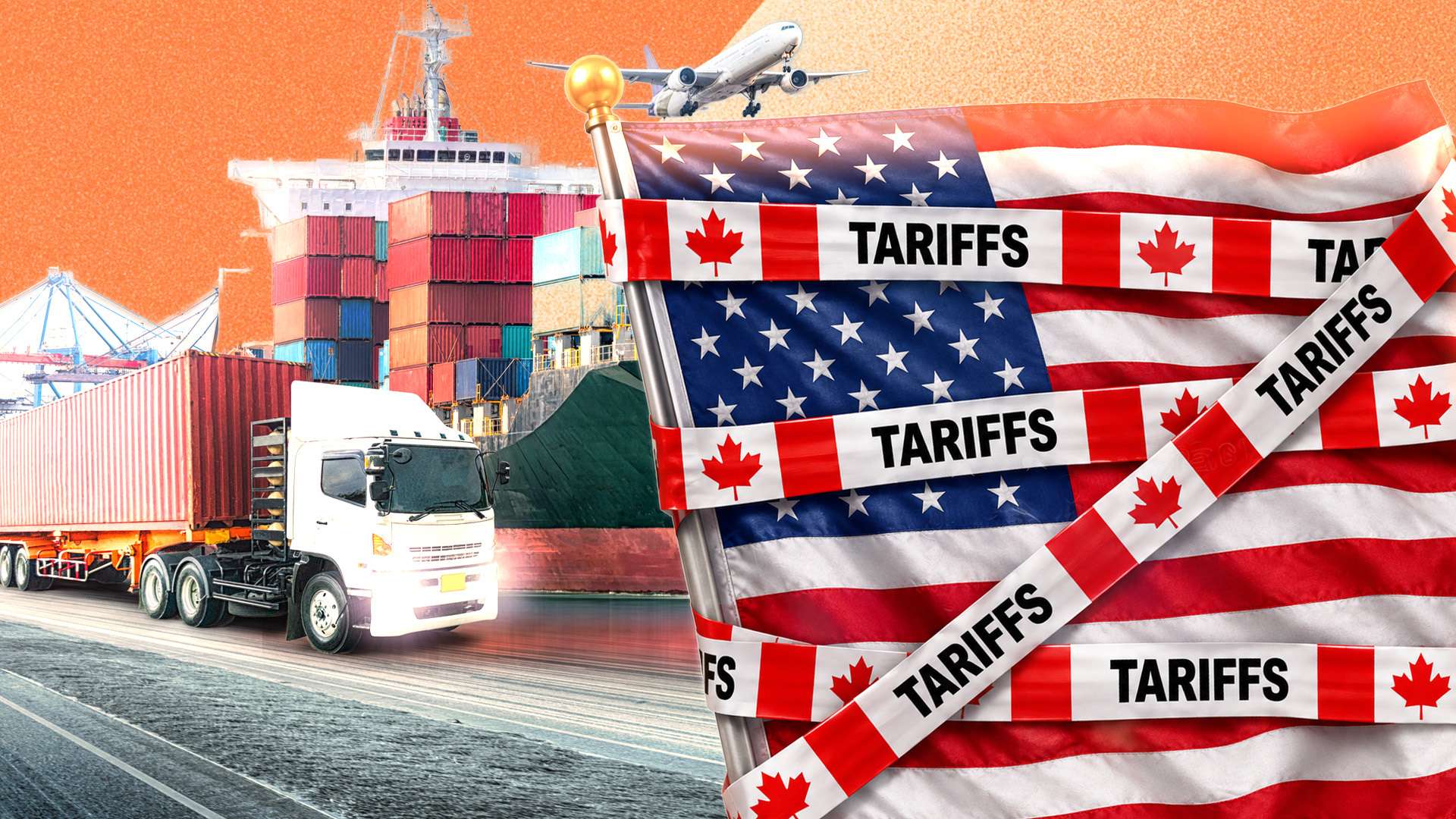
Canada imposes retaliatory duties on U.S. goods: Beginning today, a broad array of American imports—including apparel, dairy, metals, paper goods, and wood products totaling roughly $20 billion—will be hit with new Canadian tariffs. The measures will also double the existing duties on American steel and aluminum entering Canada and will affect around 700 items, ranging from aluminum foil to railway locomotives and steel bridge components, according to The New York Times.
Ottawa’s move is a direct response to duties imposed by the United States on Canadian products during a volatile phase of trade negotiations. Just a few weeks earlier, Prime Minister Mark Carney declared that the United States intends to compel Canada into subservience, adding that such an outcome would never come to pass. When pressed about his forceful tone, Carney insisted that Canada has been attacked and that the nation is essentially at war with the aggression it faces, a sentiment he reiterated as justification for the tough posture.
Carney is following through on earlier pledges to match U.S. tariffs on Canadian goods on a one-for-one basis, a strategy backed by polling that shows substantial domestic support for his stance.
Meanwhile, U.S. officials pushed back. Treasury Secretary Scott Bessent argued that addressing injuries with a tit-for-tat approach is untenable against a country of vastly greater economic scale. President Trump, for his part, floated the possibility of severing all trade with Canada in comments made last week.
“Tariffs carry heavy costs and often fail to achieve their political aims, all while sowing dysfunction across the system,” the piece notes. The author questions why Washington would jeopardize a longtime neighbor and ally for uncertain gains, asking whether there is a legitimate rationale for souring relations with Canada.
A concise reflection: the debate over who bears the burden of tariffs is evolving, and some warn that the rhetoric has outpaced the real gains. 1/x pic.twitter.com/placeholder
— Scott Lincicome (@scottlincicome) May 3, 2018
Scenes from New York: “During the grim days following the World Trade Center attacks, residents were repeatedly reassured that the air around the fallen towers was safe to breathe,” reports The New York Times. Yet a decade later, investigators still uncovered asbestos traces as far as half a mile away, according to a set of air-quality records released on Tuesday. The Mamdani administration is unveiling more than 170,000 pages of air-quality reports, contamination logs, and internal correspondence among city officials. The files were kept in 68 boxes in a municipal office, hidden from public view for over twenty years. Officials themselves had misplaced the documents, only discovering them last year. The veracity of that detail remains uncertain.
QUICK HITS
- The art of blaming capitalism:
“Capitalism is why people have to work” may seem an overstatement, yet it sits within a long-standing habit of pointing the finger at capitalism for almost everything, no matter how unfounded the claim.
A brief thread: pic.twitter.com/placeholder2
— Jeremiah Johnson 🌐 (@JeremiahDJohns) September 5, 2026
- “Desalination, the process of turning seawater into potable water, has transformed arid regions into thriving oases,” writes Stephen McBride for the Rational Optimist Society. “In Dubai, the world’s largest desalination plant delivers enough fresh water each day to fill 890 Olympic pools. Abu Dhabi alone contributes nearly a tenth of all desalinated water globally. With 97% of Earth’s water being ocean, undrinkable without desalination, the technology has reshaped national fortunes.” The challenge, though, is that desalination plants demand vast space. What if space is limited? Two former SpaceX engineers in Torrance, California, developed a compact solution: “Access weighs 25 pounds and resembles a portable cooler. I can lift it with one hand. You lower a hose into the sea, press a button, and you obtain six gallons of fresh water every hour.”
- “Iran-supported Houthi militants in Yemen unleashed drones and missiles at several of Saudi Arabia’s southern energy sites on Tuesday morning, intensifying hostilities on what has become a second front for the kingdom and nudging oil prices back toward the $100 per barrel mark,” reports The Wall Street Journal. “Saudi authorities confirmed the strikes, which the Houthis claim targeted sites in Abha, Najran, and Jizan. The hits damaged gas and oil storage facilities, including a power plant in Abha, and the Jazan refinery was set ablaze and taken offline, according to individuals familiar with the damage. Output at Jazan had already been reduced by earlier Houthi assaults.”
