
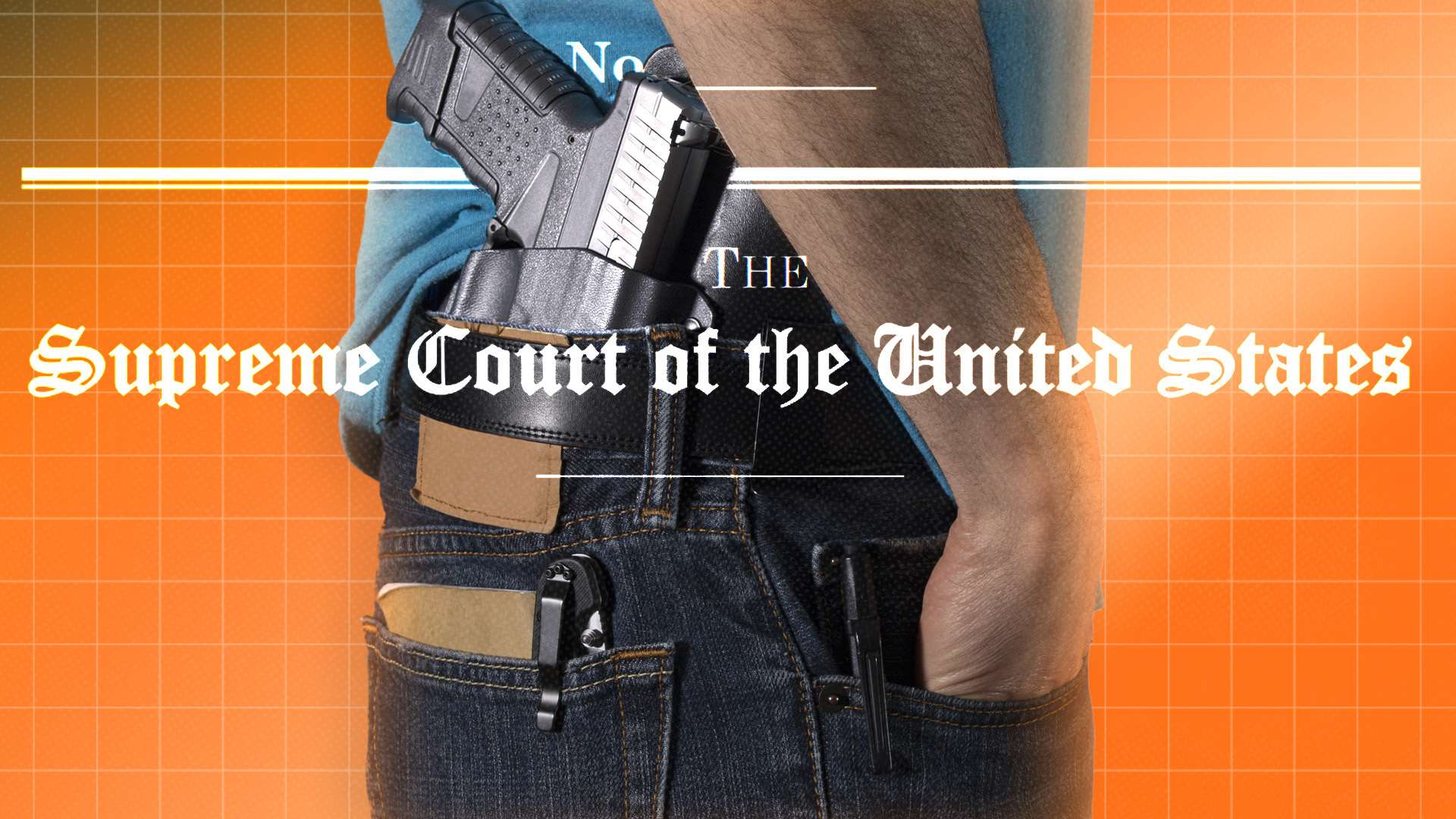
Meanwhile, Massachusetts’ highest court is weighing whether the state may deny handgun-carry licenses to applicants labeled as unsuitable.
Four years earlier in New York State Rifle & Pistol Association v. Bruen, the Supreme Court stated that the Second Amendment bars states from demanding that individuals prove a “special need” before they may publicly carry handguns for self-defense. Yet the Court stressed that nothing in its ruling should be read as an endorsement of rules that license only those who are demonstrably “law-abiding, responsible citizens.”
Two ongoing cases probe the boundaries Bruen sets for state carry-license schemes. In Johnson v. Jacobson, a long-haul trucker with Florida and Georgia permits asks the Supreme Court to reject Minnesota’s insistence that he also hold a Minnesota license to carry there. And in Pratt v. Westbrook, a denied applicant for a Massachusetts permit asks the state’s highest court to declare the state’s “suitability” standard unconstitutional under the Second Amendment.
Jeffrey Johnson, who is represented by the Liberty Justice Center (LJC), hauls freight across the nation and makes regular routes through Minnesota, the petition notes. “Because long-haul truck drivers face unique risks, Johnson always carries a handgun for self-defense. But Minnesota’s law requires him to unload and containerize his weapon when crossing into Minnesota, which does not recognize firearm license reciprocity with fifteen states, including Florida and Georgia.”
The LJC contends that this arrangement clashes with the Second Amendment. “Once a person proves they are a law-abiding citizen, they should be entitled to carry a gun in public for self-defense,” argues LJC Senior Counsel Ryan Morrison. “Constitutional rights, including the Second Amendment, should not force individuals to prove their worthiness to exercise civil liberties repeatedly. Forcing people to juggle a patchwork of licenses to preserve their constitutional rights reduces the Second Amendment to a lesser status and subjects it to an entirely different set of rules than other guaranteed rights.”
Florida and Georgia both permit legal gun owners to carry publicly without a license, but they issue permits for carrying in other states with different prerequisites. A Florida concealed-weapons license requires the applicant to be a U.S. citizen or lawful permanent resident at least 21 (18 for certain veterans), free of disqualifying criminal or mental-health records, not under a domestic-violence restraining order, and able to demonstrate firearm competency. Georgia has parallel requirements, though its permits are issued only to residents of the state.
To Minnesota, those standards are not stringent enough: although the state recognizes permits from 33 other jurisdictions, Florida and Georgia do not meet its reciprocity criteria. The Eighth Circuit has ruled that the decision rests with Minnesota.
As Bruen stated, when the plain text of the Second Amendment covers a person’s actions, the Constitution presumptively protects those actions. The government must then show that the regulation aligns with the nation’s historical tradition of firearm control. Only if a rule fits that historical pattern may a court conclude that the person’s conduct lies beyond the Second Amendment’s unqualified protections.
Johnson’s challenge to the Second Amendment “fails at Bruen step one because Minnesota’s reciprocity statute, by itself, does not regulate the act of bearing arms,” the Eighth Circuit determined last spring. “Although carrying a firearm in public in Minnesota falls under the Amendment’s text, that behavior is regulated by Minnesota’s permit requirement, and Johnson repeatedly concedes that Minnesota’s shall-issue system does not violate the Second Amendment.”
By contrast, the court said, Minnesota’s reciprocity policy “does not regulate any conduct addressed by the Second Amendment’s text, which says nothing about reciprocity between licenses.” Allowing permit-holders from recognized states to act as though their out-of-state licenses were Minnesota permits exempts qualified individuals from Minnesota’s own licensing process. Since the reciprocity rule merely grants an exemption from applying for a Minnesota permit, it does not restrict any arms-bearing conduct.
Johnson’s petition contends that this is mistaken because “Minnesota’s licensing regime and its reciprocity statute are distinct laws that can affect Second Amendment rights independently.” Johnson could legally carry in Minnesota if he obtained a Minnesota license, but he could also do so if his Florida or Georgia license were recognized via reciprocity. In either case, the law constrains his right to bear arms, which falls squarely within the Amendment’s scope.
In Wolford v. Lopez, decided last June, the petition notes, the Court acknowledged that “the Second Amendment has the same meaning in every corner of the United States.” Yet the Eighth Circuit’s ruling would make the Second Amendment the only enumerated right that a state may extinguish solely based on which sister state issued a citizen’s credentials, a concept without an analogue in the Court’s broader constitutional jurisprudence.
The issue is nationwide in scope, the petition argues, because millions hold state-issued firearm licenses and cross state lines daily for work and travel. The Eighth Circuit’s decision would subject them to a patchwork of reciprocity rules that only this Court can resolve.
Unlike Johnson, Randy Westbrook resides in the state where he seeks to carry. But Holyoke’s Chief of Police, David Pratt, rejected Westbrook’s Massachusetts permit application after finding him unsuitable under the state’s suitability standard. This provision, adopted after Bruen, lets local licensing officers deny applications based on “reliable, articulable and credible information” suggesting that granting a license could endanger the applicant or the public.
Long before Pratt’s decision, more than thirteen years earlier, Westbrook had faced domestic assault and aggravated assault and battery charges. Prosecutors dropped the first charge, and the latter was resolved by a “continuance without a finding” (CWOF), meaning no conviction but an admission of facts sufficient to establish guilt. In 2014, drug charges against Westbrook were also resolved by a CWOF.
“I evaluate the facts presented in each individual case and I make a decision based on those facts,” Pratt testified when Westbrook challenged the denial. He said his determinations of “unsuitability” drew on his three decades of law-enforcement experience, rather than a fixed set of criteria.
Although a federal judge found the state’s suitability requirement unconstitutional, a Hampden County Superior Court judge disagreed, and the Massachusetts Supreme Judicial Court (SJC) granted Westbrook direct appellate review. Oral argument in the case is scheduled for October 7.
In a brief backing Westbrook’s appeal, the Second Amendment Foundation (SAF) and several other gun-rights groups emphasize that Westbrook was never convicted of the offenses cited by Pratt. “Other factors besides a guilty mind—including expediency or avoiding publicity—can drive a defendant to admit to sufficient facts for a continuance,” the filing argues, citing a 1986 SJC ruling. “Criminal charges that do not result in a conviction do not provide reliable proof that the alleged crime occurred.”
Because the state opted to “settle these matters with Mr. Westbrook rather than pursue convictions or guilty pleas,” the SAF contends that Massachusetts cannot “renege on them and insist that one constitutional right is not part of the deal.” If the state sought to permanently disarm Westbrook, it should have pursued a conviction; instead, it chose a different course, and the charges were dismissed, leaving his rights intact.
The SAF argues that the suitability requirement is “clearly unconstitutional” as applied to Westbrook and also facially unconstitutional because it allows licensing officials to determine someone’s unsuitability using non-objective criteria such as whether they “may pose a risk to public safety.” The only permissible grounds to deny a permit, the filing asserts, should be objective criteria like a violent-crime conviction or a mandatory mental-health commitment.
Licensing authorities should effectively perform a ministerial task—verifying whether the applicant meets an objective list of grounds for automatic denial. Once officials embark on judging whether someone might threaten public safety, they engage in the subjective form of suitability assessment that Bruen expressly forbids.
Bruen notes that the majority of states operate as “shall issue” jurisdictions, where officials grant concealed-carry licenses when applicants meet specified thresholds, without discretion to deny based on perceived need or suitability. These statutes are described as containing narrow, objective, and definite standards rather than requiring an evaluative exercise of judgment. A few states, however, maintain discretionary criteria.
While the SAF argues that Westbrook’s case strongly suggests a constitutional flaw, Bruen’s own language leaves room for doubt. Notably, Bruen’s footnotes acknowledge three states with discretionary standards that nevertheless function similarly to shall-issue regimes. Connecticut allows denial to anyone deemed unsuitable, but the standard restricts permitting only to those whose conduct reveals a lack of the essential temperament to handle a weapon. Rhode Island is also treated as a de facto shall-issue state despite its suitability rule, with the state Supreme Court having rejected the claim that demonstrating a need forms part of that rule.
It remains unclear whether the Court intended to approve such criteria. The justices may simply have been distinguishing Connecticut and Rhode Island from the kind of “special-need” requirement Bruen targeted.
The SAF further contends that a “suitability” rule such as the one thwarting Westbrook’s application does not satisfy Bruen’s historical standard. Although the Court has acknowledged a historical tradition of disarming those who pose a clear threat of violence, the SAF argues that the facts here do not place Westbrook in that category.
“If this were 2011 and Westbrook had recently admitted to enough facts for a domestic-violence judgment, or had received a CWOF, the situation might be seen as dangerous,” the brief concedes. But Westbrook’s latest alleged violent act dates back more than 16 years, and the most recent crime on record occurred over a decade ago.
As the SAF points out, the Court’s approval of restricting gun possession for those subject to domestic-violence restraining orders rests on a finite duration; by contrast, Massachusetts would bar Westbrook indefinitely based on old findings with no clear temporal limit. The brief argues that there is no basis in history or Supreme Court precedent for such a lifelong denial for alleged past conduct.
Massachusetts recognizes that there is a problem, noting that Westbrook did not submit evidence showing he no longer posed a danger. Yet the SAF argues that the state also offers no concrete evidence or objective standard for overturning a suitability denial on a future application. The lack of a clear, objective criterion leaves the applicant to guess what might satisfy the chief’s subjective assessment.
One could wonder what steps Westbrook might take to prove himself—psychological assessments, letters of recommendation, community service—but under the current policy he remains guessing what would satisfy Chief Pratt’s subjective criteria for suitability.
Westbrook has spent years in a kind of Second Amendment limbo: legally able to own firearms but barred from carrying them due to Pratt’s unconstitutional suitability ruling. The SAF concludes that whatever danger existed in 2010, the state opted not to pursue a conviction, and it cannot forever deprive him of a constitutional right based on decade-old alleged crimes. Our historical tradition will not support such a stance.
