

Although many of the observations surrounding the drop in PISA results focus on issues strictly related to education, such as the impact of technologies (and their algorithms) on the minds of our adolescents, education does not happen only in schools and colleges. Among the characteristics present in PISA, the socioeconomic and cultural index of families shows the strongest association with the level of educational competencies. In many of the countries where declines have been more pronounced, a larger drop is observed among families with higher socioeconomic and cultural status. Those who attribute the entire decline to issues such as AI will have to explain why the downturn began in 2018. In Graph 1, the situation for Spain is shown (the lines are shaded with the statistical margin of error; when the point of one line enters the shade of another, the differences are not statistically significant).
Gráfico 1. Evolución de la competencia científica del alumnado de 15 años, según el nivel de estudios de la madre o tutora (sombreado el nivel de confianza al 95%)
It is striking how little attention is given to the fact that the adolescents of 2025 have spent their entire academic life in a world after the 2008 crisis, a crisis from which families have not yet recovered and whose cuts to the education system, in many places, have not been reversed.
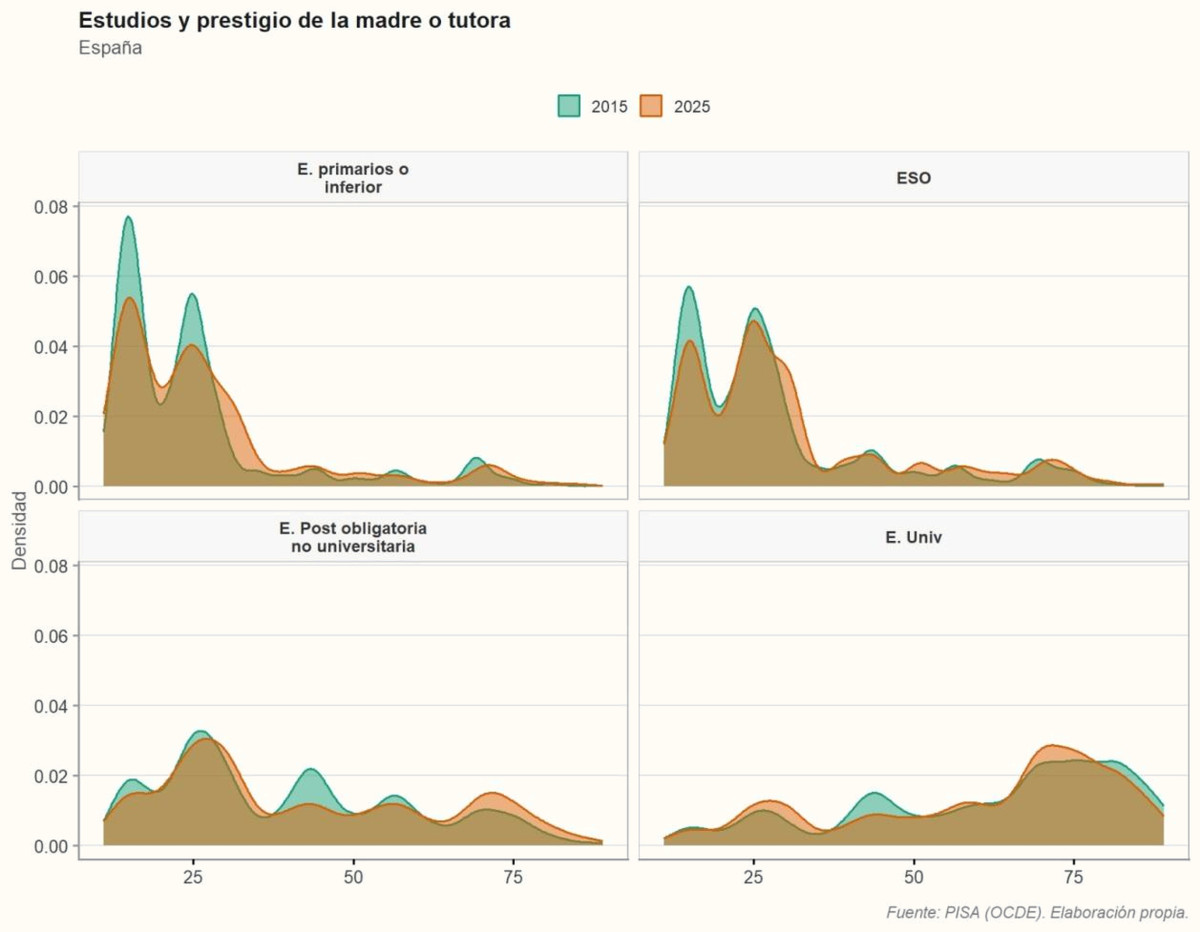
What has happened recently to university mothers that the educational outcomes of their children have deteriorated more sharply? That they are more exploited in the labor market. The standard family economy rests on the time and the income that parents bring into the home. When both parents participate in the labor market, the reduced time available for raising children is offset by more income—for tutoring, extracurricular activities, etc. After the 2008 crisis, the incomes of university-educated mothers no longer compensate for the time. The job market has worsened for them more than for other women. To support this hypothesis, in Graph 2 we show an indicator of job quality by level of education. We note that university-educated mothers in 2025 hold lower-prestige jobs (a combination of the average earnings of the occupation and the level of qualification required to perform it) than those in 2015. The difference may not be very large, but it invites further exploration along this line of analysis.
Gráfico 2. Prestigio de la ocupación de la madre o tutora en 2015 y 2025, por su nivel de estudios
The traditionalist alternative is not viable. On one hand, giving up labor income means giving up freedom. On the other hand, in recent decades we have moved from a household being able to live on a single salary to now needing two. The wage seeks to balance the cost of the family’s standard of living, and that level has now been set at the necessity of two salaries.
“In recent decades we have moved from a household being able to live on a single salary to now requiring two”
The worsening of working conditions after the 2008 crisis may have been worse for women, as several studies show the penalties that women face in the labor market after their first child. It could be that the life-condition gaps among university-educated women are widening still further. Although university-educated women have a greater likelihood of accessing top jobs, motherhood truncates their careers more than those of other women. After the 2008 crisis, this penalty is so large that money no longer compensates for the lack of time. Consequently, for the article’s title I draw inspiration from the song of a punk band, Siniestro Total, “Bloodbath in Puerto Banús”. We cannot understand why results decline in so many countries simultaneously without recognizing that the 2008 crisis has signaled a reconfiguration of the middle class. If in the sixties one spoke of the bourgeoisification of the working class, now we are witnessing the proletarianization of the middle class. A greater proletarianization for university-educated women.
Educational outcomes are not only the result of what happens inside a classroom; they are the result of what happens across society. A more proletarianized society, with lower wages and less time available, is a society that educates worse (and that has fewer children). Improving education also requires a labor market that enables work-life balance, greater job stability, and a dignified life. Focusing so much attention on technologies, legislation, or pedagogy moves us away from studying the impact of family impoverishment on the quality of education.
