
The spoken word is the foundation of social interactions and, therefore, of the social fabric. It involves cognitive and emotional processes capable of generating durable trust-based relationships that digital language cannot build. Well, according to a recent study based on a sample collected across several countries, between 2005 and 2019 the number of words spoken per person has fallen by 28%.
This process is linked to the rise of single-person households in a broad diversity of countries, the adoption of teleworking and, especially, the development of social networks, which enable interaction between people through screens; generative artificial intelligence adds a new twist to this through person–machine interaction.
In this sense, cities acquire special relevance, for their material configuration has the capacity to condition the way we relate to one another. Although it is difficult to analyze the responsibility for its evolution in recent decades in the decline of spoken language, it is possible to propose urban design measures that help recover it.
“The cities acquire special relevance, for their material configuration has the capacity to condition the way we relate to one another”
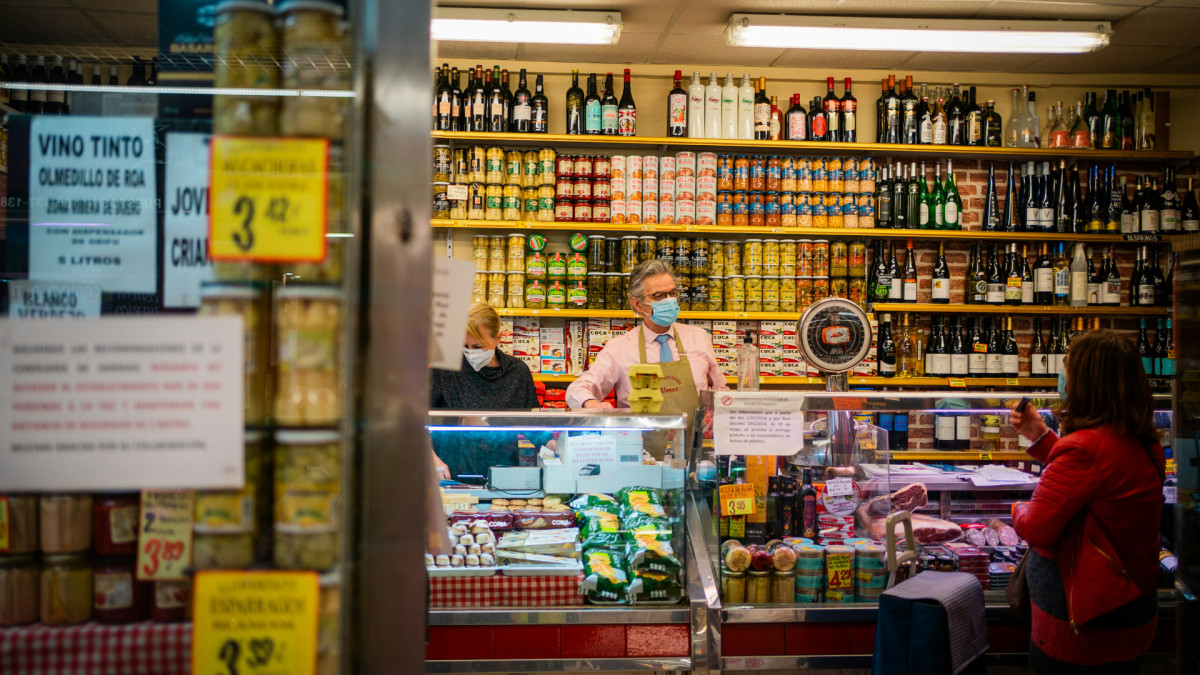
Edward T. Hall in The Hidden Dimension seeks precisely to decipher how space influences the way we interact with others without us realizing it. In the book he uses two not very pretty, but meaningfully charged terms: sociopetal and sociofugal. A sociopetal space is one that enhances interaction among the people who are in it, while sociofugal spaces discourage it. The counter at the old grocery stores, where the customer and the clerk faced each other, made conversation between them much more likely than the current supermarket checkouts, where talk unfolds in parallel.
At the urban scale, superblocks are a prime example of how public space can be redesigned to enhance social interaction, and with it the spoken word, by replacing ground devoted to private vehicle traffic with plazas and leisure zones. Now that there is much debate about restricting minors’ access to social networks, it is urgent to offer a street-level play alternative beyond screens. In this direction, Izaskun Chinchilla, in The City of Care, points to the idea of pixel gardens distributed across the city, capable of improving the environmental surroundings while also enabling enjoyment in a wide variety of places. It is also important to take care of the relationship between buildings and streets, with a road hierarchy that can generate pedestrian-friendly zones and promote active storefront fronts that enhance the link between neighbors and their neighborhood.
Eric Klinenberg, studying Chicago’s 1995 heat wave, realized that, beyond income, the factor that most influenced neighborhood mortality was the strength of community ties. A few years ago he wrote Palaces for the People, where he develops the concept of social infrastructure, made up of places with the capacity to improve social cohesion. He notes how in the United States there are libraries that act as genuine multifunctional civic centers, carrying out activities of all kinds for people of all ages. The opening of school courtyards on weekends also offers new places for play and interaction in the city without the need to build new buildings or undertake any kind of urban intervention. Not only is space design important, so is its management.
“The counter at the old grocery stores, where the customer and the clerk faced each other, made conversation between them much more likely”
Another relevant question when forming the social fabric, beyond the decline of the spoken word, is who talks to whom. Or, in other words, what is the degree of social interaction between people of different social classes in the city. Raj Chetty and his team, through the Social Capital Atlas, showed that American areas with the highest level of friendship across different social classes were those with greater upward mobility for the most precarious households. Therefore, urban design and its management must also maintain social mixing with the aim of reducing inequality, through a sound territorial distribution of public housing, through bridging physical gaps between neighborhoods with spaces for gathering, and through activity programs capable of generating interaction among different social groups.
In a moment of rising polarization, of loss of social cohesion and of growing isolation, recovering the spoken word can contribute to building another kind of communities, more empathetic and capable of generating inclusive collective identities. Cities, and those who build them both from above and from below, have a significant responsibility in this.
