
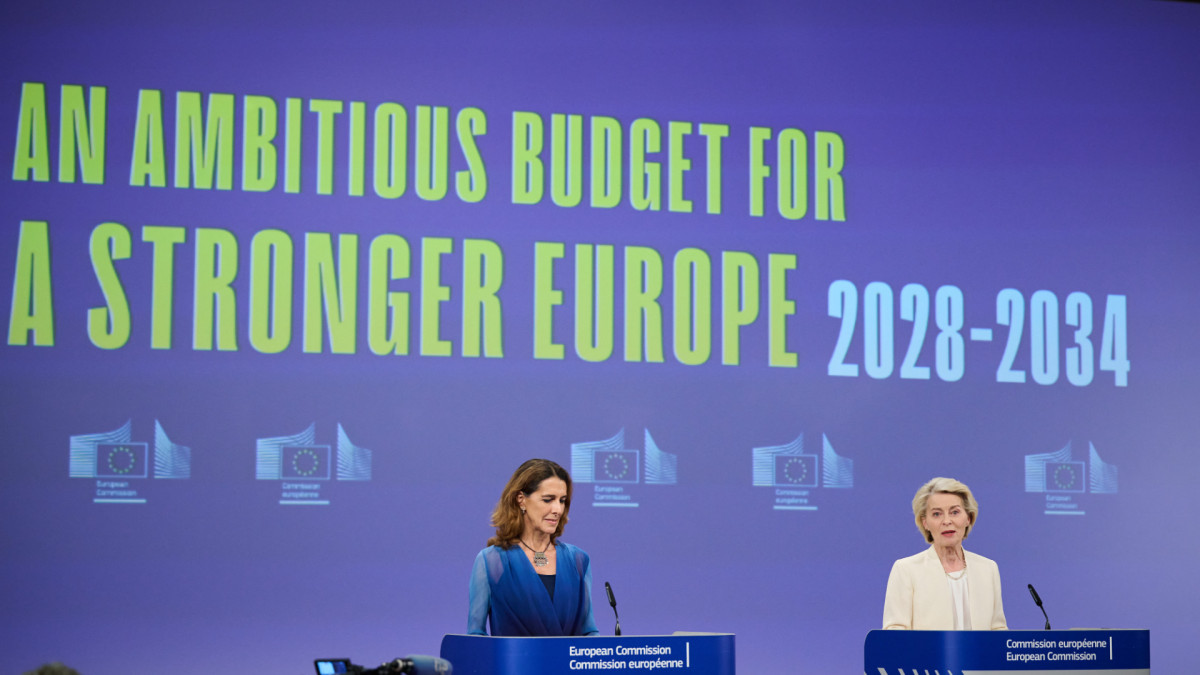
The negotiation of the European multiannual budget will determine to what extent the EU can finance the new priorities (decarbonization, competitiveness, technology), while maintaining the delicate balance with traditional social commitments such as the CAP or Cohesion Funds. With limited resources and rising demands, the EU faces difficult choices about priorities and reforms.
“The proposal from the European Commission envisions a Multiannual Financial Framework of 1.98 trillion euros in total, but it is necessary to deduct at least 200,000 million”
The European Commission’s proposal envisions a Multiannual Financial Framework (MFF) for the period 2028-2034 that totals 1.98 trillion euros over the seven years. This corresponds to 1.26% of the EU’s gross national income (GNI) or 280,000 million euros annually. Of this total, the payments for NextGenerationEU funds must be deducted. Once this adjustment is made, the budget proposal not only does not represent an increase, but entails a subtraction of 200,000 million euros. The new financial framework, in real terms, would hover around 1.15% of GNI, compared with 1.8% for 2021-27. Moreover, this figure remains two-thirds below the 800,000 million euros per year proposed by Draghi to reactivate European competitiveness and tackle the new priorities.
The new pillars of the European budget
One of the central debates of the new MFF is flexibility. In a volatile global environment, where foresight and long-term planning are more uncertain and unforeseen priorities arise, the Commission proposes a thorough reordering of budget pillars and major changes to traditional funds that will be central to negotiations in the Council and the European Parliament. The proposal reduces the number of pillars from 7 to 4, and the number of programs within the pillars from 52 to 16.
The first pillar amounts to 894,000 million euros (excluding NextGen payments), representing 45% of the MFF proposal, and it merges the Cohesion Funds with the Common Agricultural Policy (CAP), historically the largest funds (two-thirds of the total). They now amount to 453,000 million; the CAP could be reduced by 30% and Cohesion Funds by 20%. The management of this pillar shifts to the National and Regional Partnership Plans (NRPP) drawn up by each central government, in consultation with the regions. This change transfers spending capacity to the member states and enables greater domestic flexibility. Although the Commission, anticipating hurdles in Parliament, has already proposed amendments that give more voice to the regions and secure a minimum spending (10%) for the CAP in each national envelope.
The second pillar concentrates the new European priorities and would represent 30% of the proposed MFF (versus 18% currently), with a focus on competitiveness, industrial decarbonization, energy and electrification, digitalization and technological innovation. It is allocated 589,000 million plus 41,000 million from the Innovation Fund. The defence and security allocation is nearly multiplied by five.
The third pillar is dedicated to the EU’s external action: neighbourhood agreements, development cooperation, humanitarian action and foreign and security policy. The Commission plans an allocation of 200,000 million euros.
“Although the Commission’s proposal makes an effort, the amount of resources available is insufficient to achieve the programs’ objectives”
The Commission’s proposal makes an effort to reorganize the budget to redirect resources toward new productive investments (defense). However, the amount of resources available is insufficient to achieve the programs’ objectives. Moreover, while the Commission seeks to increase spending flexibility and grant greater autonomy to the Member States, it also risks allowing excessive control by national governments over spending. This would be counterproductive because fragmented and inefficient spending loses its impact.
Where should we focus our efforts
To understand financing needs, one must refer to the concept of European Public Goods: goods that are not provided by the market or the member states, requiring European scale and generating cross-border externalities. An example is defense capability, where, a broader investment across twenty-seven closed markets would not only be an extremely inefficient expense but would be insufficient to produce and supply capabilities at the necessary scale. The retention of national sovereignty, especially in this domain, runs counter to the interests of European citizens as a whole, both economically and in terms of security.
The electricity grid is another of these goods. An infrastructure that is essential for a competitive and decarbonized industry. It is necessary to reduce energy costs, replacing external dependence on fossil fuels with electricity generated from renewable and autonomous sources on European soil. Cutting-edge technologies and digital infrastructure are another collective good where research, development and commercialization require European-scale infrastructure and financial backing, since national markets are too small to supply it.
As for sources of revenue for the budget, the Commission proposes new own resources to modestly enlarge the size of the next MFF and to meet the payments of NGEU. This increase would be in the order of 350,000 million over the seven-year period. It is proposed that 30% of revenues generated by the ETS (Emissions Trading System) be transferred to the EU budget; also 75% of revenues from the Carbon Border Adjustment Mechanism (CBAM). In addition, a tax on non-recycled electronic waste (2 euros per kilogram) and a special tobacco tax (15%) are proposed. There is also the controversial Corporate Resource for Europe (CORE), a fixed annual contribution for companies with a net turnover of 100 million euros or more, tiered by bands, to be directed to the EU budget. The Commission proposes it be a tax on income rather than on profits, which presents economic and political acceptance problems. At present, it seems to be the option with the least likelihood.
“The available own resources do not align with the European priorities and goals (European Public Goods) laid out by the Commission”
This amount of new own resources does not translate into a substantial increase in the overall budget.
De nuevo, los recursos propios disponibles no se corresponden con las prioridades y objetivos (Bienes Públicos) europeos que la Comisión plantea. Para llegar a la cifra de 800.000 millones anuales de Draghi y, a la vez, conservar los fondos tradicionales (PAC y Cohesión) para no trastocar los delicados equilibrios sociopolíticos, hace falta un profundo aumento de la capacidad fiscal europea (nuevas fuentes autónomas de ingresos). Aunque la unanimidad es un obstáculo difícilmente salvable.
Considering the current context in Europe and the outlook for the coming decade, there are a series of pressing socio-economic challenges ahead. Demographic aging, the decline in productivity, the loss of competitiveness of traditional industrial sectors, external economic dependency, the disruption from emerging technologies, or security. On the other hand, member states find themselves in a delicate budgetary situation: with low (or negative) growth rates, high debt ratios (more than 100% of GDP in many cases) and limited fiscal capacity. This leads to a cycle of low growth — low competitiveness — low fiscal capacity and public investment.
The EU could, however, increase its investment capacity if it considers the possibility of joint debt issuance, backed, not by a single state, but by twenty-seven economies. In addition to providing a new EU revenue stream, it would be a “safe” or risk-free asset. Therefore, highly rated, with very low risk and interest rate. It would be the cheapest possible form of debt and the most efficient spending pathway for all member states. This European debt asset, if issued in substantial amounts, would form the basis of a single capital market and would position the euro as a global reserve currency.
Moreover, it is essential to increase the share of financial instruments in European spending. Today, they account for only 8% of the budget; the rest is grants. However, guarantees and loans are far more efficient investment tools in their deployment and multiplier effect. A rise to 20% of the MFF in the form of financial instruments targeted at the business fabric could yield a multiplier effect three times larger than direct subsidies.
Nevertheless, Enrico Letta’s report identifies completing the Capital Markets Union as a key measure to enable continent-wide projects comparable to those in China and the United States. The Capital Markets Union, backed by the Banking Union, is the route to channel European savings efficiently toward innovation and the growth of large-scale business projects. Today, fragmentation and inertia of private savings persist: 34% sits in deposits with low returns, and 300 billion euros per year flows to the United States in search of higher yields and liquidity.
“Negotiations will be long and arduous: Germany, the Netherlands, Denmark, or Sweden have already signaled their discomfort with some adjustments”
The negotiations will be long and arduous. The Danish presidency of the Council has announced that at the upcoming European summit in December it will present an initial compromise. The Netherlands has already stated that the Commission’s proposal is dead on arrival. Germany and Sweden have also expressed reservations about cutting the CAP or the overall size of the proposal. Overall, member states are likely to push for reducing the initial proposal’s size and for budgetary austerity. Spain could be one of the exceptions among the larger member states.
EsadeGeo has published a Policy Brief that examines the Commission’s proposal in detail, its limitations, and the reforms needed for Europe’s social and economic transformations. They can also listen to the DoBetter Podcast discussion with Nils Redeker (Jacques Delors Institute), Béatrice Dumont (College of Europe) and Juan Moscoso del Prado (EsadeGeo).
The discussion around the new MFF should not distract from the real need to implement reforms that strengthen business competitiveness, which go far beyond the multiannual budget’s scope.
- Review the National Plans proposal. Tie the spending flexibility of each EM to long-term objectives. To avoid fragmentation and short-termism.
- An European Council agreement that gives the Commission the mandate to finalize the Capital Markets Union.
- A European Commission proposal for the creation of a common European debt asset to finance transformations and European Public Goods.
- An European Council agreement to establish new own resources for the EU that could fund common debt and European public investment (cutting-edge technologies, electrical infrastructure, energy, defense).
- Prevent the adverse effects of fragmented state aid, ineffective and detrimental to the Single Market. A stronger capacity for EU institutions to oversee.
- An increase in the use of financial instruments in public spending and the MFF. Raise the share of loans and productive investments from 8% to 20% in the next MFF.

Natalie Foster
I’m a political writer focused on making complex issues clear, accessible, and worth engaging with. From local dynamics to national debates, I aim to connect facts with context so readers can form their own informed views. I believe strong journalism should challenge, question, and open space for thoughtful discussion rather than amplify noise.