
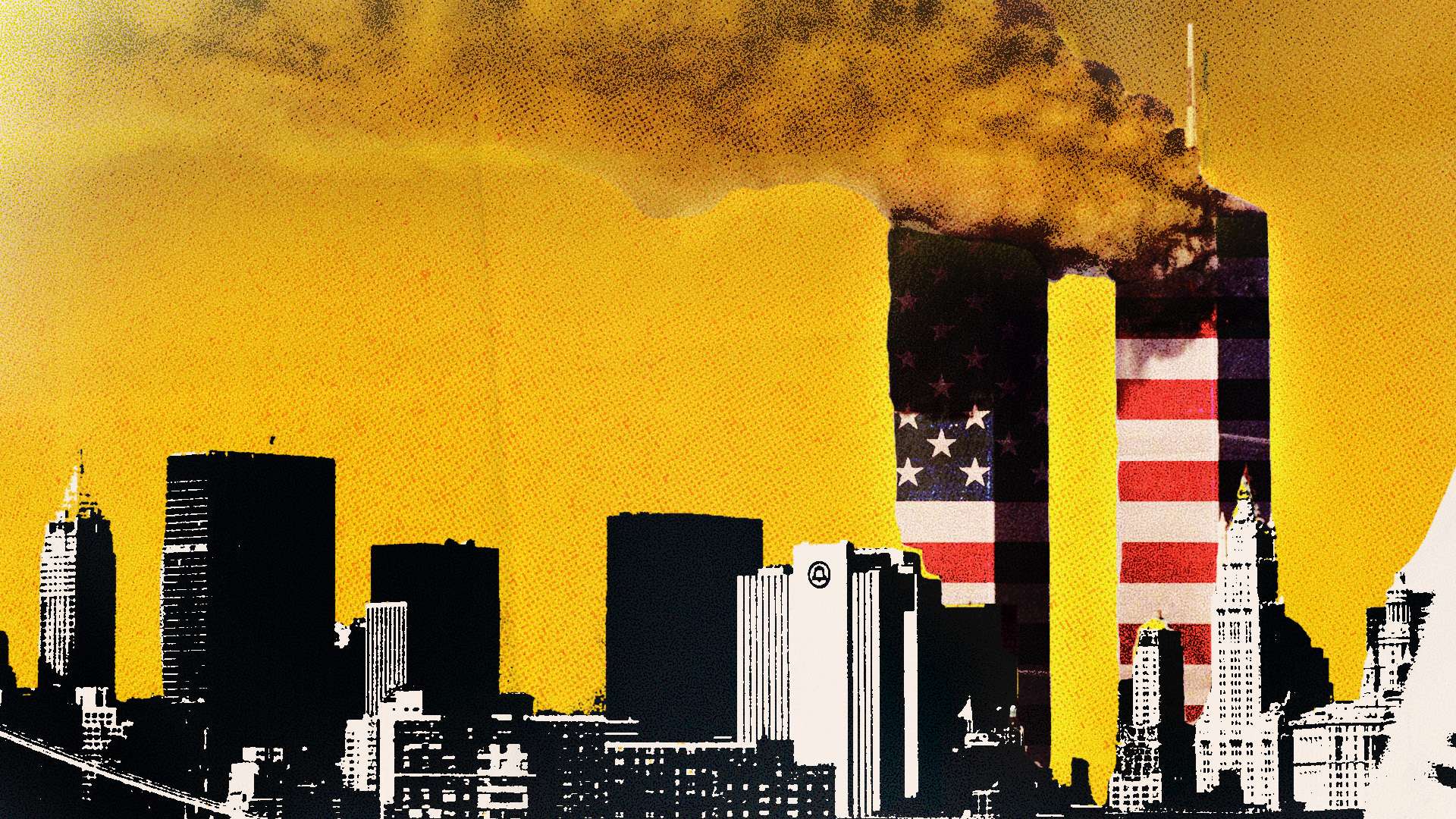
We persist in clinging to the counterfeit pledge that safety can be bought by surrendering liberty.
It is both impossible and perhaps unwise to attempt to recapture the nightmarish emotions unleashed by the September 11 attacks a quarter of a century ago—that profoundly nauseating moment when the second aircraft struck the South Tower of the World Trade Center at 9:03 a.m., making it unmistakably clear that a deliberate terrorist assault, not a freak accident, was in progress. The Pentagon was struck a mere 34 minutes later. The South Tower fell, and then Flight 93 ripped into rural Pennsylvania’s earth, spared from Washington, D.C., only by the courageous revolt of passengers.
It happened in under two hours from the initial impact that the World Trade Center’s North Tower came down, taking with it not just thousands of lives but the nation’s collective breath that had once been guided by what Time’s Henry Luce had called “the American Century” in 1941, urging the United States to act unabashedly as the global hegemon it was about to become. In real time, that morning unfolded at a maddening pace, and it is astonishing to reflect on how compressed the sequence actually was.
Contemplating 9/11 now, twenty-fifth years on, feels like a punch to the solar plexus—a volatile, almost unmanageable blend of disbelief, anger, horror, and overwhelming grief at the sight of people leaping to certain death, survivors staggering out through smoke and ash, and the reading of “portraits of grief”—short, powerful obituaries of the nearly 3,000 people who died that day—that would carry on for months. There is also outrage at the blunt dismissal on September 12 of “the little Eichmanns inhabiting the sterile sanctuary of the twin towers” by an academic who would later be exposed as a liar about Native American heritage. Remembering that day means recalling truths that, for the most part, should have remained forgotten.
If grief ebbs and flows across years or even decades, the political response to 9/11 was almost instantaneous and unvaried in its trajectory, always steering toward greater power and more money for the state, at whatever level was deemed necessary. (As a case in point, the flood of homeland-security funding yielded a rescue vehicle for Colchester, Vermont, capable of boring through concrete.) Within mere weeks, Congress overwhelmingly enacted the USA PATRIOT Act, a bizarre acronym for “the Uniting and Strengthening America by Providing Appropriate Tools Required to Intercept and Obstruct Terrorism Act.” Only one senator, Russ Feingold (D–Wis.), voted against it, and merely 66 House members (including only three Republicans and independent Bernie Sanders of Vermont) rejected it.
Then-Defense Secretary Donald Rumsfeld—whose calculated cynicism, his folksy rhetoric about “known unknowns,” and his notable failures jeopardized us all—asserted that the so-called “global war on terror” (GWOT) resembled a variant of the Cold War that had ceased a decade earlier, in 1991, with a superficially decisive victory for the United States. Rumsfeld’s GWOT, as he described it in an era when the press eagerly swallowed every point he offered, was “undoubtedly going to resemble a lot more a cold war than a hot war.” Consider that the Cold War stretched across roughly five decades, involved ongoing pressure, and required populations in many nations to invest in and sustain it.
When then-Attorney General John Ashcroft—an awkward, prudish figure who once lost a Senate race to a deceased opponent and whose staff rented drapes to conceal nude statues in the Department of Justice—attacked “those who frighten peace-loving people with phantoms of lost liberty,” he could at least claim to be reflecting the will of the people. In the wake of the 9/11 attacks, Americans broadly supported exchanging a wide array of civil liberties for the sake of safety. By 2002, polls consistently showed nearly eight in ten Americans willing to surrender civil liberties for greater safety and about seven in ten advocating for a national ID card. (In 2005, Congress would pass the REAL ID Act, which would take two decades to implement.)
As Ohio State political scientist John Mueller reminded readers in the years after 9/11, catastrophic events and social panics regularly generate laws and policies that outlast the moments that inspired them. He noted that the postwar Red Scare produced loyalty oaths, civil-liberties crackdowns, and other measures that persisted for years or even decades after any credible fear of subversion. After 9/11, he wrote, the issue extended beyond surveillance to how spending could be locked in—such as with the creation of the new Department of Homeland Security. Osama bin Laden had stated in 2004 that his aim was to “bleed America to the point of bankruptcy” by dedicating vast sums to activities and services loosely linked to safety.
In 2011’s Terror, Security, and Money: Balancing the Risks, Benefits, and Costs of Homeland Security, Mueller and Mark G. Stewart persuasively argued that swift and relatively cheap measures—like strengthening cockpit doors and training crews—effectively ended the prospect of another 9/11-style airliner strike; and importantly, that the attack was an outlier event unlikely to be repeated. Their case is that excessive overreactions in both domestic and foreign policy pose a far greater threat to the American way of life than anything terrorists could dream of achieving. “Your odds of dying in a bathtub are about one in a million, and from terrorism about one in 3.5 million,” Mueller told me in 2011, and it remains far from clear that safety improved in the face of big expenditures (see the interview below).
Yet if perpetual funding for the Transportation Security Administration (TSA) seems locked in despite scant evidence of its effectiveness, it remains true that both politicians and voters are still willing to cling to the belief that trading freedom for safety is a prudent bargain. A Reuters/Ipsos poll recently showed that, compared with 2013, more Americans fear domestic terrorism (33 percent) than foreign terrorism (20 percent). Regarding wars undertaken in the name of eradicating or suppressing terrorism, only 21 percent regarded Afghanistan and Iraq as worthwhile, and merely 25 percent believed Iran was worth it. Still, two-thirds of those polled agreed that “airport security disruptions are worth it because they make flying safer,” and they preferred government agencies to private providers.
The one bright spot is that 65 percent of Americans believe the government should not be allowed “to monitor electronic communications of citizens without a warrant,” including majorities of Democrats (77 percent), independents (63 percent), and Republicans (55 percent). Given that the law enabling such practices, Section 702 of the Foreign Intelligence Surveillance Act (FISA), lapsed in June without reauthorization, that still signifies progress.
But twenty-five years on from the gravest terrorist act in U.S. history, that progress remains insufficient.
