
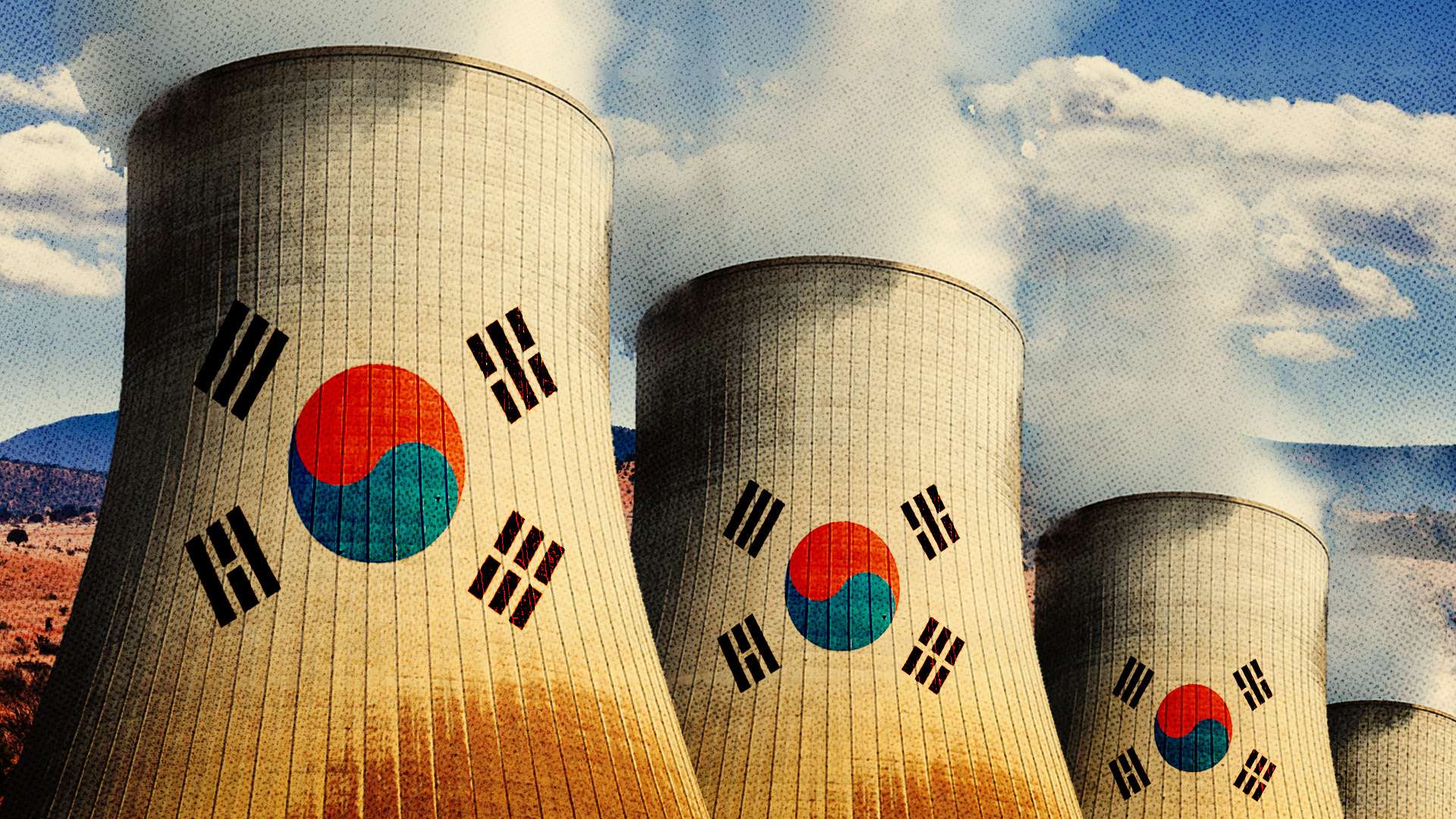
Confronted by a looming 25% tariff, Seoul pledged to back eight nuclear reactors and a Texas natural‑gas project, a commitment whose price tag is already edging past the planned budget.
If the United States secures the lead in the race against China in artificial intelligence, it may owe a portion of the credit to South Korea. On Thursday, The Wall Street Journal disclosed that Seoul is poised to unveil an investment exceeding $100 billion targeted at eight nuclear power plants and a Texas liquefied natural gas venture. The nuclear facilities are expected to be erected on federally owned land and to utilize the AP1000 design developed by the American company Westinghouse Electric.
There is talk of ensuring that at least some of the reactors would be the APR1400 model, produced by the South Korean manufacturer Kepco, according to the Journal. This development marks the onset of a broader sequence of strategic investments by Korea that could eventually extend to the Alaska LNG pipeline—a prospective 807‑mile route designed to move natural gas from Alaska’s North Slope—, as reported by the Seoul Economic Daily. The projects are described as part of the Trump administration’s effort to speed up America’s AI infrastructure, in this case by securing the energy resources necessary to sustain it.
This sequence represents the culmination of a yearlong trade negotiation between the two allies. The initial agreement, reached in October 2025, stated that South Korea would invest $350 billion in the United States in exchange for Washington reducing its tariff rate from 25% to 15% on the majority of imports from Korea. The package would include $200 billion for strategic investments—of which $100 billion was allocated to energy initiatives—and $150 billion for the U.S. shipbuilding sector.
Yet tangible investments did not materialize in the months that followed. The Journal notes that the lack of concrete commitments put South Korea out of favor with the Trump administration. In January, President Donald Trump threatened to reimpose the 25% tariff because the South Korean National Assembly had not yet approved the deal. In response, Seoul established a state‑run corporation earlier this year to identify, finance, and oversee investments in the United States, and to present recommendations to the president, as reported by the Journal.
Dubbed the Korea‑U.S. Strategic Investment Corporation, the agency is intended to pursue investments that generate mutually beneficial outcomes for both countries, according to Seoul’s Ministry of Finance and Economy. It remains unclear whether Seoul would retain any meaningful control over the projects, as a conventional primary investor would. Nevertheless, the Seoul Economic Daily reports that a memorandum of understanding governing the energy deal could be finalized as early as September 18.
There is a touch of déjà vu here. Last October, Japan’s trade ministry announced a plan to invest $550 billion in the United States in exchange for lower tariffs. As part of that agreement, Japan agreed to participate in the Trump administration’s roughly $80 billion initiative to expand Westinghouse’s AP1000 nuclear reactors across the United States, a venture that could yield substantial financial gains for the federal government.
An irony undercuts the administration’s tactic: deploying tariffs to coerce Seoul into pouring billions into the U.S. economy, even as the initial trade accord favored Korean vendors and project managers. Such a preference would likely raise imports of Korean goods and skilled labor, potentially widening the trade deficit with South Korea—one of the chief justifications President Trump has offered for slapping tariffs in the first place.
While The Wall Street Journal has framed the deal as a “win for Trump,” the cost to South Korea could be steep. Building a single pair of AP1000 reactors in Georgia reportedly cost about $35 billion; financing eight nuclear plants along with a natural‑gas project will probably exceed the more than $100 billion that Seoul earmarked for American energy projects last October.
Revisions to the cost estimates for the energy plans have already emerged. The projected price for the Encinal, Texas, natural‑gas facility has risen to around $22 billion from $20 billion, while the eight nuclear plants are now pegged at roughly $120 billion, according to the Seoul Economic Daily. The outlet also notes that because including all the projects demanded by the United States could push the total beyond the $200 billion set aside for strategic investments, the government is weighing adjustments to the size of each project or the possibility of excluding some of them.
A multi‑billion‑dollar push into the domestic AI sector would align with President Trump’s stated aim of ensuring American leadership in the field. Yet the apparent achievement of that objective could also be realized through a commercial agreement that did not rely on pressuring South Korea with tariff threats.
