
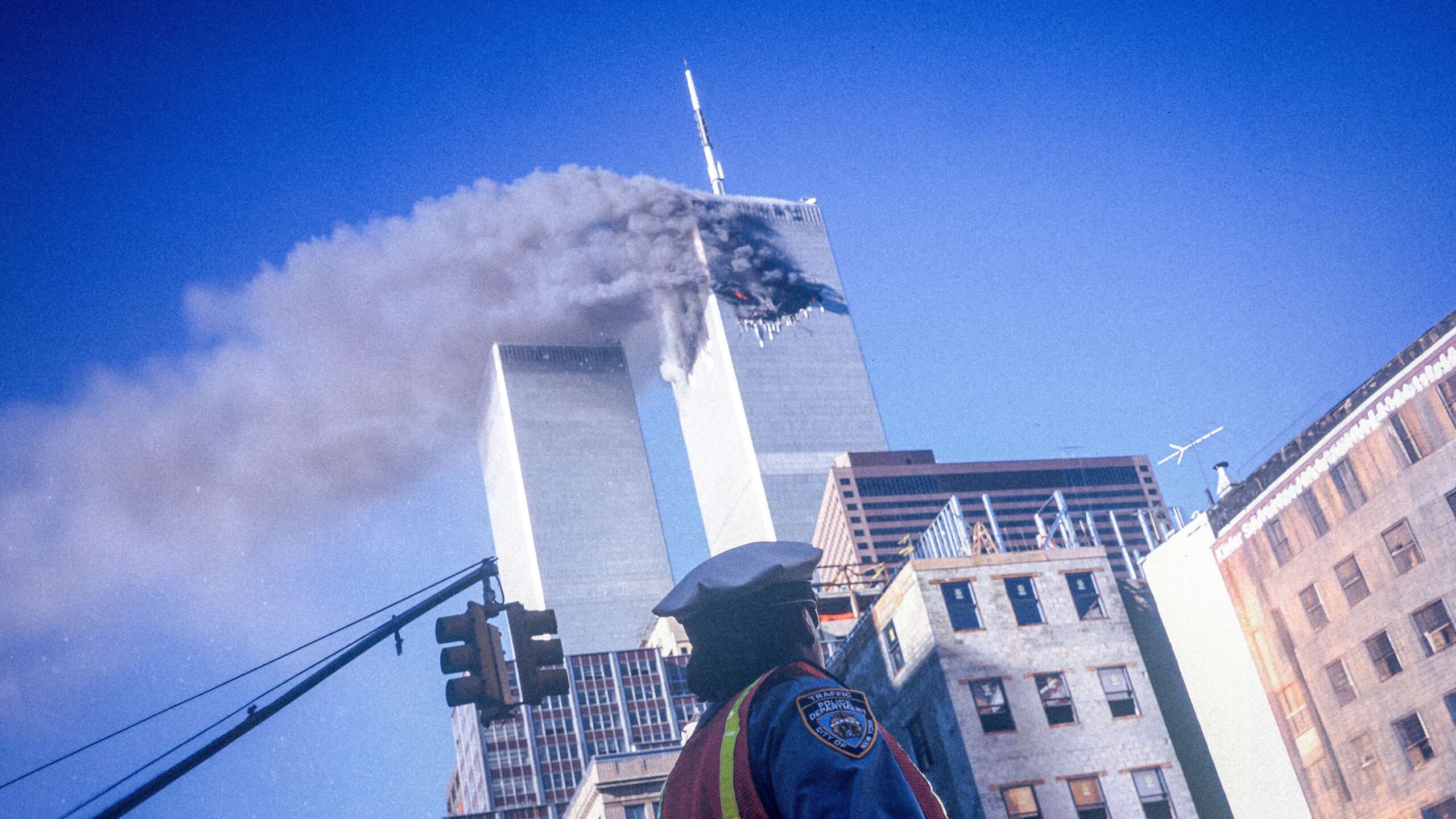
Twenty-five years after the assaults, the institutions that handle foreigners who travel to or settle in the United States operate under tight control and pervasive suspicion.
Rahinah Ibrahim’s journey to a Hawaii conference unraveled her sense of security.
The Malaysian scholar was a PhD student at Stanford on a visa, and her 14-year-old daughter traveled with her as they moved through San Francisco International Airport in January 2005. Ibrahim, recovering from an emergency hysterectomy, asked for wheelchair assistance at the ticket desk. Instead, the agent summoned security. Ibrahim’s name had surfaced on the government’s no-fly list, a consolidated registry of thousands of individuals deemed known or suspected terrorists created in the wake of the 9/11 attacks, as reported by Stanford Magazine in 2013.
According to Ibrahim, she endured a search under her headscarf and was denied pain relief. A Department of Homeland Security (DHS) agent eventually told her the name had been removed from the no-fly list. “The next day,” Stanford Magazine explained, “she flew to Hawaii, unaware that the days she spent there would prove to be her last in America.”
Ibrahim then proceeded from Hawaii to Malaysia, her homeland. Two months later, while preparing to resume her studies, U.S. Embassy staff in Kuala Lumpur informed her that her student visa had been canceled on account of alleged terrorist associations.
It later emerged that she had been added to the no-fly list in 2004 because an FBI agent “checked the wrong box on some paperwork,” as reported by Reason’s C.J. Ciaramella in 2021. “At that time the government refused to confirm or deny a person’s watch-list status,” the article notes, leaving Ibrahim to fight a program whose reach she could not prove affected her.
Only after roughly eight years of litigation did the government relent. In 2014, Ibrahim became the first person to win a lawsuit and be removed from the no-fly list. “I want my children not to hate America because of what happened,” she emphasized.
The no-fly list took shape in the wake of the September 11 attacks. Like numerous other policies of the era, it has become a civil-liberties nightmare—secretive and sprawling—and it has sharpened the government’s wary gaze at foreigners who travel to or reside in the United States.
Forty years of moving freely across American borders did not end with the collapse of the Twin Towers; by that point, such freedom was already fading. Today, from entry to naturalization, almost every facet of how foreigners enter, live, and work in the United States is subjected to scrutiny and oversight. Countless ordinary people have been harmed by the day-to-day and monumental choices the government has made in wielding the immigration system since the attacks.
‘The Dangers of a New Era’
The response to the September 11 assaults swiftly altered how migration was governed.
“From the outset, the immigration system was implicated because the attackers had arrived on U.S. visas,” notes Doris Meissner, a senior fellow at the Migration Policy Institute (MPI) who led the Immigration and Naturalization Service (INS) from 1993 to 2000. The 19 hijackers had all entered legally on nonimmigrant visas and interacted with consular officers and border officials without heightened scrutiny.
Policy tools were sharpened almost immediately. Nine days after the attacks, the Department of Justice (DOJ) adopted a rule allowing the government to detain noncitizens for more than 48 hours without charges if there is an “emergency or other extraordinary circumstances.” That October, President George W. Bush announced that the administration would “tighten up the visa policy” among other measures, including asking numerous questions that had not previously been posed.
The same October saw the passage of the USA PATRIOT Act. Once infamous for expanding government surveillance, the act also targeted immigration and foreign visitors. It broadened the definitions of terrorism-related offenses, including what kinds of support for—or associations with—designated terrorist groups could trigger deportation. It provided for the “mandatory detention of suspected terrorists” and allowed authorities to hold such suspects for up to seven days before charging them.
By 2002, lawmakers were engaged in what MPI later described as “the largest restructuring of the federal bureaucracy since World War II”: the birth of the DHS. Up to that point, the INS had contained both the adjudicatory and the enforcement functions of immigration. After the reorganization, these powers were split among three new DHS subagencies: Immigration and Customs Enforcement (ICE), which polices the interior and runs detention; Customs and Border Protection (CBP), which guards borders and entry points; and U.S. Citizenship and Immigration Services (USCIS), which handles benefits, employment authorization, and related paperwork for legal residents.
“Homeland security—before 9/11 that was not a term we used,” Meissner remarks. “The attacks fostered a shift in thinking: immigration began to be framed as a national-security issue rather than a civilian law-enforcement matter.”
The DHS was explicitly created to “prevent terrorist attacks within the United States” while still “carrying out all functions of the agencies that were absorbed.” In other words, routine immigration tasks—such as processing benefits—were now enveloped in language about safeguarding the nation from catastrophe.
“We learned that vast oceans no longer shield us from the threats of a new era,” Bush declared as he swore in Tom Ridge, the first homeland-security secretary, in 2003. “This government must confront the menace of terror wherever it is found.”
Caught in the Machine
These reorganizations and shifts in mindset produced disastrous consequences for individuals and for entire communities.
In 2001 and 2002, the DOJ detained more than 700 noncitizens in connection with investigations into the September 11 attacks. “We identified substantial deficiencies in how the department handled the September 11 detainees,” testified Glenn A. Fine, the DOJ inspector general, before the Senate Judiciary Committee in June 2003. Many detainees “did not receive timely notice of the charges against them,” and numerous “did not receive their charging documents for weeks, and some for more than a month after arrest.” Moreover, the FBI cleared “less than 3 percent” of detainees within three weeks of arrest.
Noncitizen residents faced heightened surveillance and strict secrecy in the immediate aftermath. A September 2001 memo by former Chief Immigration Judge Michael Creppy pushed immigration judges to “close selected cases to the public, family members, and the media,” according to Human Rights Magazine. “More than 600 secret immigration hearings were held by May 2009.” In March 2002, Attorney General John Ashcroft ordered federal prosecutors to interview thousands of people holding passports from predominantly Islamic countries who “fit the criteria of individuals who might have information about terrorism.”
Newcomers also came under tighter scrutiny. In 2002 and 2003, the National Security Entry-Exit Registration System (NSEERS) required noncitizen males aged 16 and older from 25 countries—24 of them Muslim-majority—to provide biometric data on arrival and to check in with immigration officials after entry. The Washington Post reports that more than 83,500 men complied voluntarily and over 13,700 faced deportation proceedings. NSEERS eventually evolved into the US-VISIT program, which in turn became the Office of Biometric Identity Management. By 2017, MPI notes, that office had become the world’s largest biometric law-enforcement database.
Universities and government agencies scrambled to comply with the Student and Exchange Visitor Information System (SEVIS), and deadlines were moved up—from 2005 to 2003. The new regulations caused severe backlogs, delays, denials, and hindered attendance at international conferences, as Rep. Jerry Costello (D-Ill.) observed in a February 2004 congressional hearing. The government also began to impose stricter checks on students in fields tied to national security.
The cellist Yo-Yo Ma testified before Congress in 2006 that two Iranian musicians who had participated in his Silk Road ensemble, and who had visited the United States nearly ten times, were forced to wait months for visas. With no U.S. embassy in Iran, they had to fly to Dubai for an in-person interview and then return home to be issued the visas, a process costing about $5,000 and taking three months. A Mongolian singer and a Chinese musician often could not even reach the embassy gates.
“Trust is at the core of this discussion,” Ma concluded. “Do we trust people to come here to do good, or not?”
The Persistence of Enforcement
Mistrust has remained a dominant force in America’s post-9/11 immigration policy. Even when politicians loosened border controls, the memory of the attacks led officials to hesitate.
Before 9/11, H-1B visa renewals could be completed from within the United States. That changed in 2004 due to security measures mandated by the Enhanced Border Security and Visa Entry Reform Act. For nearly two decades, most foreign workers needed to return home to obtain visa stamps at U.S. embassies or consulates to renew their status, with the State Department citing infeasibility of domestic biometric collection. In 2024, the Biden administration tried a targeted pilot to reinstate domestic renewals, but there has been no broad, permanent revival.
Humanitarian programs followed a similar arc. The United States admitted more than 72,000 refugees in FY 2000. In the wake of the attacks, Bush paused refugee intake for several months on security grounds. “As many as 20,000 refugees from across the world, cleared to escape persecution, have had their arrival delayed indefinitely,” The New York Times reported in October 2001. Admissions dropped to 26,839 in FY 2002, and by FY 2008 they had not returned to pre-9/11 levels. They began to recover under both the Bush and Obama administrations, which kept annual caps between 70,000 and 85,000, but Donald Trump reversed that trend in his first term. Joe Biden later raised caps and intake, yet Trump’s early presidency again shifted policy on national-security grounds. The 1980s record intake of 207,116 individuals is a distant memory.
The 1996 Immigration and Nationality Act authorized state and local officials to assist federal authorities through the 287(g) program. The first 287(g) agreement was not signed until 2002. Initially aimed at narrowing security risks, the program’s scope broadened by the mid-2000s to cover potentially all unauthorized immigrants. The number of agreements—and the number of noncitizens swept up through them—rose in subsequent years, declined during the Obama years, then rebounded under Trump. The second Trump administration expanded 287(g) substantially to support its mass-deportation agenda.
Other remnants of the 9/11 response have become so entrenched that reversing them is politically unthinkable. The proposed 2026 DHS budget for its three immigration-focused subagencies stands at $41.2 billion—more than six times the INS’s peak budget of $6.3 billion. With only a handful of exceptions, the government has evaded accountability for errors that placed people on the no-fly list or for justifying certain placements. U.S. immigration law bars entry to those who supplied “material support” to terrorism, and despite lawmakers’ testimony, the administration has not crafted a robust exception for individuals whose support was given under duress.
Lost Liberty
In a different reality, just before September 11, 2001, the United States and Mexico were nearing a landmark migration pact. “It would have created a temporary Mexican visa program” and enabled cooperation on enforcement along the border on Mexico’s side, says Stuart Anderson, executive director of the National Foundation for American Policy, who participated in the American delegation during INS years.
“At the time, virtually all illegal entry arrests came from Mexico, so the plan would have fundamentally reshaped the border,” he adds. Talks between the two nations occurred about a week before the attacks and were very close to an agreement. But after the attacks, any reform discussion was rendered moot. “It was clear nothing would happen at that point,” Anderson notes.
Many lawmakers now resist comprehensive immigration reform unless it includes heavy security concessions. MPI attributes the failure of reform bills in 2006, 2007, and 2013 to the almost singular focus on immigration as a national-security issue.
“Most activities within the immigration system have little to do with anti-terrorism,” Meissner observes. “They are ordinary operational functions—akin to how the Department of Veterans Affairs or the Social Security Administration processes enormous volumes of transactions.”
Today, that security-centered view of immigration does not enjoy broad political appeal. The Trump administration embraced the language of national security to defend its actions, even as its policies undermine the concept. That phrase has become a kind of rhetorical talisman that may help in court, Anderson suggests. “Yet you cannot reasonably classify the arrests of workers in construction, car-washing, and landscaping as national security.”
The administration’s mass-deportation approach seeks to detain and deport as many undocumented people as possible, often at the expense of genuinely dangerous individuals. Still, the imprint of the post-9/11 immigration regime on Trump’s policies is unmistakable: NSEERS-adjacent registration requirements for noncitizens, travel bans targeting people from Muslim-majority nations, and ever-expanding biometric data collection.
Twenty-five years after the attacks, the ease of mobility has become a clear casualty of the post-9/11 trade-off between liberty and safety. The idea that strangers arrive to share peace has faded, and politicians have continued to bury the consequences beneath ever thicker layers of policy.
