
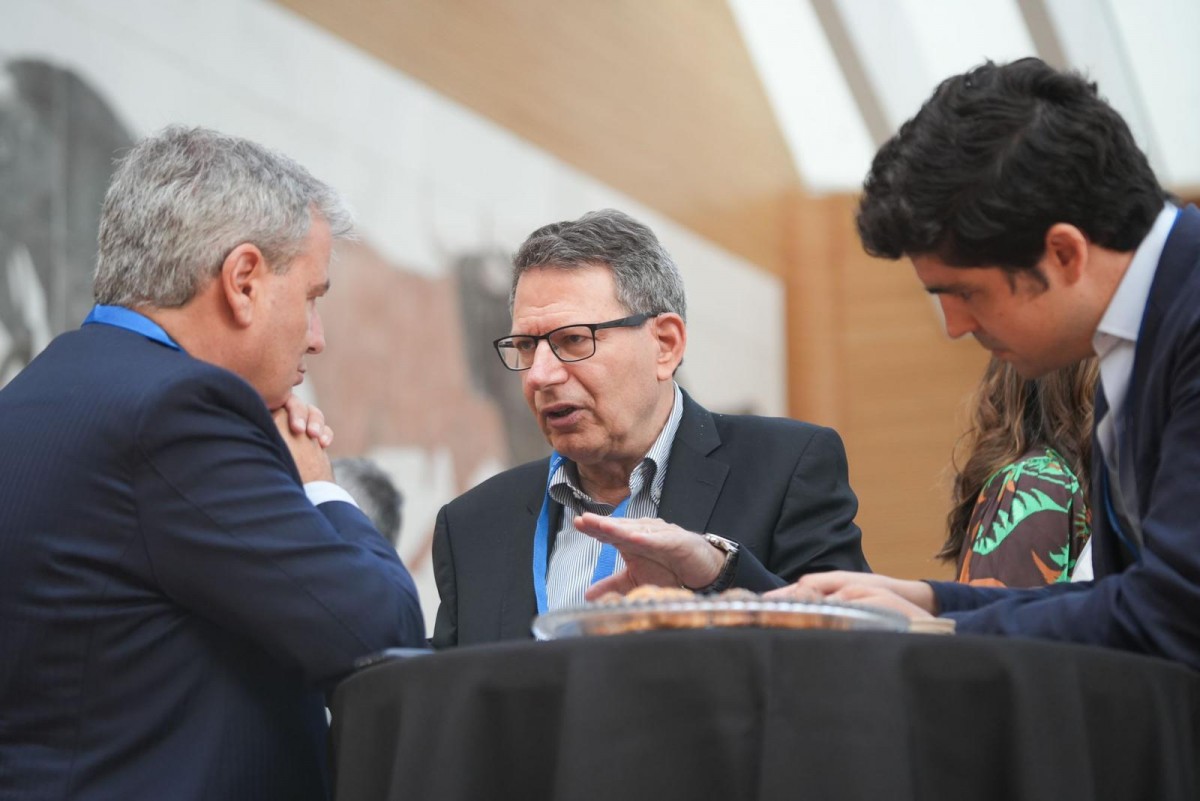
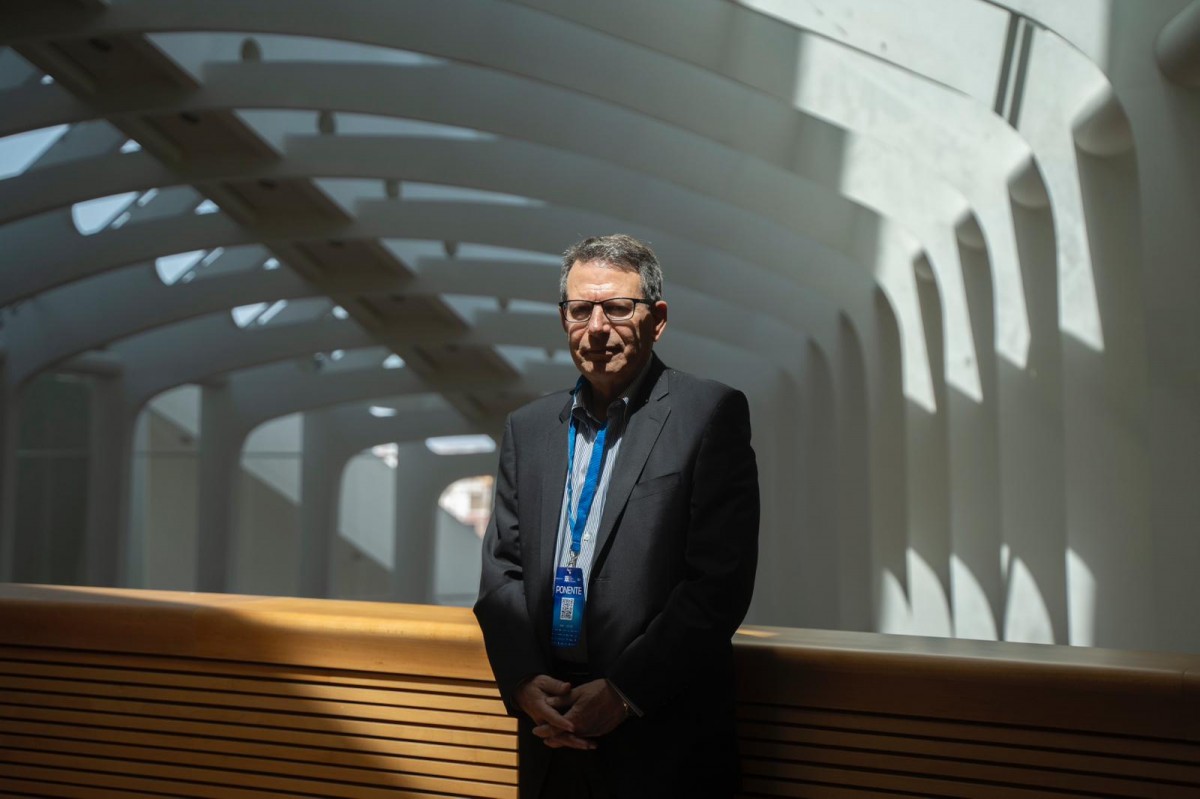
Robert D. Kaplan (New York, June 23, 1952) is a journalist, writer, and one of the most influential geopolitical analysts of today. His works are indispensable for understanding the world as it stands now. He has authored twenty-two books on international politics. For more than three decades he analyzed foreign policy for The Atlantic and was a member of the Defense Policy Board and of the United States Navy’s Executive Panel. His latest book, The Tragic Mind, is a journey into the thinking of the classical writers, aimed at clarifying the questions of our era, recalling the dangers of anarchy, the importance of order, and the consequences of losing it in today’s world.
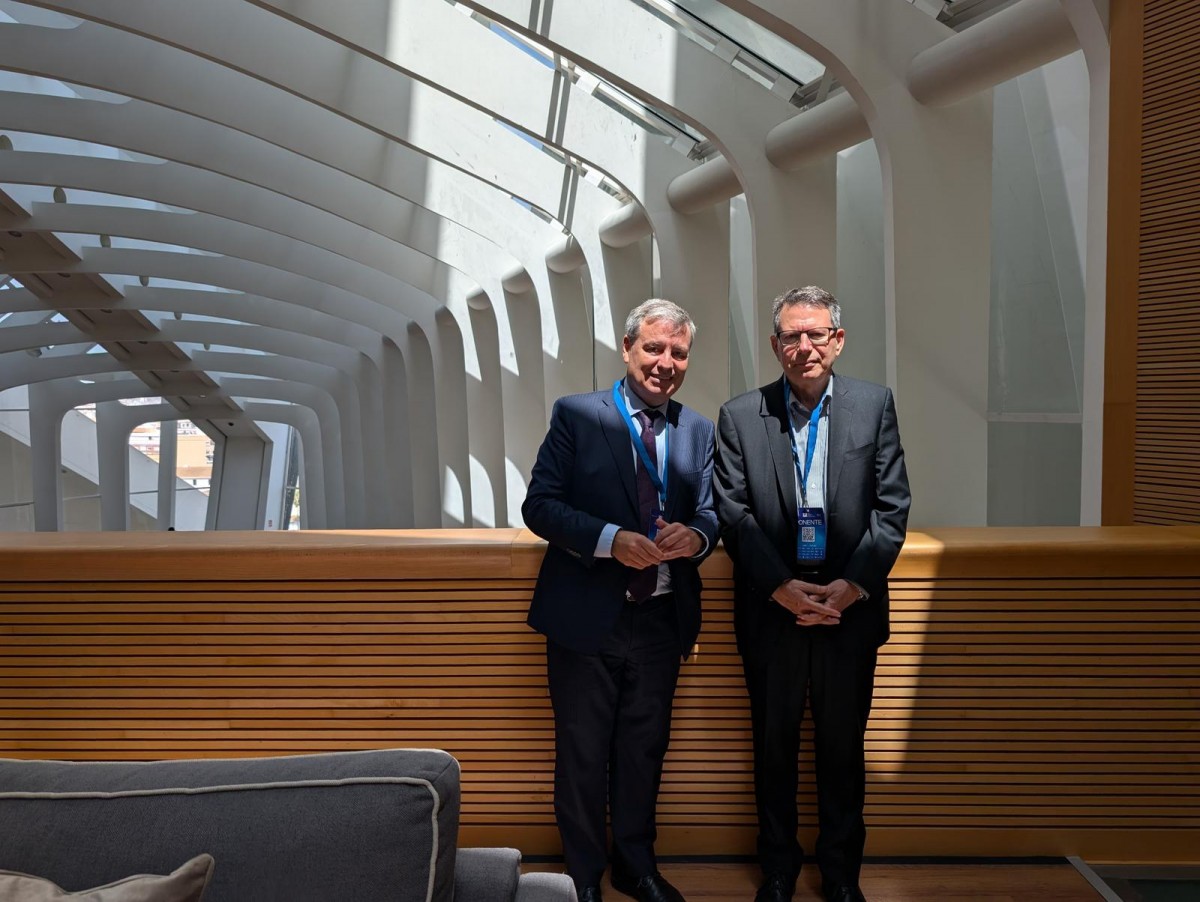
Our fellow contributor and expert, Jordi Xuclà, took advantage of his visit to Valencia to speak with Robert D. Kaplan, who participated in the Mediterranean Economic and Social Forum, organized by Prensa Ibérica and the La Caixa Foundation.
Spain must engage with full ambition in addressing the great global challenges, influence, and be influenced by the deeper currents. At Agenda Pública, precisely, we do not distinguish between national and international politics because national and international visions converge. This conversation is yet another example of our commitment to better understanding from Spain the underlying movements of international politics and how they affect us.
Thanks to you, Professor Kaplan, I have learned that Illy is not only a coffee brand but also the name of a former mayor of Trieste. You have revealed many facts and details and have encouraged us to rethink geography and international relations with new, provocative approaches.
[Laughs] I can see you’ve read my penultimate book in detail, Adriatic, which traces a journey along an arc that begins in northern Italy and ends in the southern Balkans. And yes, I also paused in Trieste and sought conversations with people who could broaden my mind. One of them was Mr. Riccardo Illy, of the third generation of coffee makers, but also former mayor of Trieste and former deputy for the Democratic Party. His grandfather Francesco Illy was born as a citizen of the Austro-Hungarian Empire, and his original given name was Illy Ferenc, in Hungarian, though he was born where today is Romania. Trieste is a great place to ponder the empires that collapsed during World War I.
You argue that the demographic evolution of the northern shore of the Mediterranean—Europe—, the southern shore—Africa— and the eastern Mediterranean—the Middle East—will diverge dramatically for the remainder of the 21st century, and that this should prompt Europe to consider how it will receive a significant migrant influx and how its identity will evolve.
Yes, I posit that population growth in the south and north of the Mediterranean will be seven to one, that is, for every person born in the north, seven will be born in the south. But my forecast of seven Africans per European is aimed 76 years ahead, by the end of the twenty-first century. It is something we are gradually getting used to. It is happening before our eyes, but very, very slowly and gradually. In the twenty-second century, populations will stabilize and decline everywhere, including Africa. Yet the demographic divergence between Africa and Europe will continue to widen. We are not talking about a distant future, but about the decades ahead.
“I think Europeans will have to evolve, with a different concept of their identity”
I believe Europeans must evolve, adopting a broader notion of European identity and of their national identities. The United States has an easier path because it was founded as a society of immigrants bound by ideals, while European nations were built on religion, language, and in some respects race. We must make room for people of different races and religions who nevertheless embrace democratic ideals. Europe needs to contemplate what identity will define it in the face of substantial migratory flows that will shape its future.
He argues that Africa will give rise to a new middle class, but many of them will wish to emigrate to Europe rather than consolidate themselves as leaders in their own countries.
Yes, I want to clarify that this aspiration will affect only part of Africa’s new middle class.
Why do you think this segment of Africa’s new middle class will prefer migrating to Europe over contributing to the consolidation of progress in their more prosperous countries and aiming to become its leadership?
Because once people join the middle class, they pursue education, raise their expectations, want a better life for their children, and have opportunities. They look at their own governments in Africa and think: “Perhaps it will be better for my children to be in Europe.”
So these families that aim to improve their livelihoods in Africa do not intend to contribute to consolidating progress in their own countries?
People do not think in those terms. People think in personal terms. The elites may think as you suggest. The people, the new middle classes, think about themselves and their children.
In your conference at the Mediterranean Economic and Social Forum in Valencia, you have developed the hypothesis that the Mediterranean as a geopolitical term has shifted toward the Pacific.
That’s right. For centuries, the Mediterranean geopolitical concept stood at the center of trade relations, civilizational aspirations, and the great conflicts and struggles for geographic dominance. The idea of the Mediterranean as a geopolitical epicenter has moved to the Pacific.
You conceptualize the existence of three Mediterranean geopolitical concepts in the contemporary world.
Yes, the Mediterranean continues to exist as a geopolitical term that must contend with rising migration flows that will shape European identity. But there are two equivalents to the Mediterranean understood as the epicenter of geopolitics. One is the Caribbean Mediterranean, with a rich North that is grounded in the values of liberal democracy, while in parts of Central America and the southern Caribbean—especially in Venezuela—non-democratic regimes are consolidating.
“Of the three symbolic geopolitical Mediterraneans that exist today, the Southeast Asian one poses the greatest risk of open conflict within a ten-year period”
The other geopolitical Mediterranean is Southeast Asia, in the East China Sea. There, democratic systems such as Japan and Taiwan clash with China’s policy and its ambitions to expand its maritime and territorial reach. Of the three symbolic geopolitical Mediterraneans that exist today, the Southeast Asian one presents the greatest risk of open conflict within a decade.
With the collapse of the Soviet Union, it was once reasoned that a new unipolar world would emerge and that Western democratic values could spread across the planet, that democracy and free-market economics could be globalized. But that has not happened. Just look at the UN General Assembly voting records on Russia’s invasion of Ukraine to realize that a substantial portion of the world distances itself and has different geopolitical and political-value priorities.
“The UN matters less and less. We must think in terms of a Western democratic order of the United States, Europe, Japan and other allies in Asia, with their own value system. Of course, it will face competition from another value system, China, Russia and their allies”
I don’t think the United Nations matters much anymore. The United Nations mattered after World War II. It no longer does. India is not a Security Council member. France is. In fact, American media are reading less and less about the UN. It matters less with each passing day. We must think in terms of a Western democratic order of the United States, Europe, Japan, and other Asia-Pacific allies, with their own value systems. Of course, there will be competition from another value system, China, Russia and their allies. In a sense, we are entering a new bipolar world.
You have defined the perimeter of the liberal democratic order, but who guides and inspires the other order, the other pole?
The great Eurasian land powers of Russia and China, especially China, are what I mean by the other bloc.
Russia has deployed a doctrine of regaining influence and control over the former Soviet republics. It is very evident in the Ukraine war, but Russia already signaled it in August 2008 with the war against Georgia. Can Russia attempt to extend its influence in the South Caucasus and in some Western Balkan countries?
The longer the Ukraine war lasts, the harder it will be for Russia to influence the South Caucasus, Central Asia, the Far East, the Western Balkans… Because Russia may be winning the Ukraine war at this moment, but it is sacrificing much of its economy and potential by being entirely focused on Ukraine.
Could the balance of forces in the Ukraine war become a new frozen conflict?
“An armistice or a ceasefire could be reached in Ukraine”
Ukraine? I think Ukraine is too large to remain a frozen conflict. In other words, all the frozen conflicts we have known—Abkhazia, South Ossetia, Transnistria, or Karabakh—have occurred in very small places. Ukraine is too big. An armistice or a ceasefire could be reached, which is what exists in Korea since 1953.
Nagorno-Karabakh ceased to be a frozen conflict almost overnight in the 2020 war.
Nagorno-Karabakh has been recovered by Azerbaijan because Russia no longer has the focus to protect the Armenians.
Perhaps because the Armenians began to pivot their alliances, distancing themselves from Moscow and moving closer to Washington?
The Armenians will never be able to do that completely. They are too small, too vulnerable with Russia. It is a delicate situation. Armenia will have to get along with Russia whatever happens. But Russia cannot do as much for Armenia as before.
European Union institutions are about to begin a new mandate, and one item on their agenda could be the possible admission of new member states. The Western Balkans have waited for years for accession and, in fact, they are surrounded by member states (Croatia, Hungary, Romania, Bulgaria, and Greece). But the Western Balkans are a laboratory of influence where Western democracies operate, but so does Russia. Is it possible that only some of these countries—like Albania or North Macedonia—make notable progress and join?
No, it won’t work that way. Either all of these countries join the EU or none will.
Spain has spent the last decade submerged in a crisis of the territorial distribution of power, which even brought a failed declaration of independence in Catalonia. How do you analyze this crisis that Spain has lived through?
“Spain can prosper better when it has diversity, national diversity, vibrant cities”
Spain can prosper better when it embraces diversity—national diversity and vibrant cities. Only then will it work. Look at the United States. The federated states have real identities. It means something to be a Texan. The question also arises: “What does it mean to be a Vermonter?” In that sense, Spain can function by recognizing its diversity.
There will be crucial presidential elections next November in the United States. What is your forecast?
First of all, I must say that it is very hard to make confident forecasts about the outcome of the upcoming U.S. presidential elections. It seems to me that some political dynamic, still unknown today, will influence the election result.
Are you referring to a political dynamic or an international interference or a significant domestic political factor?
Who knows, it could be any of the two scenarios. Something new is going to influence the presidential campaign.
