
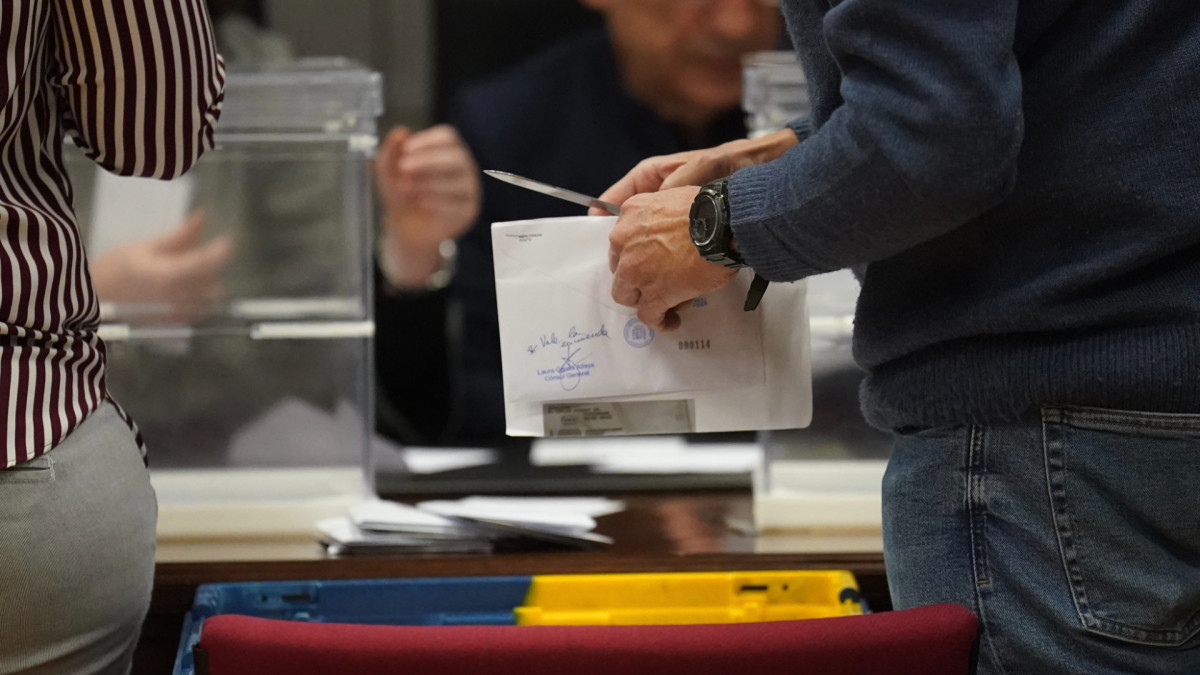
On September 10, 2026, the Fourth Section of the Administrative Litigation Chamber of the Supreme Court issued a precautionary order that suspends, until a ruling is issued, the registration in the Census of Electors Resident Abroad (CERA) or the electoral effects of certain registrations linked to the first scenario described in paragraph 1 of the eighth additional provision of Law 20/2022, on Democratic Memory. The order was adopted by a majority of five out of six judges in the Section. The measure, which does not revoke any nationality, does provisionally affect the census registration and the electoral participation of the people within its scope.
The figures explain the tension. According to the latest official Foreign Affairs data cited publicly, as of May 31, 2026 the consulates had received 1,225,188 applications, approved 571,761 cases and processed 333,696 registrations. More than 2.4 million people had begun the procedure or expressed interest in it before the deadline closed on October 22, 2025. The CERA, which counted 2,328,261 electors in the 2023 general elections, reached 2,736,522 on July 1, 2026. Argentina and Cuba concentrate the majority of the applications.
In this case, the debate blends two distinct issues. The first is whether Spain is right to recognize the nationality of the descendants of those who emigrated or went into exile. There are historical and reparative reasons to do so, and the Supreme Court litigation does not dispute them. The second issue is how that nationality translates into political representation. Here Spain is an anomaly in Europe, and this anomaly will outlast any consideration of the first.
What Spanish law says
The Spanish peculiarity lies not only in who votes from abroad, but in where their vote is counted. Those who obtain nationality remotely register in the CERA through their consulate and, since Organic Law 12/2022, which eliminated the “voto rogado” (voted on request), the Office of the Electoral Census sends them the documentation ex officio: Italy and Portugal do the same. What no one else does is what happens afterwards. That vote is not counted in a separate constituency nor diluted in a national tally; it is added to the tally of the province of the assignment, where it competes with the votes of those living in that province.
“That vote is not counted in a separate constituency nor diluted in a national tally; it is added to the tally of the province of assignment”
The province derives from the municipality of assignment. The absent resident elector is registered in the municipality of their last residence and, if they have never resided in Spain, in the one that attests “own rootedness or the rootedness of one of their ancestors”; if none is indicated, the consulate assigns it ex officio. No prior residence, tax contribution, or knowledge of Spain is required. On July 16, 2026, the Central Electoral Board (JEC) opened a review of the criteria applied by the consular offices and requested that the Office of the Electoral Census report on the determination of the municipality of registration.
The effect can be arithmetically relevant. In the Parliament, provinces elect between 2 and 37 deputies; Ceuta and Melilla elect one each. The allocation is done using the D’Hondt method, so the last seat can depend on a relatively small vote difference. In the general elections of July 23, 2023, the tally of only 44,833 CERA votes in Madrid allowed the PP to seize a seat from the PSOE.
How the others do it
In this comparative sample, none of the Western democracies combines the three pieces of the Spanish model: unconditional access to voting for those who never resided there, the elector’s own margin to set their constituency, and computation within an ordinary district in dispute. That combination, more than any of its components individually, is what makes the Spanish system peculiar.
| Country | Do they vote if they never resided there? | Where is the vote counted? | Legal basis |
|---|---|---|---|
| Spain | Yes, unconditionally | Province of “strongest ties,” as declared by the elector | Organic Law on the Electoral Regime (LOREG), arts. 36 and 75; Order EHA/642/2011; LO 12/2022 |
| Italy | Yes, unconditionally | Exterior constituency with its own seats (8 deputies, 4 senators) | Law 459/2001 |
| France | Yes, unconditionally | Eleven exterior constituencies in legislative elections; national tally in presidential elections | Code électoral; reform of 2009, applied since 2012 |
| Portugal | Yes, unconditionally | Exterior circles “Europe” and “Outside Europe” with their own seats | Lei 14/79 |
| Netherlands | Yes, unconditionally | National distribution of seats; external vote counted in The Hague | Kieswet arts. B1 and E1 |
| Hungary | Yes, but only national list | Excluded from single-member districts | Law CCIII/2011 |
| Poland | Yes, unconditionally | Fixed district of Warsaw, no election | Kodeks wyborczy |
| Germany | Only if they demonstrate “familiarity” with German politics | District of declared affiliation | BWahlG §12(2) |
| United Kingdom | No; requires prior residence or registration | Last constituency of residence | Elections Act 2022 |
| Canada | No; requires having resided | Last district of residence | Canada Elections Act; Frank v. Canada (2019) |
| Australia | No; requires prior residence and intention to return | Last electoral division | Commonwealth Electoral Act ss. 94-94A |
| Sweden | No; requires having been registered | Last municipality | Valmyndigheten |
| Norway | No; requires having been registered | Last municipality | Valgloven |
| Denmark | No; requires intention to return within two years | Last municipality | Folketingsvalgloven §2 |
| Ireland | No; no vote for emigrants | — | Electoral Act 1992 |
In the first category of countries, Italy, France, and Portugal admit remote nationalization voting, but this vote is channeled, together with that of the rest of the overseas residents, toward an exterior constituency with its own seats. The Italian-Argentine living in Rosario, Argentina, chooses deputies representing Italian citizens of the Americas; they do not decide who represents Bologna. Thus no one accuses the diaspora of having tilted an internal result: structurally it cannot do so.
Moreover, the legislator has decided how many seats correspond to the exterior and, in fact, weights them downward. In Portugal, exterior voters represent roughly a seventh of the census and elect four of the 230 deputies. In Italy, they represent about a tenth of the census and elect eight of the 400 deputies. France reserves eleven of the 577 seats in the National Assembly for its citizens abroad.
| Country | Electors abroad | Total census | Weight in census | Exterior seats | Weight in chamber |
|---|---|---|---|---|---|
| Italy (2022) | 4,743,980 | 50,864,123 | 9.3% | 8 of 400 deputies; 4 of 200 senators | 2.0% |
| Portugal (2025) | 1,578,890 | 10,850,215 | 14.6% | 4 of 230 | 1.7% |
| France (2024) | 1,570,155 | c. 49 million | c. 3.2% | 11 of 577 | 1.9% |
| Spain (2026) | 2,736,522 | c. 38.5 million | c. 7.1% | Provincial tally | Full weight in the province |
| Sources: Ministry of Interior and Chamber of Deputies (Italy, elections of September 25, 2022); SGMAI, AR2025 Report (Portugal, May 18, 2025); Ministère de l’Europe et des Affaires étrangères and UFE (France, legislative elections of June 30 and July 7, 2024); INE, CERA to July 1, 2026 (Spain). | |||||
In the second category, the exterior vote is channeled differently. The Netherlands distributes the lower house seats through a national tally; its twenty electoral districts mainly serve for presenting lists. Hungary allows postal voting for citizens without a domicile in the country, but limits their vote to the national list. Poland attributes votes cast abroad to the fixed district of Warsaw I in Sejm elections, thereby closing any margin to choose the constituency.
A third approach ties the exterior vote to a prior relation with the country. Germany normally requires three months of residence in the last 25 years, though it allows an alternative path based on a personal and direct familiarity with German politics. Canada requires having resided in the country at some point; Australia requires an intention to return within six years. The United Kingdom maintains a connection to a prior residence or registration, though since 2024 it has removed the former fifteen-year limit. Sweden, Norway and Denmark also condition the exterior vote on prior residence, periodic renewal, or an asserted intent to return. Ireland does not recognize, as a rule, the votes of its emigrants.
None of these restrictions has been deemed contrary to the European Convention on Human Rights. Strasbourg upheld the old British fifteen-year rule in Shindler v. United Kingdom (2013) and ruled in Sitaropoulos v. Greece (2012) that governments are not obliged to facilitate voting from abroad.
Why the Spanish combination is problematic
Each component of the Spanish model can be defended on its own merits. The problem arises when the three components are combined and applied to a population that, by definition, has no territorial tie: the result is a right to vote that could be directed, at no cost or prerequisite, to the province where it yields the most. It is not necessary to imagine fraud to see the incentive. It suffices to know that in Ourense, where CERA already accounts for 30% of the census, or in Soria or Jaén, the last seat could be decided by only a few thousand votes; that there is a pool of new electors without a natural assignment. This suspicion, even if it does not materialize, erodes the legitimacy of the count in itself, especially when the overseas vote reaches current volumes in such a short period. The Supreme Court has framed it as “a well-founded uncertainty about the electoral result.”
“The problem arises when the three components are combined and applied to a population that, by definition, has no territorial tie”
There is also a matter of principle. Political representation is justified, among other reasons, because the voter bears the consequences of what they vote for. The Argentine resident of Buenos Aires with a Spanish passport does not pay Spanish income tax, does not use its healthcare or schools, and will not live under the budget passed by the Congress that aids in electing it. The maxim no taxation without representation has a reverse that is less cited but equally reasonable: representation without contribution or burden should be at least a tempered representation. It is not an argument to deny the vote; it is an argument to give it the form of electoral representation that best balances duties and rights.
What could be done
For a case like Spain’s, the cleanest answer would be the one already adopted by Italy, France and Portugal: an exterior constituency with its own seats. It would be more than just an electoral firewall. It would also provide a representation specifically connected to matters such as consular capacity, pension portability, double taxation, credential recognition, and conditions of return. Deputies would continue to constitutionally represent the entire Spanish people, but exterior citizens would directly elect representatives whose political responsibility would be more clearly tied to their problems.
In Spain, however, such reform would have to overcome a constitutional hurdle: Article 68.2 fixes the province as the Congress’s constituency, and 69.2 does the same for the Senate. Creating an exterior constituency requires a constitutional reform, with the reinforced majorities that this entails.
“For a case like the Spanish, the cleanest answer would be the one already adopted by Italy, France and Portugal: an exterior constituency with its own seats”
Until that reform arrives, LOREG and its implementing rules offer room for two immediate corrections. The first is to strengthen the arraigo declaration with a regulated and verifiable affiliation, documented and without alternative option. It is, essentially, what the JEC has begun to require by instruction. The second is to introduce, for those who have never resided, an arraigo requirement of the German type: a minimum period of prior residence or a demonstrated political tie not merely inherited. Neither measure touches the right to nationality nor, strictly speaking, the right to vote; both affect only how and where the vote is exercised.
The timing remains an issue. If these corrections were to apply to those who already obtained nationality under the “grandchildren law” and are registered in the census, they would operate retroactively to the detriment of expectations that the State itself fostered, with the discontent that entails. It is worth remembering, however, that the initial flaw was approving that law without the consensus that any rule capable of altering the electoral body requires. The prudent course would be to assume that the electoral status of those new citizens will not be resolved in time for the 2027 general elections and to set 2031 as the horizon. A reform agreed upon in the next legislature, with delayed entry into force, would avoid both trampling those who are already voters and the suspicion that the rules are being blurred with an eye toward the forthcoming elections.
Ceasing to be the exception
It is legitimate and just that Spain recognizes citizenship for the descendants of those who suffered political exile or unfairly lost their legal bond with the country. But citizenship and suffrage are not the same, and most European democracies, with similar historical vicissitudes, attest to this. Either they require additional residence requirements or permit voting without prior residence, but they place it in an exterior constituency, or they pool it into a national tally, or they establish it in a location outside of any discretion.
“Citizenship and suffrage are not the same, and most European democracies, with similar historical vicissitudes, attest to this”
Among the compared countries, Spain is the only one that hands a citizen without roots the key to a specific province. It is a rarity vulnerable to suspicion and difficult to justify as the number of overseas electors grows rapidly. An exterior constituency, as in France, Italy, or Portugal, would offer a more tempered separation between Spanish citizenship of those living abroad and the regional representation of those living in Spain. The Supreme Court will decide the legal scope of the challenged registrations. It is up to the legislature to ensure that Spanish overseas voting ceases to be an anomaly exposed to controversy.
