
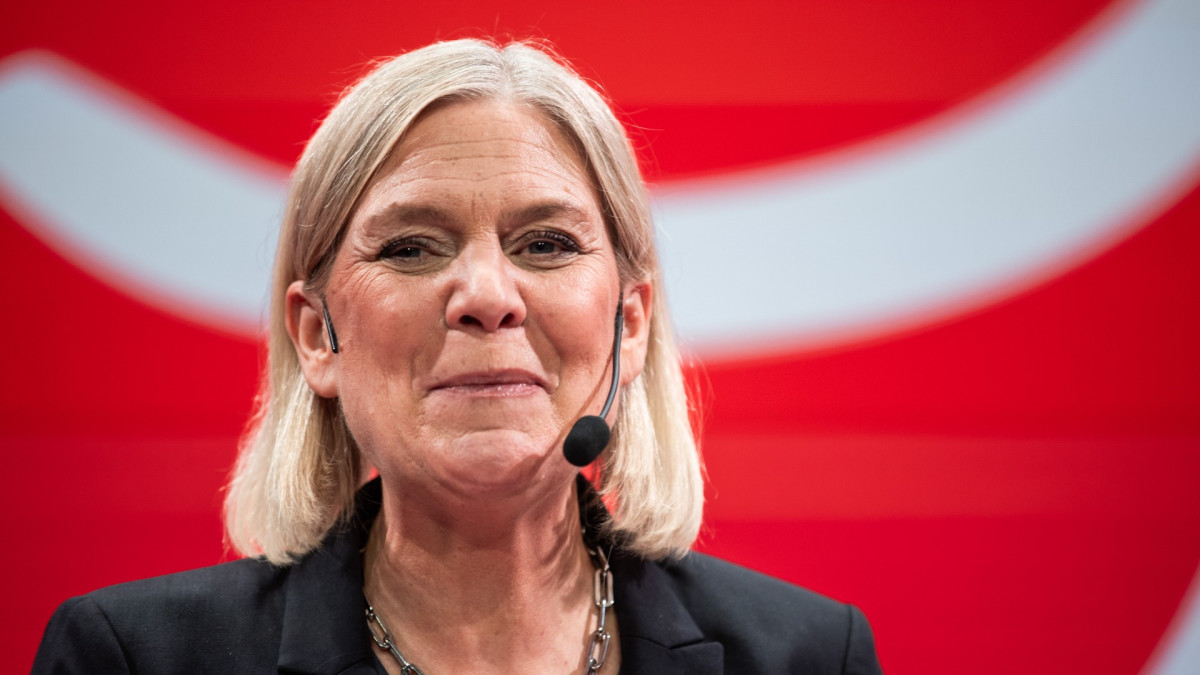
Swedish elections yield a paradox that deserves attention. Sweden has shifted politically to the right, but the beneficiary this time does not appear to be the radical right. For the first time since entering Parliament in 2010, the Swedish Democrats (SD) lose electoral support. The Moderates of Ulf Kristersson regain the second position they had lost in 2022, while the progressive bloc led by Magdalena Andersson provisionaly obtains 176 seats against 173 for the right. A margin of only a few tenths, which still must be confirmed with the count of late votes and ballots from abroad.
But speaking simply of a Social Democratic victory would be misleading. The party led by Andersson remains the country’s first force, as in every general election since 1917, but it falls from 30.3% in 2022 to less than 28%, one of the worst results in its contemporary history. The paradox is notable, since the Social Democrats could return to government after four years in opposition precisely in an election where they lose support.
A More Plural Left
What enables the victory of the progressive bloc is, therefore, something more interesting than a Social Democratic recovery: the reconfiguration of the Swedish left. The Greens and the Left Party strengthen their positions and become indispensable players for any alternative to Kristersson. Andersson remains at the center of gravity of the progressive space, but she can no longer govern it with the dominant stance that the Social Democrats held for much of the 20th century. If she returns as prime minister, she will do so more dependent than before on a strengthened left and Greens.
“What makes the victory of the progressive bloc more interesting than a Social Democratic recovery is the reconfiguration of the Swedish left”
This will also have political consequences. Both the Greens and the Left Party disagree with the Social Democrats on important issues, including how hardline the immigration policy should be. And the Left Party has made clear that it intends to translate its parliamentary support into influence in government. The victory thus opens an opportunity for the left, but also a negotiation about which left will govern Sweden.
This transformation also has a territorial dimension, as is being seen across Europe. Sweden appears increasingly crossed by fractures that overlay the traditional left-right axis. The great cities and university districts provide a particularly favorable ground for the Greens, the Left Party and the progressive camps, while smaller towns, rural areas and certain industrial regions present a much more intense competition among Social Democrats, Moderates and Swedish Democrats. In the north, regions historically bastions of the Social Democrats, sustained by industry, mining, unions and a powerful welfare-state system, have seen segments of the traditionally Social Democratic working-class electorate penetrated by the SD. Meanwhile in the south both the right and the far right maintain their strongholds without issue. Add to that a growing urban-rural fracture, where the metropolitan areas concentrate much of the Green and left vote, while the radical right finds greater room to penetrate beyond them.
“The old Social Democratic coalition that united industrial workers, public employees, cities and territorial peripheries exists still, but is increasingly fragmented”
This geography helps explain the Social Democrats’ strategic challenge. Andersson must compete simultaneously with SD for the working-class and peripheral vote, with the Moderates for middle-class segments and with the Greens and the Left for the urban progressive electorate. The old Social Democratic coalition that united industrial workers, public employees, cities and territorial peripheries still exists, but is increasingly fragmented.
Losing Votes, Winning the Agenda
And there lies the other great paradox of these elections. Since entering the Riksdag in 2010, the SD had increased its vote share in every general election. In 2022 they reached 20.5%, overtook the Moderates and became the country’s second force. Four years later they retreat precisely after the legislature in which they have exercised the greatest political influence. The Tidö Agreement allowed Kristersson to govern thanks to their support and turned much of his priorities on immigration, citizenship, integration and security into government policies.
Thus, the far right loses votes after having managed to reshape the agenda. And those who electorally reap the benefits are, in different directions, the Moderates and the left. The former can offer restrictive immigration and security policies without the political baggage of voting for the SD. The Greens and the Left Party, for their part, can mobilize those who reject that adapting to the new conservative consensus is the only path to defeat the right.
That also requires tempering the idea of an extraordinary Social Democratic resilience. The resilience exists because, despite achieving one of its worst results in history, the party remains by far the country’s leading political force. But that is no longer enough to explain the victory. If the progressive bloc ends up forming a government, it will be because the plural left is compensating for the decline of its historically dominant party.
“In recent years, the Social Democrats have hardened their positions on immigration, security and crime in an effort to win back workers drawn to the DS”
And this presents an especially interesting dilemma for Andersson. In recent years, the Social Democrats have hardened their positions on immigration, security and crime in an effort to win back workers drawn to the SD. But their future partners are strengthening precisely by defending more progressive positions on some of these matters. The eventual government will have to manage that contradiction.
The Swedish elections thus leave two simultaneous movements. On the one hand, the far right retreats electorally after having decisively helped push the country’s political center to the right. On the other hand, the Social Democrats could regain the government despite obtaining one of their worst results, thanks to the strengthening of a more plural left.
That is why the outcome should not be read simply as the return of Swedish social democracy. In this scenario, we could have a progressive government in a Sweden that is politically more conservative and with a left that is internally more fragmented. From there, we will first see whether Andersson is able to secure the government and then which policies she will have to negotiate with those who make her majority possible. Because the Swedish Democrats may lose votes after having won part of the cultural battle. And the Social Democrats may win the government after having lost part of their former hegemonic status.
