
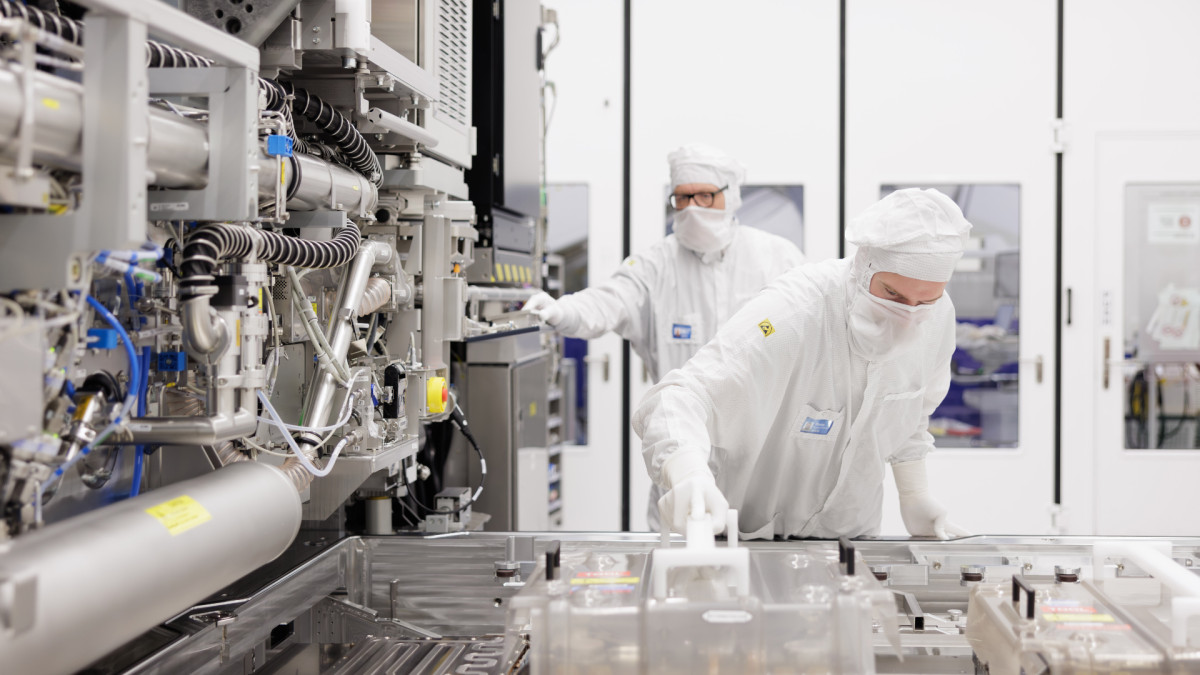
Veldhoven, a quiet, affluent town in the southern Netherlands, does not look like the kind of place that should be on the front line of the geoeconomic competition between the United States and China. Yet, in addition to hosting a large number of commuters who travel daily to Eindhoven, it also houses one of the world’s most important companies.
ASML can fairly claim to be the European company most important yet least known. It manufactures advanced lithography machines—the technology that allows chipmakers to etch circuit patterns onto silicon wafers. All of the world’s major chip manufacturers, from Taiwan’s TSMC to South Korea’s Samsung or Intel, depend on ASML’s Extreme Ultraviolet (EUV) lithography systems to produce the most advanced chips. There are other suppliers of Deep Ultraviolet (DUV) lithography machines that can produce less advanced chips, but ASML is the only global supplier of EUV equipment. Anyone who makes the chips needed to power the race in artificial intelligence relies on the Dutch company.
Since the first term of President Trump, throughout the Biden Administration, and now again under renewed pressure from his team, the Dutch Government has progressively tightened restrictions on ASML’s sales to China. Not only has the EUV supply been curtailed, but so too have the most advanced DUV models. In July last year, reports that China had begun producing its own DUV machines—largely based on Dutch technology—were enough to slam ASML’s stock and trigger a fresh wave of concern among American geopolitical strategists. The Chinese lithography industry may be about a decade behind ASML, but given that the Dutch company started with a forty-year lead, it is rapidly narrowing that gap.
“Anyone manufacturing the chips necessary to feed the AI race depends on the Dutch company”
For those who study economic and technological history, none of this is new. The concerns over what a contemporary economist would call a “technology transfer” are, at least, as old as modern economic growth itself. During the Industrial Revolution, when Britain cemented an overwhelming—though temporary—economic advantage over its rivals, a series of laws passed by Parliament sought not only to prohibit export of key machinery, but even to forbid skilled artisans from carrying their know‑how out of the country.
The overall efficacy of this knowledge blockade was uneven. A notable example is Samuel Slater. Born in Derbyshire in 1768, he began working in a cotton factory at ten and later became an apprentice, during which he learned to use the still-novel water frame, a water-powered spinning machine that was revolutionizing Britain’s textile production. At twenty-one, disguising himself as a farmer to evade the restrictions, he emigrated to New York. By 1793 he was running a factory in New England that not only incorporated numerous elements of British technology but also copied and adapted its organizational and managerial techniques. During a visit to one of his factories in the 1830s, then-President Andrew Jackson lauded him as “the father of the American factory system”. In Britain he was known as “Slater the traitor.”
The technological blockade was always porous, never complete. The water frame that Slater brought to North America began to be used in England in 1769, and despite restrictions, by 1779 there were machines of this type in France and by 1785 in the Netherlands. It is known that at least 1,000 British artisans traveled to France between 1710 and 1800.
“The concerns over what a contemporary economist would call ‘technology transfer’ are, at least, as old as modern economic growth itself”
Over time, the British government shifted strategy. The ban on emigration was lifted by the mid-1820s and export controls on machinery were drastically reduced before being abolished in the 1840s. Rather than trying to protect tightly guarded secrets, British manufacturers began showing growing interest in selling their technology abroad. In the 1840s, with Britain’s turn toward free trade, those restrictions became increasingly hard to justify.
The consensus among economic historians is that, although technology and skilled workers often escaped those controls, the overall strategy raised the costs of reproducing the British model. The British Government could not prevent its technology from eventually being used in France, the Netherlands, or the United States, but it could substantially delay its deployment.
During the Cold War, efforts to block technology transfer were, if anything, more effective. From the late 1940s onward, the leading Western economies did not only seek to prevent the export of military technology to ideological adversaries, but also imposed controls on the sale of numerous goods and processes, especially in computing and semiconductors. Once again, there were ways around the restrictions. In some cases, it involved tranches of transactions through third parties and even intermediaries; in others, traditional industrial espionage. Recent investigations have found solid evidence that this was one of many factors that slowed Soviet productivity and that of the Eastern bloc during the 1960s, 1970s, and 1980s.
Most likely, it is impossible to prevent technology from crossing borders forever, though “forever” is a very long time. History books are full of examples of what trade economists would call “frictions” that managed to delay those technology transfers for years, even decades.
“The British Government could not prevent its technology from ending up in France, the Netherlands, or the United States, but it could delay its deployment substantially”
The most interesting question, especially when facing a rival like China, is how the embargoed party responds. Recent research into US export restrictions to China during the 2000s and 2010s has concluded that, in the short term, these geoeconomic tools often work: Chinese imports of restricted products fall by a substantial margin. In the medium term, however, these restrictions have spurred innovation. When Western supply of a component or a machine essential to production is cut off, Chinese firms typically respond by increasing their own R&D spending and the number of patents they file. According to a recent study, these innovation incentives are “economically significant in magnitude and persistence”.
In other words, policymakers must strike a delicate balance. Blocking ASML’s exports to China will almost certainly have hampered China’s AI efforts in the short term, but the price may be to spur China to develop its own alternatives and end up creating a stronger Chinese AI and chip-manufacturing sector, rather than a weaker one.
This piece has been published in Engelsberg Ideas and translated by Agenda Pública.
© Engelsberg Ideas, London, 2026
