
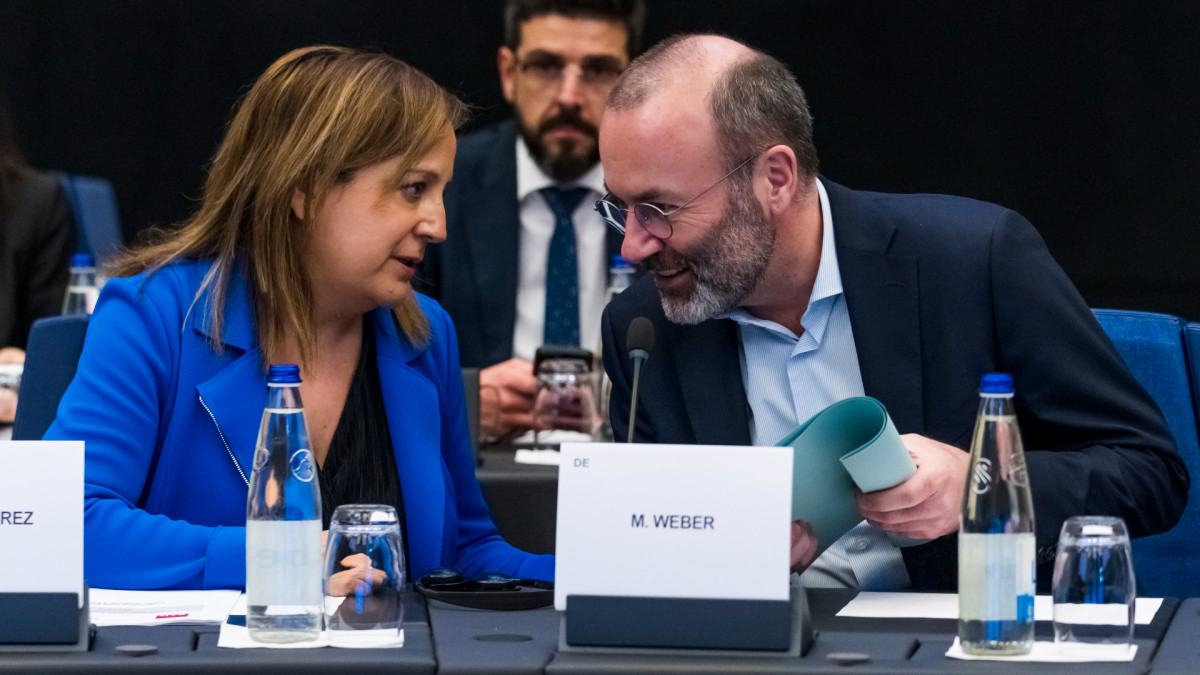
The historic alliance between socialists and Christian democrats could be coming to an end. The current situation in the European Parliament, where the European People’s Party plays with two majorities, is unsustainable for the Social Democrats. “This double game will not be tolerated [any longer],” says Iratxe García, the president of the Socialists and Democrats (S&D) parliamentary group, who has confirmed that they have asked Manfred Weber’s party to sit down and negotiate the situation.
The alliance between social democrats, Christian democrats and liberals is hitting its lowest point of the legislature just as mid-term negotiations begin. This process involves renewing key posts, such as the presidency and vice-presidencies of the Parliament, and is seen by the S&D as a turning point. García lamented that, in the past, there was an agreement with Weber for there to be, in the second half of the term, a President of the Parliament from the S&D, but now that is in doubt.
“The alliance between social democrats, Christian democrats and liberals reaches its lowest point of the term just as the mid-term negotiations arrive”
In the past there have been moments when the blocs have drifted apart. In fact, the last episode occurred at the start of this same term, when Ursula von der Leyen proposed as executive vice president Raffaele Fitto, a leader of Fratelli d’Italia and coming from ECR. The decision provoked the rejection of social democrats and liberals, since ECR was not part of the majority that had backed Von der Leyen’s reelection. At the same time, the PPE took issue with Teresa Ribera’s designation as executive vice president of the Commission. Ultimately, the agreement to accept both lifted the cross-vetoes and was set down in a cooperation declaration signed by Weber, García and the liberal leader Valérie Hayer. Almost two years later, however, the discrepancies over which majorities the PPE can rely on remain open.
Now, from the socialist side they point out that “this is the last opportunity” to steer a European legislature that has just a little over two and a half years left. Or, at least, to bring it back to its traditional course. In the event that motions of censure against the European Commission were to recur, and if the PPE backs the German, reaching two-thirds of the votes cast and the majority of the Members would require combining the support of the social democrats with a portion of the radical right. That does not seem to be the current scenario, but a blocked legislature is not unlikely.
For the moment, the socialist side has not thrown in the towel. García says she is willing to negotiate with Weber just as with the PPE to get the situation back on track. However, the offer to sit down comes with a condition: transparency. In this sense, there must be in advance a “public, open and transparent” agreement so that there are no double agendas. The objective, according to García herself, is that in case of non-compliance the relevant responsibilities can be assumed.
“An advance call for a ‘public, open and transparent’ agreement to avoid double agendas”
The truth is that the European calendar leaves little room for a legislative pause. If anything, the opposite tends to be true. In the capitals there is a push to speed up negotiations such as the next multiannual financial framework (MFF), among other reasons, to avoid coinciding with the French presidential elections of 2027. Reaching an early agreement on the budget that will govern the Union between 2028 and 2034 will be key to financing a large part of the Community’s competitiveness priorities. And the Social Democrats want to tackle that negotiation after clarifying with which majority the PPE intends to legislate.
