
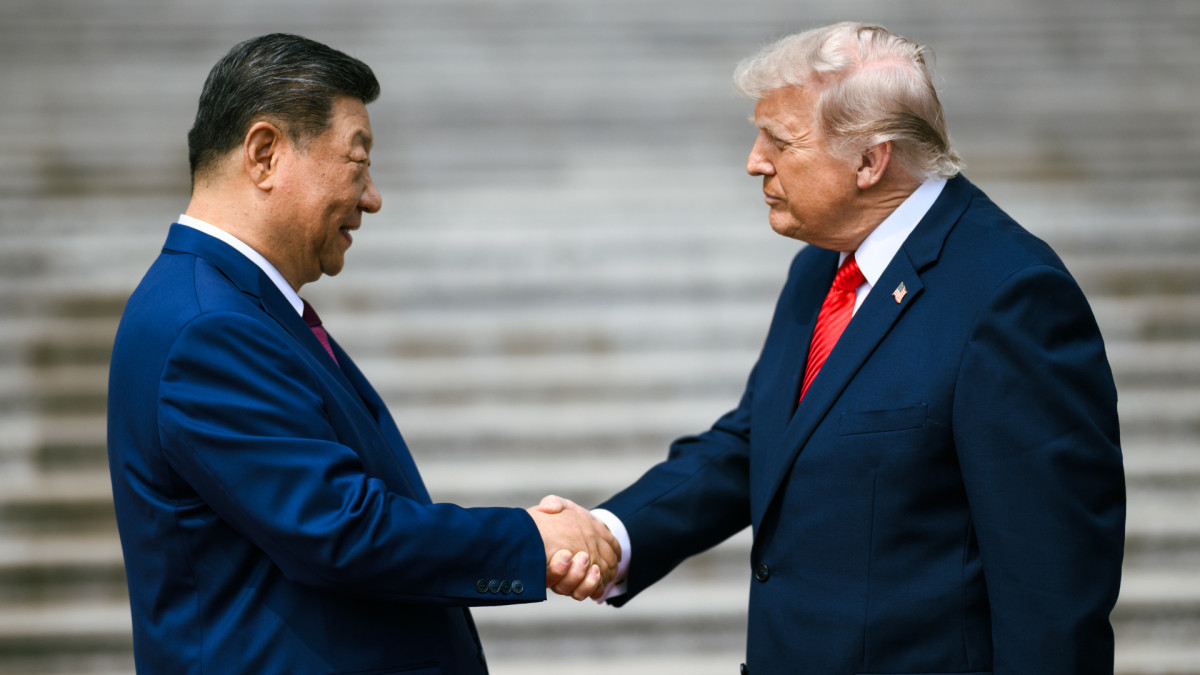
When Donald Trump visited Beijing in May 2026 and met with Xi Jinping, both governments announced a commitment: an intergovernmental dialogue on artificial intelligence between China and the United States. The spokesperson for the Chinese Foreign Ministry, Guo Jiakun, summarized the objective with the usual formula —two leading AI powers that must work together to improve governance for the benefit of humanity— the kind of phrasing that fits in any statement and commits to nothing concrete. With only a few weeks remaining before the Chinese leader’s trip to the U.S. capital, the date, venue and agenda of the AI talks are not known.
Urgency of Negotiation Without an Institutional Architecture
The only hint of any possible development of the political will expressed four months earlier appeared in the early days of September. At the G20 ministerial conference on innovation, both sides affixed their signatures to the G20 AI prosperity objectives. It is a roadmap reflecting the group members’ commitment to leverage AI as a driver of economic growth, industrialization and the creation of high-quality jobs. In other words, a list of principles to guide the formulation of national policies in each country that does not bind global governance. A modest outcome given the time elapsed, but with the significance of being the first meaningful AI agreement signed by Beijing and Washington since the distant Bletchley Park meeting in November 2023.
Since May, however, the urgency of a global AI development agreement between the two superpowers has grown. There are accumulating reasons to set up a global framework that both channels and accelerates the deployment of this technology. On one hand, incidents triggered by frontier models. First, cyberattacks by internally developed research models, arising from possible negligence in testing environments. Later, the detection of the possible use of language models in commercial service to create biological weapons. On the other hand, the industry demands global regulatory stability. It is no longer only export controls that hinder AI development, but also the uncertainty about the limits of public intervention in the private sector.
“The urgency of a global AI development agreement between the two powers has grown”
At the same time the need for dialogue becomes more urgent, structural obstacles to developing it remain. First, leadership within each side is diffuse. Neither Washington nor Beijing has developed the institutional architecture necessary to sustain this dialogue on a routine basis. On both sides there is an internal struggle among the diplomatic corps, those responsible for national security, and those with the capacity to assess frontier models. Second, there is mutual distrust fostered by hawks in each Administration. While U.S. officials analyze how to neutralize the Chinese challenge by bombing data centers, those in the Asian country judge negotiation with someone who cannot—or will not—control their own industry as futile.
The Possible Agenda
To understand what really fits on the table, the most useful parallel remains the Cold War nuclear agreements. Washington and Beijing share a genuine interest in controlling the diffusion of technology, but neither is willing to concede ground in its own race. The path toward an agreement will necessarily have to be walked in steps.
This inherited framework of coexistence in the face-off defines three levels of possible dialogue on the global governance of AI. In the first —avoiding disaster— lie the nonproliferation of powerful models to non-state actors, the protocols for biological risk, or cyberattacks on critical infrastructure caused by AI, and direct lines of communication for ambiguous incidents. In the second —limits to development— are open-weight models, distillations among rival laboratories, lethal autonomous systems, and capability thresholds that should trigger greater scrutiny on both sides. The third —cooperation and competition— is the most aspirational: joint safety research or shared-benefit applications in health or climate.
The viability of a pact between the two powers reduces to the first domain. But expectations about concrete points that could be agreed differ between diplomats and experts. The former narrow the chances of an agreement to the risks of nuclear war, the use of new models to close vulnerabilities in open-source code, and the establishment of contact lines for incidents. The latter extend it to a few more areas, such as biological risks or controlling non-state actors.
“The viability of a pact between the two powers reduces to the first domain”
Beyond the dialogue on AI governance, an agreement between China and the United States on export-control limits is also necessary. In November the Busan 2025 deal, which has slowed the militarization of the technology supply chain and limited the reach of the trade war in critical goods and semiconductors, expires. Negotiators would do well to explore the suggestion of an analyst to bring under the same umbrella both agreements, institutionalizing a Technology Stability Council.
Finally, the negotiating agenda must include mechanisms to involve the international community in the agreement. China and the United States have so far chosen to maintain separate cooperation blocs, the World AI Cooperation Organization and Pax Silica. Returning to a Cold War reference, the Council’s membership should go beyond the two world powers, in a manner similar to the Nuclear Non-Proliferation Treaty. At a minimum, it should accommodate arbitration powers from both the industrialized nations and the Global South.
“The Council’s membership should go beyond the two world powers, in a manner similar to the Nuclear Non-Proliferation Treaty”
Warnings about the risks of all kinds stemming from AI are growing, and calls to curb its development are multiplying, though some carry the scent of ulterior motives. The ability of the superpowers to find common ground to avert a potential escalation in an unregulated AI development would lay the first brick of global reassurance for the world.
