
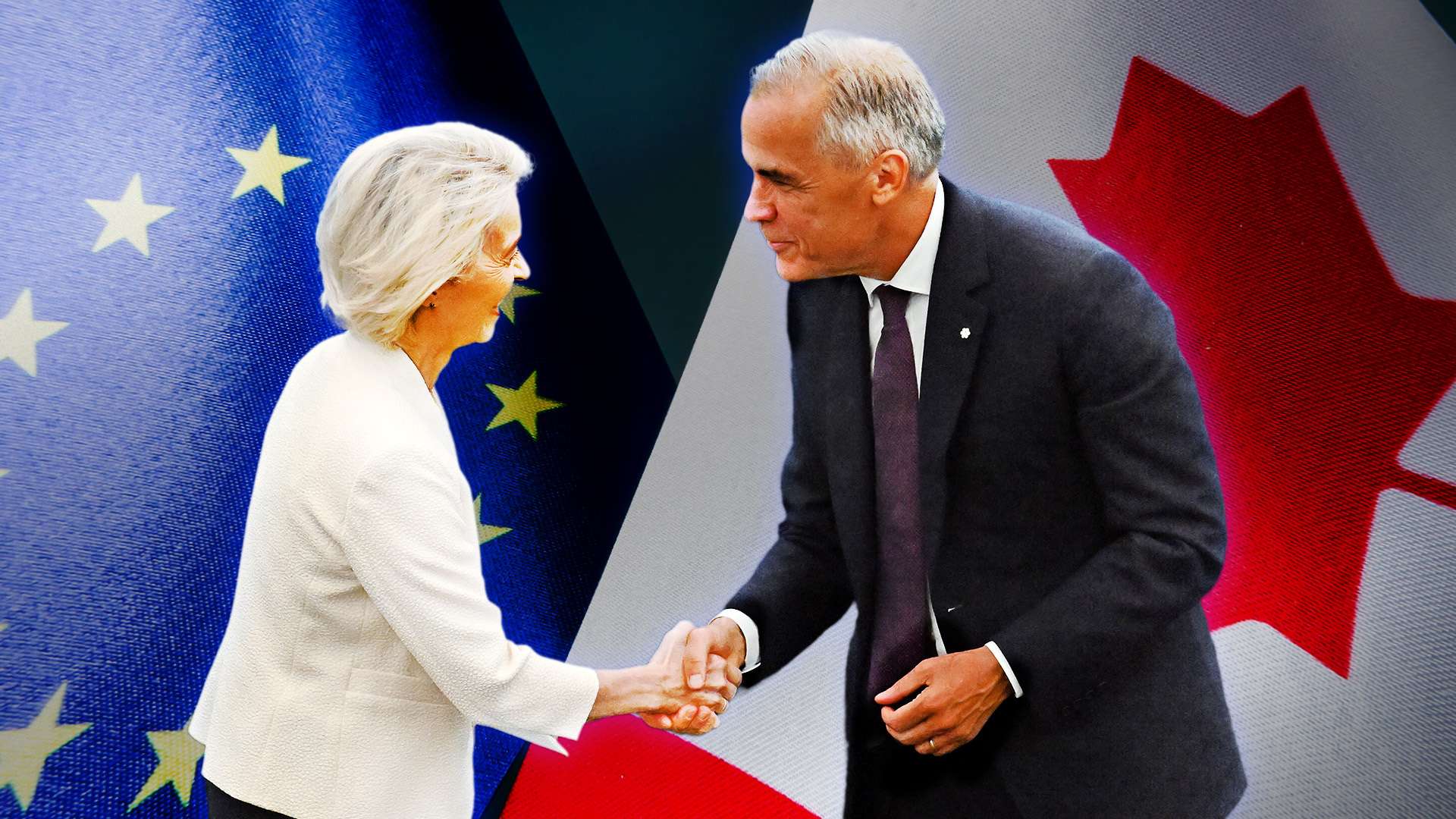
Brussels Aims for Close Canada-EU Ties as Ottawa’s Rift with Washington Grows, Proposing an Unprecedented Associate Member Status
President Donald Trump’s habit of isolating America’s allies is turning global relations into a fragile terrain for Americans, Europeans, and Canadians alike. European Commission President Ursula von der Leyen captured this fragility during her State of the Union address on Wednesday, noting that there is a pressing need to rethink partnerships. Although she spoke to the European Parliament, her message was clearly aimed at Canadian Prime Minister Mark Carney, who was in the chamber and seated prominently to von der Leyen’s left on the stage.
In a striking move, von der Leyen invited Canada to join the European Union as the bloc’s first “associate member.” The designation remains without a settled definition, but both sides say they anticipate deeper cooperation in areas such as energy, trade, technology, and Arctic security. In his briefing to the European Parliament on Thursday, Carney stated his intention to further integrate the two markets and to participate in Erasmus+, the EU’s flagship student exchange program.
Canada and the European Union have a long-standing partnership, a relationship that is accelerating. The 2017 Comprehensive Economic and Trade Agreement (CETA) eliminated tariffs on most goods traded between the two economies. Earlier this year Canada joined the SAFE Instrument, an EU mechanism for joint defense rearmament. Canada is also an active participant in Europe’s space and research ecosystem through the European Space Agency and Horizon Europe, and it contributes to EU election monitoring missions.
The precise mechanics of the arrangement and how Canada would fit into the EU remain to be disclosed. It could take a page from the bloc’s existing arrangements with Norway, Iceland, and Liechtenstein under the European Economic Area, which integrates those countries into the EU’s single market, allowing for the free movement of goods, capital, and people. Similar trading and travel liberalization has been achieved with Switzerland through bilateral agreements. In both cases, these “partial members” accept EU rules without joining EU institutions, retaining autonomy over sectors such as fishing and agriculture and the ability to set their own trade policy. While many avenues for closer integration between Canada and the EU exist, experts say that Canada joining the EU Customs Union or adopting EU-wide laws is unlikely.
Beyond the technicalities, the political signal is clear: Canada and the EU are seeking closer ties as they drift away from the United States. Indeed, who could fault them?
Since taking office again, Trump has wielded aggressive rhetoric and tariff threats directed at both the EU and Canada.
On April 2, 2025, Trump announced his “Liberation Day” tariffs, establishing a 10 percent baseline for tariffs on imports from most countries, with a 20 percent rate applying to EU member states. In July 2025, after months of threats and negotiations, Europe and the United States reached a loose trade agreement that subjected most imports from the EU to a 15 percent tariff, while tariffs on U.S. industrial exports were reduced. The EU also pledged to invest roughly $600 billion in the United States and to ramp up its purchases of U.S. energy and military equipment, according to Reuters. Even so, the president’s stance did not soften; over the subsequent year, Europe faced ongoing threats as the agreement moved toward full ratification and implementation. Von der Leyen’s address appears to have energized Trump, who then threatened to impose “serious tariffs” on the EU if Canada joined the bloc.
Although Canada was spared from Liberation Day’s tariffs, sector-specific import levies have been creeping upward for the past two years. Following a tense summer marked by U.S. signals of hesitation and threats, negotiations over Trump’s proposed 50 percent tariff on a range of Canadian imports collapsed, and those tariffs went into effect last month. The conflict has since escalated into a full-blown trade war, with Canada retaliating and consumers on both sides feeling the pinch. Trump’s hawkish stance toward a neighbor—often urging Canada to become the “51st state,” and recently ordering Lake Ontario renamed to Lake America—has done little to defuse tensions.
Officials have argued that the administration’s tariff policy toward two of America’s largest trading partners has never made sense, nor has it shown a coherent strategy. The initial legal justification for the Liberation Day tariffs rested on a decades-old law that granted the president emergency powers, an argument somewhat detached from the tariff measure itself. The Supreme Court struck down that justification in February, but quick legal work secured new enforcement mechanisms. The resulting policy uncertainty, coupled with divergent rationales for the duties—whether they were intended to revive manufacturing or reduce the trade deficit—has created whiplash for negotiators and businesses. It has also led U.S. allies to conclude that Trump’s trade agenda has often been more about asserting power and prestige than about sound economic policy.
Carney underscored the sentiment in his remarks to the European Parliament: “[Europe and Canada] do not seek to dominate others. Rather, we aim for resilience so that no one can command our open markets, erode our sovereignty, threaten our territorial integrity, or undermine our freedoms, our democracies, and the rule of law.”
