
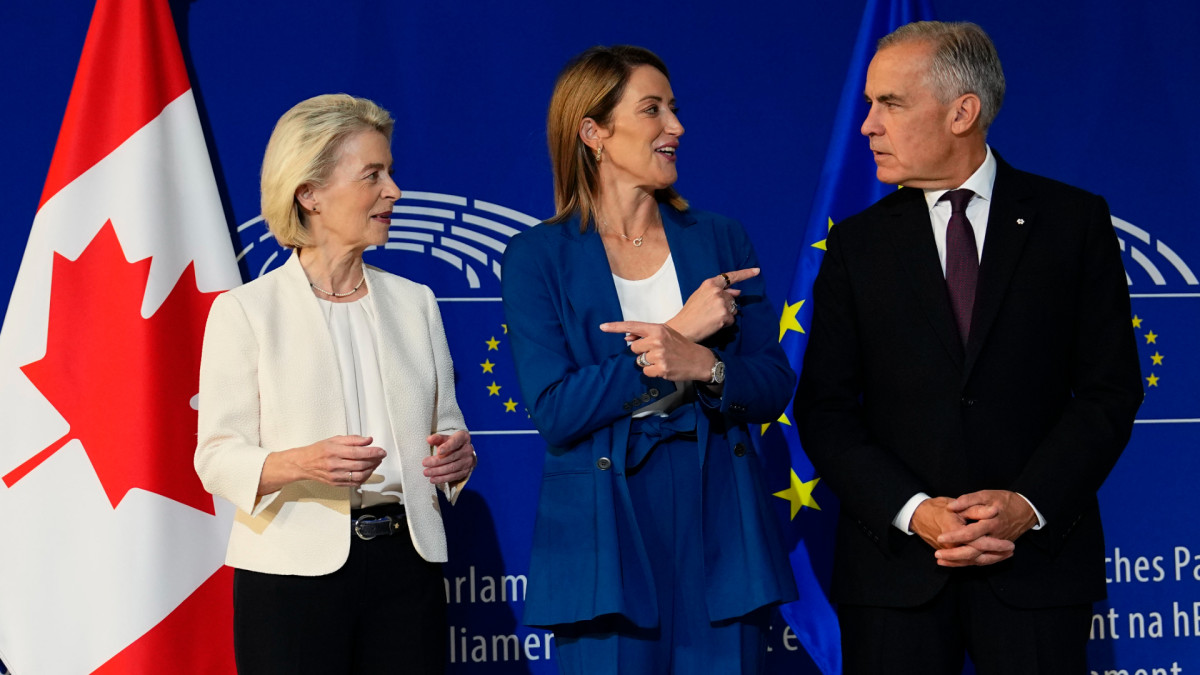
In recent years, the discourse surrounding the State of the European Union (SOTEU) has progressively become an occasion to announce policies that surprise the start of the new political year in Brussels. But probably no other SOTEU has achieved the impact of this one. The President of the European Commission, Ursula von der Leyen, used the moment not only to announce the EU KIDS Act, which this Thursday the European Commission has formally presented as a legislative proposal and which bans social media accounts for children under thirteen, but also to indicate her intention that Canada become the first “associated member” of the European Union.
This proposal has impressed as much for the idea of creating an “associated member” category, unprecedented until now in the Union as for the questions surrounding its viability. But for international analysts, little of this news is surprising. Since his electoral victory in 2025, Mark Carney, present in Strasbourg during the SOTEU, has become Europe’s quintessential ally. Not only has he diverged from the tendency of many foreign politicians (and several Europeans) to threaten the European project, but he has been a staunch admirer of it, and gradually he has been increasing his country’s integration with the EU.
That will was confirmed this Thursday before the European Parliament. Carney has backed the proposal to deepen the Canada-EU relationship, though he downplayed the exact denomination it will take: for the Canadian prime minister, the substance of the future partnership matters more than the name it receives.
The most significant development to date had been the signing of a Security and Defence Partnership with the EU in June 2025, which opened the door for non-European companies to enter the European financial instrument Action for Europe’s Security (SAFE) in February this year.
“Since his electoral victory in 2025, Mark Carney, present in Strasbourg during the SOTEU, has become Europe’s quintessential ally”
The turning point and origin of this new alliance took place during the World Economic Forum’s latest gathering, in January this year in Davos, where the Canadian prime minister delivered what is likely one of the most important speeches in international politics of the last decade and, certainly, the one that has best read the growing geopolitical rivalry we live in. In it, directly appealing to the EU’s long-desired strategic autonomy, he spoke of the imperative need for “middle powers” to join forces to avoid falling into the subordination of the great powers and their clear indifference toward a rules-based international order, contextualizing it with the already iconic metaphor “if we’re not at the table, we’re on the menu”. At that summit Ursula von der Leyen was also present, and it became clear that there was personal affinity with the European leader and, more importantly, a political synergy.
The geopolitical vision of both leaders is extremely similar. The two are in a race to diversify their trade alliances: since Von der Leyen became President of the Commission, free trade agreements with Vietnam and New Zealand have come into effect; the agreement with Mercosur has been provisionally applied; and free trade agreements with India and Australia have been concluded; and in just over a year and a half of Carney’s mandate, Canada has signed twenty trade and defense agreements on four continents, with the aim of continuing on this path to make Canada the most interconnected economy in the world. Both have prioritized projects to protect their critical infrastructure and supply chains, and to strengthen ties between their markets, increasing EU-Canada goods trade by 76% since the provisional application of the Global Economic and Trade Agreement (CETA) in 2017. Likewise, the two have put at the center of their public policies sustainability and the interconnection between energy independence and economic security, while continuing to defend an increasingly neglected multilateralism and alliances based on loyalty to democratic values. And, no less important, both have made their political and military support for Ukraine a constant in their respective trajectories.
“Both have prioritized projects to protect their critical infrastructures and supply chains, and to strengthen ties between their markets”
Understanding all this context, the announcement delivered at the podium of the European Parliament ceases to surprise as much and begins to be seen as a natural progression of recent diplomatic developments, which have cemented the EU-Canada relationship at a level hitherto unseen. Despite the news being greeted with applause from almost the entire chamber (even from other political forces opposed to the European People’s Party, to which the Commission president belongs), consolidated in a hug between Ursula von der Leyen and Mark Carney, describing the implementation of this proposal as a difficult task does not do justice to its complexity. From questions of legal legitimacy to the possible reaction of other international actors, the following are some of the main complications that the EU and the Canadian government will inevitably have to face in making the idea of Canada as an “associated member” a reality.
The legal legitimacy of the proposal
El artículo 49 del Tratado de la Unión Europea señala que “cualquier Estado europeo que respete los valores mencionados en el artículo 2 y se comprometa a promoverlos podrá solicitar el ingreso como miembro en la Unión”.
“Defining the implementation of this proposal as a difficult task does not do justice to its complexity”
Starting from the legal premise that underpins the general conditions for entry into the Union, it can be said that Article 49 establishes three requirements for this request to be considered: a geographic requirement (“any European state”), an axiological requirement (“that respects the values mentioned in Article 2”), and a teleological requirement (“and commits to promoting them”). While Canada meets the last two requirements by a wide margin, as it is one of the states most committed globally to respecting and promoting the values mentioned in Article 2 (“human dignity, freedom, democracy, equality, the rule of law and respect for human rights”), the distance provided by the Atlantic Ocean would automatically render the North American nation unable to meet the geographic requirement.
There are precedents that attest to the severity of European institutions in applying this territorial criterion, considering what has long been understood geospatially as “Europe.” The 1987 application by the Kingdom of Morocco to join the then European Economic Community was rejected immediately “on the basis that Morocco was not a European state.” Despite years of constant diplomatic efforts, Turkey’s accession process, a country of over 87 million people located between Europe and Asia, is stalled, with Montenegro the only candidate with realistic prospects of becoming the EU’s next member this decade. Based on these examples, numerous jurists and political commentators have argued that “European state” refers not only to a territorial requirement, but also to a cultural affinity.
In Canada’s case, there are several unknowns. Foremost is to establish that we are not dealing with a full membership request to the EU, in which case Article 49 would apply: we are facing a new model of political cooperation, and the European Commission is aware of this. Just before saying the words “associated member,” President Von der Leyen said she wished to raise the relationship with Canada to the maximum level possible. The explicit acknowledgment of the limitations of its ability to act signals that we are not facing a political process that can resemble the classic accession model, but rather something whose final form is not yet clear.
“We are not dealing with a full membership request to the EU, in which case Article 49 would apply”
We also do not know what benefits and responsibilities this new category would entail: interior market access via a formula similar to the European Economic Area? Participation in Schengen? Some kind of obligation to coordinate Canada’s foreign policy with the Common Foreign and Security Policy? Does it require signing a new treaty? Despite the questions, what is certain, given the linguistic, cultural, and political connections shared by the EU and Canada, is that this initiative has revived the idea that the adjective “European” included in Article 49 carries a highly cultural and discretionary component on Brussels’ part.
El possible desacuerdo de los Estados miembros
La fórmula jurídica de esta nueva relación aún no se ha definido. Si se articulase como un acuerdo de asociación, su conclusión requeriría unanimidad en el Consejo de la Unión Europea y el consentimiento del Parlamento Europeo. Mientras que la naturaleza política inherente de la Comisión Europea es continuar con el crecimiento de la UE, esta no es la de los Estados miembros, siendo la política de ampliación una de las más contenciosas de la Unión. Muchos se muestran reticentes por las implicaciones políticas, pero sobre todo económicas, de integrar un nuevo Estado en el sistema de la UE. Estas objeciones normalmente vienen de la mano de dudas respecto de la capacidad económica, la calidad democrática y del Estado de derecho de los candidatos. De nuevo, con matices, por supuesto, esto, aparentemente, no supondría un gran reto para Canadá, siendo un país próspero y desarrollado. Pero no siempre a los países miembros de la UE les gusta seguir las directrices enviadas desde Bruselas. Horas después del discurso, ya había reacciones agridulces a lo largo de Europa. Aunque las relaciones de Canadá con todos los Estados miembros de la UE son positivas, y además parece existir también una buena dinámica entre Mark Carney y el conjunto de líderes europeos, es posible que haya algún Estado miembro que reniegue de esta idea por sus futuras implicaciones. ¿Aceptaría Chipre a Turquía como Estado asociado? ¿Dinamarca a Estados Unidos tras lo ocurrido con Groenlandia? Existen muchas incógnitas sin resolver.
Adicionalmente, existe un gran precedente que muestra que las relaciones entre la UE y Canadá no siempre se desarrollan de forma tan fructífera. Independientemente de los beneficios económicos en términos cuantitativos que ha propiciado para las relaciones comerciales entre ambos actores, CETA no ha sido ratificado por todos los parlamentos de los Estados miembros debido a numerosas inquietudes laborales, medioambientales y de protección al consumidor, entre otras. Al haber sido firmado por todos los Estados miembros, el acuerdo ha funcionado y se aplica provisionalmente, pero esto demuestra que las dinámicas entre Ottawa y Bruselas no siempre son igual de fluidas. ¿Una premonición de los obstáculos que están por venir?
El enfado de Trump
Durante su intervención en Estrasburgo, Ursula von der Leyen ha recalcado, demostrando una gran capacidad de previsión, que “esta no es una alianza contra nadie más, sino para nuestra fortaleza común”. De poco ha servido esta aclaración, ya que, tras la finalización del SOTEU, el presidente de los Estados Unidos, Donald Trump, ha vuelto a amenazar con imponer nuevos aranceles a Europa o incluso prohibir la entrada de algunos productos europeos al mercado estadounidense, a no ser que se demuestre que este acuerdo (el cual ha calificado de “cómico”) se haya hecho con “buena intención”.
“Canada, just like the EU did in the summer of 2025, is currently in the midst of a trade war with the United States”
Canada, just like the EU did in the summer of 2025, is currently in the midst of a trade war with the United States. After several months of negotiations for a new trade agreement between the United States and Canada, Mark Carney decided on August 21 to bring back to Ottawa his negotiators, arguing that the American administration had imposed on him “unacceptable conditions”, including control over possible future trade agreements between Canada and the rest of the world (completely contrary to the policy set out by the Canadian government) and restrictions on the use of French, a matter of great sensitivity for Canadians (and which, of course, would not pose any problem in Europe). Calming the hostilities toward this agreement that come from Washington is another of the major challenges facing Canada and the EU in this new way of understanding membership in the European project. While Carney’s Canada wants to adopt the EU’s motto, “United in Diversity,” in a reduced or, rather, “associated” form, for now it seems Ottawa and Brussels will stand united in the face of adversity.
