
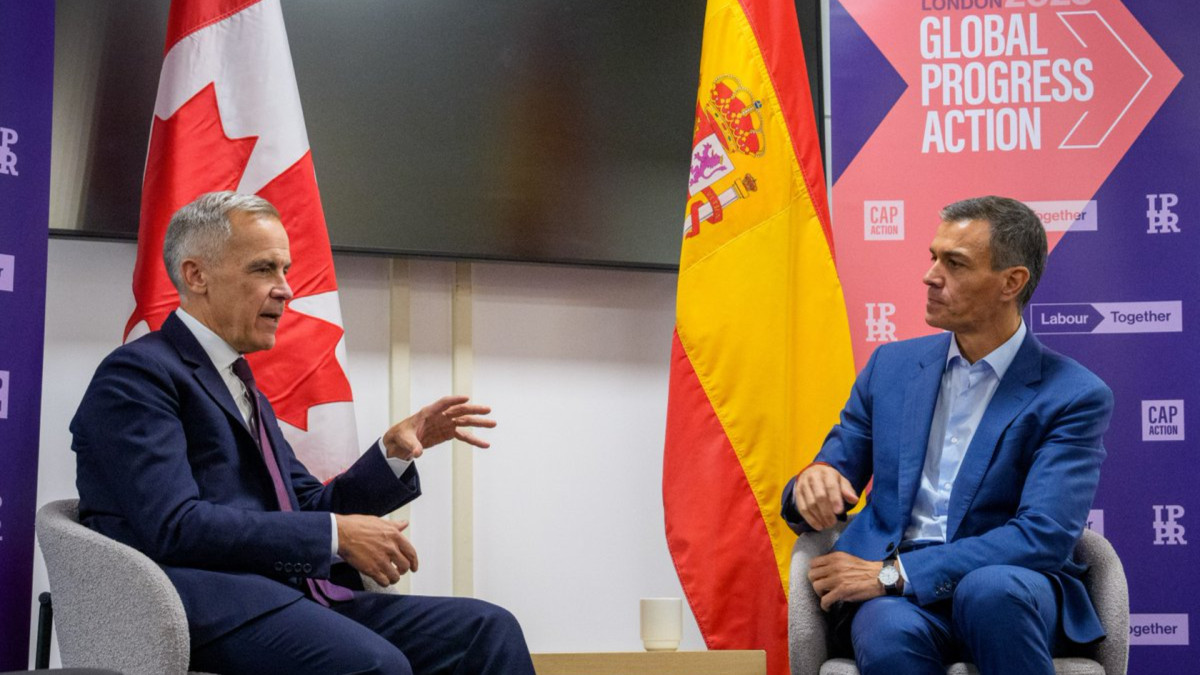
Last January, at the World Economic Forum held in Davos, two speeches captured the full attention of attendees and dominated the headlines of the international press. Trump outlined over seventy minutes his vision of the world: a world of raw power, bullying and anarchy. In response to this, and displaying a courage that one hopes would be more common among European leaders, Mark Carney presented a vision of the world that was diametrically opposed, yet equally realistic.Trump explicitó durante setenta minutos su visión del mundo: un mundo de poder crudo, bullying y anarquía. Frente a ello, y haciendo gala de una valentía que ojalá fuera más común entre los líderes europeos, Mark Carney expuso una visión del mundo diametralmente opuesta, pero igualmente realista.
El primer ministro canadiense no enarboló un discurso nostálgico, endiosando el añorado “orden internacional basado en reglas” ni reclamando una imposible vuelta al pasado. En su lugar, comenzó criticando las hipocresías del viejo orden, centrando la mayor parte de su intervención en lo que ha de venir a continuación: en qué hacer tras esta ya famosa “ruptura”.
“España, como decimoquinta economía del mundo y firme defensora del multilateralismo, debe posicionarse como potencia media a la Carney”
In a world where the law of the strongest seems to prevail, Carney argues that the only salvation lies in the action of middle powers, for it is precisely the countries caught between the rivalry of the great powers that can forge a more hopeful “third way.” These countries, according to the Canadian, must shed the exclusivism of traditional alliances, embracing “variable geometries” and seeking cooperation beyond rigid alignments, wherever there are common interests. Overall, his speech is a call for realism and for middle powers to take on responsibilities.
In this context, Spain, as the fifteenth-largest economy in the world and a firm defender of multilateralism, must position itself as a middle power in Carney’s sense, actively building an alternative to a world of hegemonies and fragmentation. To achieve this, Spain’s foreign policy should be structured around three complementary axes.
The three pillars that must be developed as a middle power
The first—and most important—has to do with European integration and achieving genuine strategic autonomy. Facing growing threats, the European project represents the most effective lever for protecting our sovereignty and influence. On its own, Spain is vulnerable to pressure from the major powers; but united with our twenty-six European allies we can endow ourselves with a weight and a bargaining power that are more than respectable on the global stage. Moreover, beyond our short-term interests, the European Union can be a genuinely positive force in shaping a new global order. Multilateralism is part of our DNA as a political project, and a stronger Union can project that logic of cooperation and rules in an increasingly anarchic world.
“In a world of carnivores, economic competitiveness must be our top priority, ensuring a green and social agenda that complements it.”
In the economic sphere, Spain must decisively back the European competition agenda: aiming to deepen the single market, supporting ambitious multiannual budgets, facilitating the capital markets union, implementing nationally the regulatory simplification agenda and promoting a new issue of eurobonds to unlock new investments. In a world of carnivores, economic competitiveness must be our top priority, ensuring a green and social agenda that complements it.
On trade, Spain must advocate strategic openness and diversification, urging Brussels to clinch new free trade agreements with like-minded partners. The final ratification of the agreements with Mercosur and India is a clear necessity, as is the completion of negotiations with Australia and a possible move toward the CPTPP (Comprehensive and Progressive Agreement for Trans-Pacific Partnership). Amid such global uncertainty, these decades-delayed agreements illustrate Europe’s renewed attractiveness as a reliable and predictable partner, laying the groundwork for greater political and diplomatic alignment.
In defense matters, Spain must continue increasing spending. Given our geographic position, it is understandable that we do not top the allied military expenditure rankings; however, we cannot detach ourselves from the European consensus nor resign ourselves to awkward followership. In Madrid, this effort should not be understood solely as a response to Russia. It is also necessary, given the growing instability of our southern flank and to reduce our structural dependence on the United States.
“We must anchor the discussion in a rigorous analysis of the operating environment and our capability gaps, avoiding letting the effort be reduced to chasing arbitrary political objectives”
Thus, Spain should advocate for a qualitative improvement in spending, pushing to invest in pan-European capabilities, in a common industrial base, in interoperability and in economies of scale. We must also anchor the discussion in a rigorous analysis of the operating environment and our capability gaps, avoiding letting the effort be reduced to chasing arbitrary political objectives. European spending, even without counting the United Kingdom, already ranks as the second largest in the world and more than doubles Russia’s expenditure. The challenge, therefore, is not merely to spend more, but, above all, to spend better and turn that volume into effective military power.
The second pillar of this middle-power strategy concerns the geopolitical articulation of the Iberian-American space. Spain, by history and geography, has a singular role here. Many Ibero-American countries share democratic values and feel increasingly threatened by the collapse of the international order. There is, therefore, a clear window of opportunity to deepen ties. With Mercosur ratified, the European Union will sign trade deals with 97% of Latin America’s GDP.
This should be seen as a starting point. With Spain at the helm, the EU and Ibero-America could strengthen their economic cooperation, promoting joint projects in strategic sectors such as infrastructure or critical raw materials. Likewise, we could coordinate positions in multilateral forums such as the UN, where together we account for about a third of the votes. Finally, Spain should be a firm advocate of Iberian-American political integration, facilitating a sister region with a shared language, culture and values to grow stronger and prosper.
“While many European countries can justifiably be accused of double standards regarding Ukraine and Israel, Spain is seen as a more aligned partner”
Beyond that, approaching Ibero-America would make Spain a privileged bridge to the global South, a hinge force poised to gain influence in the international system. Composed mainly of countries that do not desire, nor can they afford, a world of anarchy and total rivalry, the global South offers broad spaces for convergence. Moreover, Spanish foreign action, including our stance on the Palestinian question, has generated soft power capital in the postcolonial and Muslim world that deserves to be leveraged. While many European countries can legitimately be accused of double standards regarding Ukraine and Israel, Spain is seen as a more aligned partner, one that could act as a credible intermediary between the North and the global South.
The third pillar for Spain as a middle power concerns the strategic management of relations with the United States and China, the two countries that will have the most influence on the international landscape in the coming decades. The relationship with the United States remains fundamental for Spain: the architecture of European security revolves around NATO, and a fully independent alternative seems unthinkable in the short and medium term. Stabilizing the transatlantic relationship is, therefore, essential. It is clear that Trump has questioned the basic premises of the relationship, but his popularity reflects underlying trends in American political and strategic thinking, making it indispensable to move toward greater European autonomy. In the short and medium term, this implies strengthening the European pillar within NATO; but in the long term, Europe must ensure the option to go further. Ideally, a stronger Europe will allow us to rebalance and renew the transatlantic relationship. But if that proves impossible, if the United States continues its bellicose and unilateral drift, Europe must be able to pivot.
“Spain does well in maintaining high-level contacts and in being open to Chinese investment, but it must always seek European unity and reciprocity”
Regarding China, Spain should adopt a more strategic and long-term stance. At a moment when the Trump administration is undoubtedly one of the most destabilizing factors in the international order, a normalization with China has a very attractive symbolic and political value. Even so, prudence is warranted. The European characterization of China as a partner, competitor, and rival (often criticized as schizophrenic) is the most realistic. With China one can and should negotiate. Spain is right to maintain high-level contacts and to remain open to Chinese investment, but it must always seek European unity and reciprocity. The Chinese economic model, increasingly dependent on the export of surplus capacity, poses real problems for Spain and Europe, as well as China’s support for Russia. In this context, Madrid should protect and cultivate possible areas of cooperation with Beijing, but it must also acknowledge these serious structural problems.
In conclusion, Carney’s speech does not offer easy recipes, but it does provide a compass. In a world increasingly dominated by the logic of brute power, middle powers have the responsibility—and the opportunity—to build alternatives. Spain, if it embraces ambitiously its European, Iberian-American and global role, can place itself on that third path: not as a spectator to the fragmentation of the international order, but as one of its architects.
