
After the Second World War, the country wrestled with the delicate balance between safeguarding the right to free expression and curbing hate-based rhetoric.

In the decade following the war, Indiana witnessed a resurgence of the Ku Klux Klan within its borders. The Klan had effectively run the state government in the 1920s, but it lay dormant for the subsequent decade. In 1946, The Indianapolis Star exposed how white supremacists sought to revive the organization and, more alarmingly, to erect a chapter of Columbians, Inc., a neo-Nazi faction that donned khaki shirts and bore red thunderbolt patches, professing a creed of “Race, Nation, and Faith,” and marching with the air of stormtroopers.
State leaders sprang into action to enact an “anti-hate” statute, criminalizing a new offense labeled “racketeering in hatred,” defined as “acting with malice to create, advocate, spread, or disseminate hatred for or against any person, persons or group of persons, individually or collectively, by reason of race, color or religion which threatens to, tends to, or causes riot, disorder, interference with traffic upon the streets, destruction of property, breach of peace, violence, or denial of civil or constitutional rights.” According to The Indiana Law Journal, no other measure during the 1947 session of the Indiana General Assembly drew as much public and legislative support. “The KKK in Indiana must be unrobed and stamped out for all time,” declared Governor Ralph Gates. The anti-hate legislation passed the legislature without a dissenting vote and was signed into law in February 1947. The penalty for “racketeering in hatred” could reach ten years of imprisonment and a $10,000 fine.
The statute was designed to curb racist assemblies and to discipline leaders of hate organizations. Police first invoked the act in September 1947, arresting a Gary man for organizing a student strike in response to the admission of Black students into a high school. The following year, it was used to bar the pro-segregation Dixiecrat Party from appearing on the ballot. By the 1960s, the law was employed against those distributing antisemitic and racist “hate literature,” including members of the American Nazi Party. The ACLU condemned the statute as being “so loosely drawn as to endanger freedom of speech and press.”
The Indiana statute served as a catalyst for parallel laws across the nation. A California measure aimed at “racketeering in hatred” would have imposed a $10,000 fine and a two-year prison term on anyone found guilty of conspiring to “spread hatred because of race, color, or religion.” The concept of “racketeering in hatred” proved so compelling that The Columbia Law Review published a model statute in 1947 to aid legislators. Central to the model law was a provision prohibiting any person from uttering in a public place any false and defamatory assertion about a racial, religious, or national group. The authors argued the statute could enhance freedom of speech by reducing the spread of defamatory content that provoked anger, violent resentment, and a tangible danger to the community, thereby facilitating the “free interchange” of ideas. By 1950, twenty-eight states had enacted or debated such laws. The Georgia Attorney General, citing an emergency triggered by racial hatred, announced a bill to bar people from “associating or organizing for the purpose of creating or spreading hatred by reason of race, color, or religion.” Many believed the moment for the crime of “racketeering in hatred” had arrived….
The year that Indiana enacted its anti-hate measure marked a watershed moment in civil rights history. In 1947, more antidiscrimination statutes were enacted than at any previous point, covering areas such as employment, education, public accommodations, and “group defamation.” Legal scholars described group-defamation statutes as a growing element of civil rights jurisprudence.
Concurrently, 1947 was also a year of spirited discussions about freedom of speech and the “marketplace of ideas.” The marketplace metaphor, as noted earlier, traces back to Oliver Wendell Holmes’s dissent in Abrams v. United States (1919), where he argued that the Constitution’s test of truth lies in a thought’s capacity to win acceptance through open competition. Reacting to the suppression of dissent under fascist regimes, many Americans came to view the robust exchange of ideas as foundational to democracy. By the late 1940s, censorship of film, literature, and other media had fallen out of favor. Restrictions on speech and paternalistic controls were seen as hallmarks of tyranny and totalitarianism, while freedom of thought, conscience, and choice were championed as core individual rights.
The issue of hate speech highlighted a tension between liberal aims of anti-discrimination and the protection of free speech. A 1946 columnist asked, “Perhaps the most ticklish problem in the whole field of law is how we can legislate against group hates without encroaching on the constitutional right to free speech?” Leading jurists faced this dilemma without a neat solution. Civil libertarians lamented the spreading of racial and religious hatred but also feared that curbing hate propaganda might erode the freedom of speech.
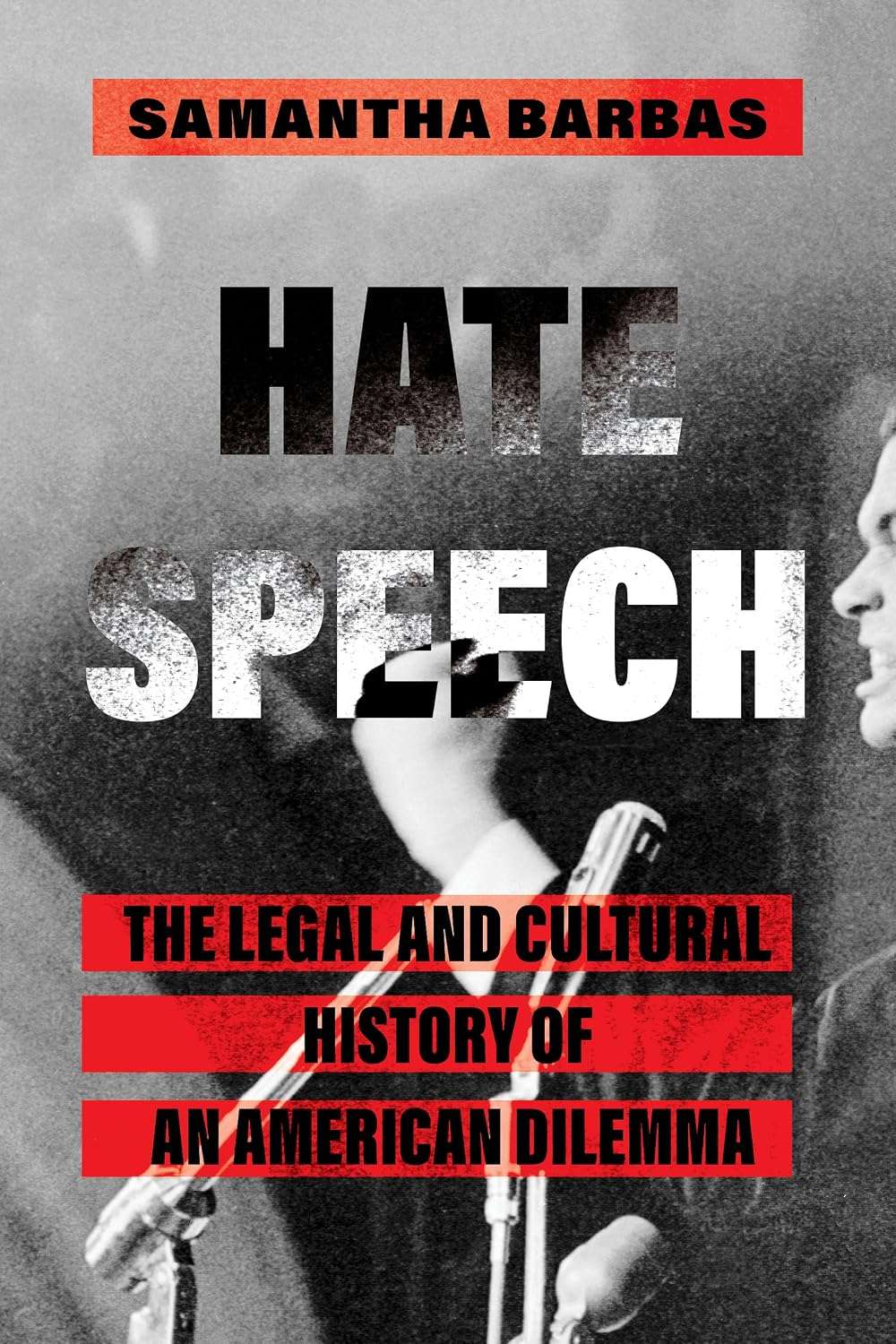
Excerpted from Hate Speech: The Legal and Cultural History of an American Dilemma by Samantha Barbas, courtesy of the University of California Press. Copyright © 2026.
