
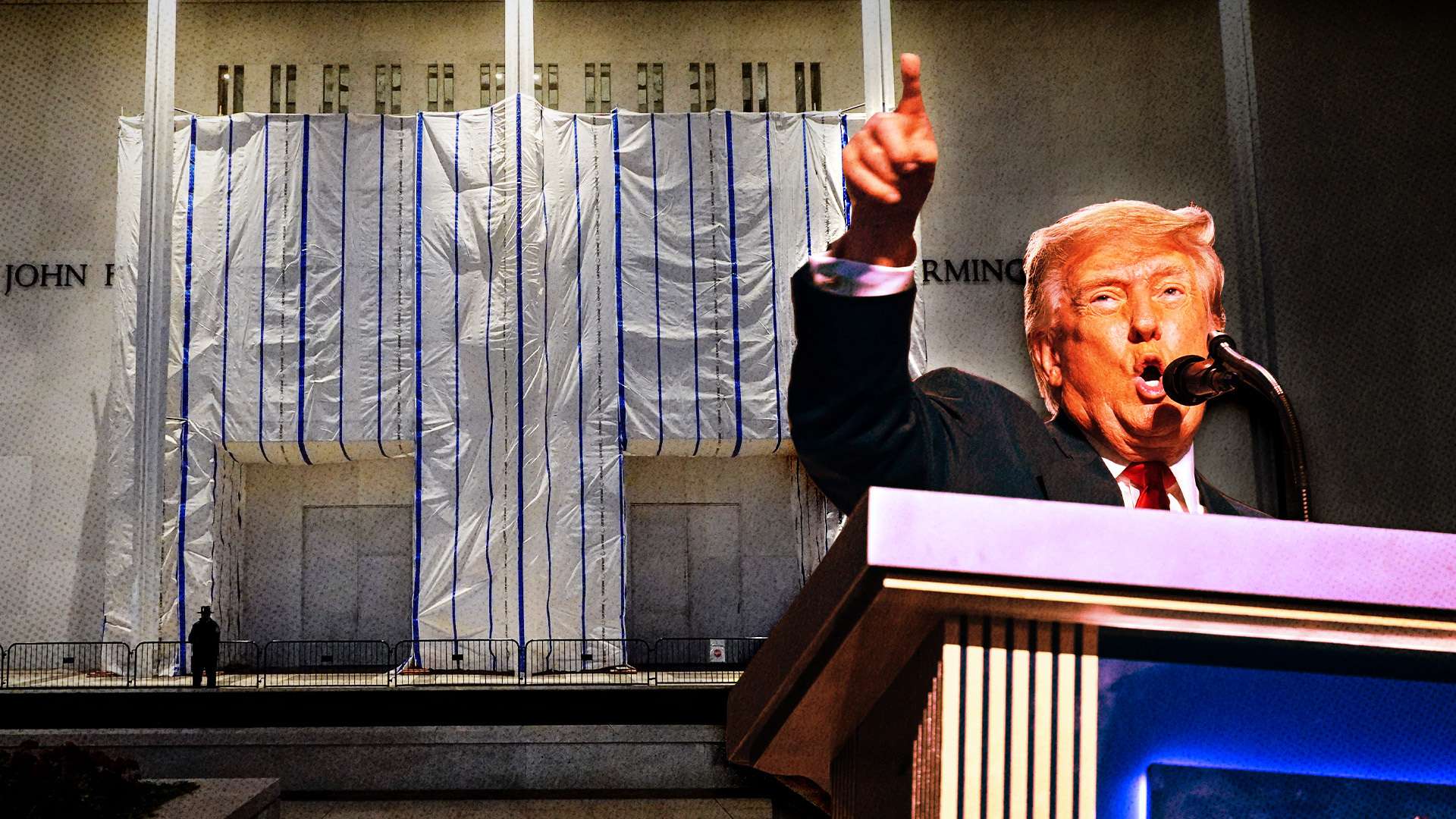
After a federal judge dismissed his attempts at self-aggrandizement, Trump warned that the edifice will eventually be demolished if he does not receive the “recognition” he desires.
Unless President Donald Trump can affix his name to the John F. Kennedy Center for the Performing Arts, Assistant Attorney General Brett Shumate cautioned last month that the building “will deteriorate further into an unsafe, decrepit structure that will be required to be taken down.” On Wednesday, Trump reiterated that threat, telling reporters the Kennedy Center will “end up being ripped down” if he does not obtain the “recognition” he seeks. That evening, an Agence France-Presse photographer captured pictures of Trump glancing at a placard reading “Kennedy Center DEMOLISHED” while seated on Air Force One.
Christopher Cooper, a federal judge in the District of Columbia who is overseeing two suits involving the Kennedy Center, referenced those “recent events” in an order issued Thursday in Beatty v. Trump. Cooper observed that the Kennedy Center’s board of trustees, chaired by Trump and filled with his allies, had stated plans to renovate the building rather than tear it down. If that plan shifts, he noted, the board must inform the plaintiffs “more than 30 days” in advance to “avoid any confusion on that score.”
Trump, by contrast, seems intent on cultivating uncertainty about the Kennedy Center’s fate. In May, Cooper ruled that Congress granted the center its name and only Congress could modify it, meaning the trustees were obligated to remove Trump’s name from the façade. In response, Trump said he was washing his hands of the project.
“Based on the fact that the Radical Left Democrats care more about opposing your favorite President, ME, than saving a dying Performing Arts Center,” he posted on Truth Social the following day, “we are going to be working with Congress to transfer this failing Institution back to them so they can make a determination as to what to do with it….Unless I am free to do what I do better than anyone else, bring this Institution back, physically, financially, and artistically, I have no interest in continuing what could only be a hopeless journey into ‘NEVER NEVER LAND.'”
The president asserted that he had “instructed the Department of Commerce to make all necessary arrangements with Congress to allow a full and complete transfer of this Institution, giving them the responsibility for its Operation, Maintenance, and Management.” In short, Trump decided to take his ball and go home. Yet he later reversed course.
Two and a half months after disavowing any interest in renovating the Kennedy Center, the board of trustees approved a resolution to “recognize and honor President Trump’s current and future existential and unprecedented contributions to the survival of the Center.” The plan was to do so by designating the site the “President Donald J. Trump Plaza” and by adding “renovated and restored by President Donald J. Trump” beneath “THE JOHN F. KENNEDY MEMORIAL CENTER FOR THE PERFORMING ARTS” on the building’s portico.
That proposal bore a striking resemblance to the modification Cooper had rejected in May, which involved inserting “THE DONALD J. TRUMP AND” above the center’s name. And according to Cooper, the new plan was likewise unlawful.
The pertinent statute declares that “no additional memorials or plaques in the nature of memorials shall be designated or installed in the public areas of the John F. Kennedy Center for the Performing Arts.” It grants a few narrow exceptions, none of which cover the trustees’ proposed changes. And another limitation, added by Congress in 2012, bars donor acknowledgments on the exterior of the building.
“Defendants are hereby enjoined from inscribing ‘renovated and restored by Donald J. Trump’ on the main building or renaming the campus the ‘President Donald J. Trump Plaza,'” Cooper wrote in an order issued on Tuesday. “Simply put, Defendants cannot install memorials for President Trump or anyone or anything else at the Kennedy Center without Congress’s blessing. The board resolution contravenes a federal court order and a statute enacted by Congress.”
That afternoon, Trump announced that the Kennedy Center had been closed “for Safety reasons” and “so that it can begin the process of Reconstruction.” Yet he warned that the project “cannot begin” until the U.S. Court of Appeals for the D.C. Circuit reviews Cooper’s ruling. “If the ruling is a negative one, which it should not be, and is not overturned by the U.S. Supreme Court,” he warned, “the Reconstruction and the Renovation of The Kennedy Center will not take place.”
The following day, Trump renewed his threat to raze the Kennedy Center. “For the Trump administration, for me, to get involved and to take that on long term and to carry it or to raise money to carry it, I think that the Trump administration should certainly have recognition because, frankly, if we don’t do that, it’s going to close,” he said. “It’ll end up being ripped down. It’s in very, very bad shape, very dangerous shape.”
Now Trump is not merely taking his ball and going home. He is threatening to puncture, flatten, and shred a ball that does not even belong to him. The Kennedy Center’s construction—originally the National Cultural Center—was financed through a blend of private donations, congressional appropriations, and “long-term revenue bonds held by the U.S. Department of the Treasury.”
As Trump recounts it, he rescued the center, and acknowledging that heroic deed is presented as essential to gathering funds for its renovation. But as Reason‘s Joe Lancaster observed last month, it was Trump’s takeover of the center that sparked a financial crisis: “Before Trump reentered office in January 2025, the Kennedy Center was doing fairly well, even posting a $6 million surplus in 2023.” However, “ticket sales and donations dried up after Trump took control with promises of branding the building and having a hands-on role in selecting events.”
The consequences of Trump’s takeover, Reason‘s Billy Binion noted in June, have been predictably dire: “Ticket sales plummeted, artists canceled en masse, [and] donations reportedly declined.”
Disregarding those points, the Trump administration casts the president’s demand for public adulation as part of a noble bid to revive the Kennedy Center. “An order blocking the Board from properly recognizing President Trump will cause donors to flee, financial contributions to dry up, and structural rehabilitation to stop,” Shumate warned last month. “There will simply not be the expertise or funding necessary to rebuild and renovate this decimated structure. The Trump Administration is ready to go but, without it, the Kennedy Center cannot be saved.”
In other words, this dispute concerns more than Trump. It just so happens that illegally glorifying him is deemed essential to raising the funds needed to revive “a dying Performing Arts Center,” just as illegally demolishing the East Wing of the White House to make way for a vast, flashy ballroom was justified as a matter of national security.
Although these projects may appear to be vanity ventures, Trump maintains that he is acting for the public good, for which we should all be grateful. In the Kennedy Center case, all he seeks is a symbolic acknowledgment, and he is perplexed that something as mundane as the rule of law could stand in his way.
