
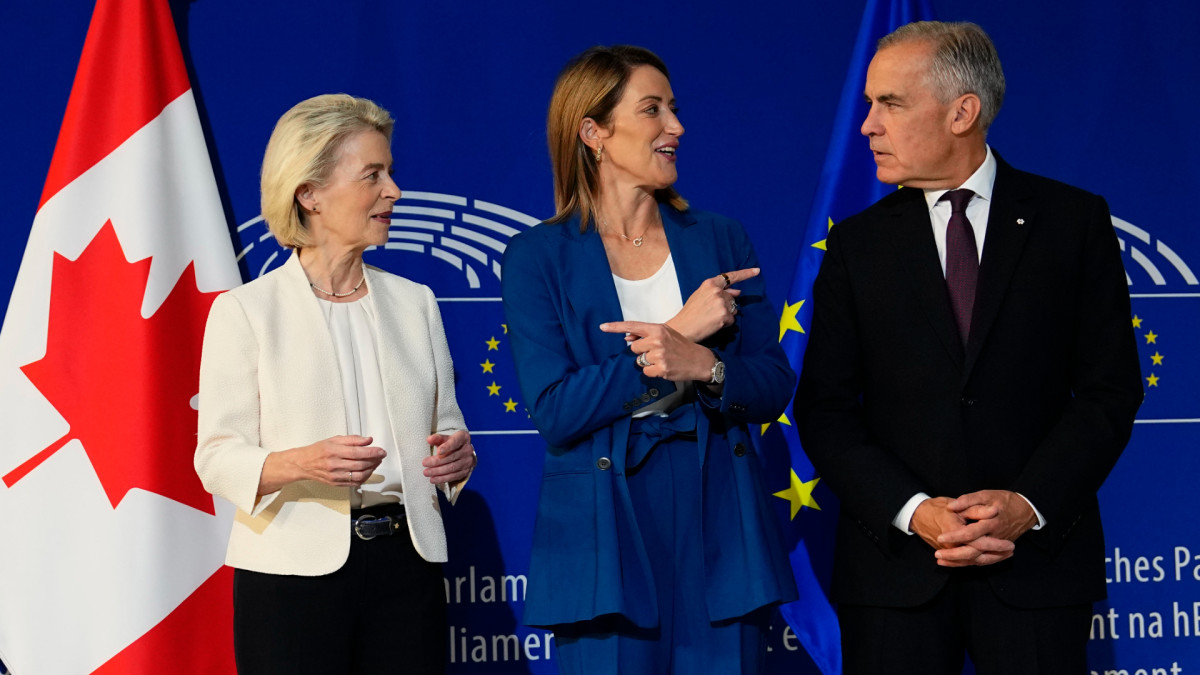
In recent years, the State of the European Union (SOTEU) has increasingly served as a platform for unveiling unforeseen policies that mark the start of Brussels’ new political cycle. Yet perhaps no SOTEU has carried the weight of this latest edition. The President of the European Commission, Ursula von der Leyen, used the moment not only to unveil the EU KIDS Act, which this Thursday the European Commission formally presented as a legislative proposal and which bans social media accounts for children under thirteen, but also to express her intention for Canada to become the first “associate member” of the European Union.
This proposal has attracted attention both for the plan to create a category of “associate member,” unprecedented in the Union, and because of the questions surrounding its viability. But for international analysts, this news is hardly surprising. Since his election victory in 2025, Mark Carney, who was present in Strasbourg during the SOTEU, has become Europe’s quintessential ally. Not only has he distanced himself from the tendency of many foreign politicians (and several Europeans) to undermine the European project, but he has also been a steadfast admirer of it, and gradually he has increased his country’s integration with the EU.
That willingness was confirmed this Thursday before the European Parliament. Carney backed the proposal to deepen the relationship between Canada and the EU, although he downplayed the importance of the label it will ultimately carry: for the Canadian prime minister, the substance of the proposed association matters more than its name.
The most significant development so far had been the signing of a Security and Defence Partnership with the EU in June 2025, leading to the entry of non-European companies into the European financial instrument Security Action for Europe (SAFE) for the first time in February of this year.
“Since his election victory in 2025, Mark Carney, present in Strasbourg during the SOTEU, has become Europe’s quintessential ally”
The turning point and origin of this new alliance occurred during the latest World Economic Forum, in January of this year in Davos, where the Canadian prime minister delivered what is probably one of the most important speeches in international politics of the last decade and, certainly, the one that has best read the growing geopolitical rivalry in which we live. In it, directly invoking the longed-for strategic autonomy of the EU, he spoke of the pressing need for the “medium powers” to join forces so as not to fall into the subordination of the great powers and their clear indifference towards the rules-based international order, contextualising it through the now iconic metaphor “if we are not at the table, we are on the menu”. Ursula von der Leyen was also present at that summit, and it was clear that there was a personal affinity with the European leader and, more importantly, a political synergy.
The geopolitical vision of both leaders is extremely similar. The two are in a race to diversify their trade alliances: since von der Leyen has been President of the Commission, free trade agreements with Vietnam and New Zealand have entered into force, the agreement with Mercosur has been provisionally applied and free trade agreements have been concluded with India and Australia; and in just over a year and a half of Carney’s mandate, Canada has signed twenty trade and defence agreements on four continents, with the intention of continuing on this trajectory to make Canada the most interconnected economy in the world. Both have prioritised projects to protect their critical infrastructure and supply chains, and strengthen ties between their markets, increasing trade in goods between the EU and Canada by 76% since the provisional application of the Comprehensive Economic and Trade Agreement (CETA) in 2017. Likewise, both have placed sustainability and the interconnection between energy independence and economic security at the centre of their public policies, while continuing to defend an increasingly forgotten multilateral system and alliances based on loyalty to democratic values. And, not least, both have made their political and military support for Ukraine a constant in their respective political trajectories.
“Both have prioritised projects to protect their critical infrastructure and supply chains, and strengthen ties between their markets”
Knowing all this context, the announcement made from the podium of the European Parliament ceases to cause so much shock and begins to be seen as a natural progression of recent diplomatic developments, which have led to the strengthening of relations between the EU and Canada to a level that has not existed until now. Despite the reception of the news with applause from almost the entire chamber (including from other political forces opposed to the European People’s Party, to which the President of the Commission belongs), consolidated in an embrace between Ursula von der Leyen and Mark Carney, defining the implementation of this proposal as a difficult task does not do justice to its complexity. From questions of legal legitimacy to the possible reaction of other international actors, the following are some of the main complications that both the EU and the Canadian government will inevitably have to face when making the idea of Canada as an “associate member” a reality.
The legal legitimacy of the proposal
Article 49 of the Treaty on European Union states that “Any European State which respects the values referred to in Article 2 and is committed to promoting them may apply to become a member of the Union”.
“Defining the implementation of this proposal as a difficult task does not do justice to its complexity”
Based on the legal precept from which the general conditions of entry into the Union are derived, it can be said that Article 49 establishes three requirements for this application to be taken into account: a geographical requirement (“Any European State”), an axiological requirement (“which respects the values referred to in Article 2”) and a teleological requirement (“and is committed to promoting them”). While Canada more than meets the latter two requirements, since it is one of the states most committed globally to respecting and promoting the values mentioned in Article 2 (“human dignity, freedom, democracy, equality, the rule of law and respect for human rights”), the distance imposed by the Atlantic Ocean would completely disqualify the North American nation from meeting the geographical requirement.
There are precedents that attest to the strictness of the European institutions in complying with this territorial criterion, taking into account what for centuries has been geographically understood as “Europe”. The application made in 1987 by the Kingdom of Morocco to join the then European Economic Community was immediately rejected “on the grounds that Morocco was not a European state”. Despite years of constant diplomatic efforts, Turkey’s accession process, a country of more than eighty-seven million inhabitants located between Europe and Asia, is stalled, with Montenegro being the only candidate with realistic prospects of becoming the next EU Member State in this decade. Based on these examples, numerous jurists and political commentators have argued that “European State” refers not only to a territorial requirement, but also to a cultural affinity.
In the case of Canada, we are faced with several unknowns. The most important point is to establish that we are not dealing with an application for full EU membership, in which case Article 49 would apply: we are dealing with a new political model of cooperation, and the European Commission is aware of this. Just before uttering the words “associate member”, President von der Leyen said that it was her desire to “bring the relationship with Canada to the highest level possible“. The explicit acknowledgement of the limitations on its capacity to act serves as an indication that we are not dealing with a political process resembling the classic accession model, but rather something whose final form remains unclear.
“We are not dealing with an application for full EU membership, in which case Article 49 would apply”
We also do not know what benefits and responsibilities this new category entails: Access to the internal market through a formula similar to the European Economic Area? Participation in Schengen? Some kind of obligation to coordinate Canada’s foreign policy with the Common Foreign and Security Policy? Does it require the signing of a new treaty? Despite the doubts, what is certain, given the linguistic, cultural and political connections shared between the EU and Canada, is that this initiative has revived the idea that the adjective “European” included in Article 49 has a highly cultural and discretionary component on the part of Brussels.
Possible disagreement of Member States
The legal form of this new relationship has not yet been defined. If it were structured as an association agreement, its conclusion would require unanimity in the Council of the European Union and the consent of the European Parliament. While the inherent political nature of the European Commission is to continue the growth of the EU, this is not that of the Member States, with the Enlargement Policy being one of the most contentious in the Union. Many are reluctant because of the political, but above all economic, implications of integrating a new State into the EU system. These objections usually come hand in hand with doubts about the economic capacity, democratic quality and rule of law of the candidates. Again, with nuances, of course, this would apparently not pose a great challenge for Canada, being a prosperous and developed country. But EU Member States do not always like to follow the guidelines sent from Brussels. Hours after the speech, there were already bittersweet reactions across Europe. Although Canada’s relations with all EU Member States are positive, and there also seems to be a good dynamic between Mark Carney and European leaders as a whole, it is possible that some Member State will reject this idea because of its future implications. Would Cyprus accept Turkey as an associate state? Would Denmark accept the United States after what happened with Greenland? There are many unresolved questions.
In addition, there is a major precedent showing that relations between the EU and Canada do not always develop so fruitfully. Regardless of the economic benefits in quantitative terms that it has brought to trade relations between the two actors, CETA has not been ratified by all Member States’ parliaments due to numerous labour, environmental and consumer protection concerns, among others. Having been signed by all Member States, the agreement has worked and is provisionally applied, but this shows that the dynamics between Ottawa and Brussels are not always equally fluid. A premonition of the obstacles that lie ahead?
The Trump’s anger
During her speech in Strasbourg, Ursula von der Leyen stressed, demonstrating great foresight, that “this is not an alliance against anyone else, but for our common strength”. This clarification has been of little use, since after the end of the SOTEU, the President of the United States, Donald Trump, has once again threatened to impose new tariffs on Europe, or even ban the entry of some European products into the US market, unless it is demonstrated that this agreement (which he has described as “laughable”) was made with “good intentions”.
“Canada, like the EU in the summer of 2025, is currently in the midst of a trade war with the United States”
Canada, like the EU in the summer of 2025, is currently in the midst of a trade war with the United States. After several months of negotiations for a new trade agreement between the United States and Canada, Mark Carney decided on 21 August to call his negotiators back to Ottawa, claiming that the American administration had imposed “unacceptable conditions”, including control over possible future trade agreements between Canada and the rest of the world (completely contrary to the policy proposed by the Canadian government) and restrictions on the use of the French language, an aspect of great sensitivity for Canadians (and which would certainly not pose any problem in Europe). Defusing the hostility toward this agreement emanating from Washington is another great challenge that Canada and the EU face in this new way of understanding belonging to the European project. While Mark Carney’s Canada wants to adopt the EU’s motto, “United in Diversity,” in a reduced, or rather, “associated” way, for the moment it seems that Ottawa and Brussels will be united in adversity.
