
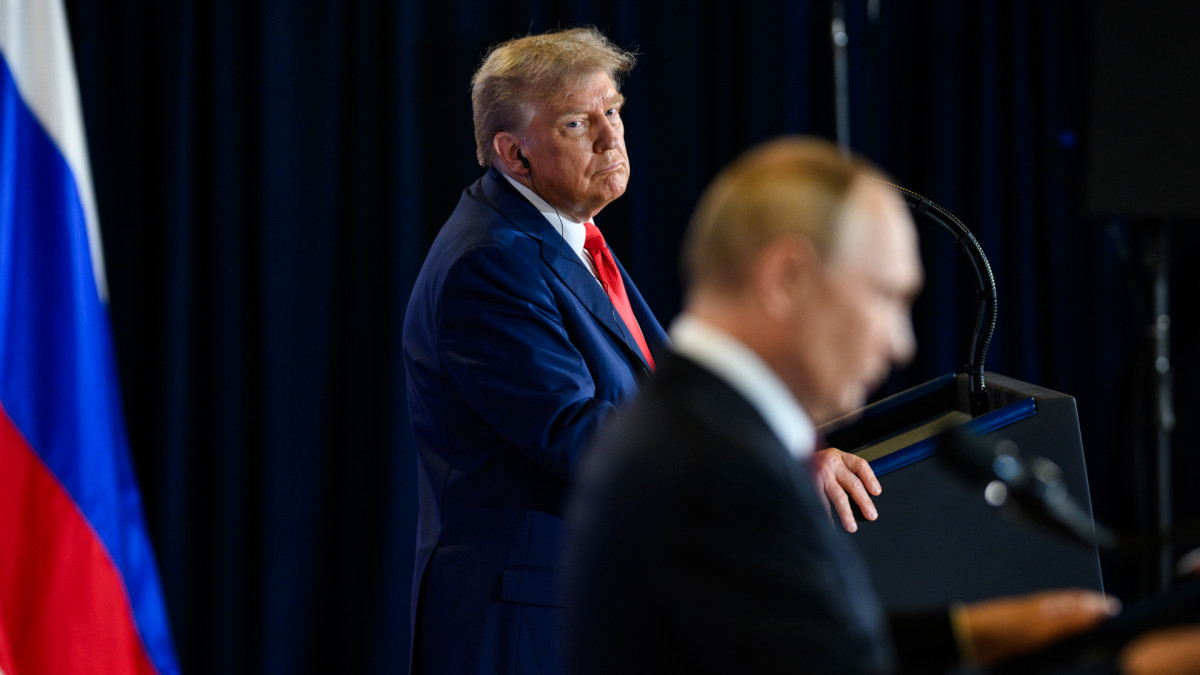
The Twenty-Eight-Point Peace Plan Between Russia and Ukraine — initially presented publicly as a “U.S. plan” — is, in fact, a draft for Ukraine’s capitulation. For four years, at the cost of tens of thousands of lives, Ukraine has not only defended its own territory against Kremlin aggression; it has also shielded Europe, buying time for European countries to reinforce their defenses against Russia’s escalation strategy, backed by China.
It is highly likely that the so‑called “Trump peace plan” was written in Russia and injected into the information space to be later presented as an “American plan.” This suspicion is supported by statements from US lawmakers, who announced at a press conference on November 22 that the secretary of state (Rubio) told them by phone that the twenty‑eight points “were not an American plan,” but rather “the Russians’ wish list”:
“He (Secretary Rubio) made it very clear that we are the recipients of a proposal that was delivered to one of our representatives,” said Senator Mike Rounds. “It is not our recommendation. It is not our peace plan. It is a proposal we received and which, as intermediaries, we simply shared—and did not publish. It leaked.”
“It is very likely that the so‑called ‘Trump peace plan’ was written in Russia and injected into the information space to be subsequently presented as an ‘American plan’”
The independent Senator Angus King said that Rubio told them the plan “was not the Administration’s plan, but “a Russian wish list.” Rubio later tried to qualify these statements, saying that it was only a document prepared by US representatives after conversations with Moscow and Kyiv. Yet nothing in the original list resembled a commitment: it was, at heart, a capitulation plan, actively promoted by the Kremlin’s negotiator, Kirill Dmitriev, possibly with the involvement of the American representative Witcoff, who allegedly handed it to the President of the United States, who seemed to endorse it, perhaps without even reading it.
“Zelenskiy prepares the Ukrainian people for capitulation,” “Zelenskiy spreads zrada (pessimism and panic) for the first time in his daily address,” “Capitulation or hunger,” “the collapse of Kyiv’s policy,” “The twenty‑eight Trump points that will crush Zelenskiy” — these are how Russian propaganda outlets described the so‑called “American peace plan” of twenty‑eight points.
Just one day later, after a wave of criticism from European leaders and Zelenskiy’s declaration that Ukraine would be forced to “lose a key ally or lose dignity, freedom and justice by trusting someone who attacked twice,” Trump clarified that the “peace plan” was not definitive. The secretary Rubio then hurried to present it as a simple general document offered as a starting point for negotiations.
On Saturday, November 22, the world first watched, with surprise, how Washington appeared to pressure Ukraine — prompting Zelenskiy’s statement — and then, with astonishment, a public clash on X (Twitter) between journalists and US senators, citing Rubio’s claim that the plan was a Russian wish list, while the State Department and Rubio himself tried to refute that interpretation in real time, apparently to prevent the White House from appearing as a political center disseminating Russian demands.
Europe in the face of American unpredictability
These events once again emphasize the unpredictability of American policy — evident since early 2025 — at the most dangerous geopolitical moment in decades: while Russia and its allies wage a war in Ukraine, and the entire Russian state apparatus — its economy, propaganda, social structures, and institutions — has been recalibrated for years of conflict, clearly beyond Ukraine.
But if the unpredictability and transactional approach of the new Administration do not surprise, what now becomes clear is the complete lack of European preparation to operate under conditions that were foreseeable. The imminent threat is not faced by the United States: it is faced by Europe, especially the EU states near the Russian borders.
“Russian Telegram channels now publish messages explaining how Europe is preparing to attack Russia, fabricating a pretext for future aggression against European states.”
The Russian propaganda campaign of April 2025 portraying “Nazi Europe” as a threat to Russia — framed by the Foreign Intelligence Service as “a common challenge for Moscow and Washington, just like in 1945” — was a clear attempt to sow division between the United States and Europe. But if disagreements among Western countries can be managed, the Kremlin’s objective of escalating with Europe is non‑negotiable. The intensified hybrid operations this autumn in Romania, Poland and other states — drone incursions, fighter jet alerts and airport closures — are proof of that. The Kremlin justified its invasion of Ukraine with a supposed “Nazism,” and now claims that the “Nazi Europe” is the cause of a conflict almost inevitable with Europe, presenting its aggression as “forced self‑defense.” Pro‑Russian Telegram channels with millions of followers now publish messages explaining how Europe is preparing to attack Russia, clearly fabricating a pretext for Russia’s future aggression against European states.
The Kremlin’s hybrid war is already on European soil
Although Russia is effectively exhausted by the war in Ukraine, it is worth remembering: the Baltic states have a combined population of just over 7 million, while Ukraine — fighting for nearly four years — surpasses 40 million. It is also crucial to remember that Kremlin propaganda militarizes its enclave Kaliningrad by portraying it as a “besieged fortress,” when, in fact, the oblast serves as an advanced base for threats to Europe, together with Belarus, whose security services function de facto as a branch of the Kremlin’s FSB.
“An attack in the Suwałki Gap — the border between Lithuania and Poland — or in the Baltic States would require only a minimal effort from Russia, but if NATO does not respond immediately, the consequences would be devastating.” Beyond the fate of the Baltic nations — lives, sovereignty, stability — would be at stake the entire architecture of modern security and the credibility of the alliance.
So, is Europe prepared to stop merely watching debates on X between U.S. officials and journalists and take responsibility for its own security? To move from a “coalition of the willing” to a “coalition of those who act,” a “coalition of defenders” and a “coalition of responsibility” grounded in values and professionalism?
This implies: monitoring and analyzing the Kremlin’s hybrid war in Europe, a proactive countermeasure strategy, a transition from rhetoric to real protective actions — not in five years, but immediately — and strengthening defense capabilities and the internal and external containment of the Kremlin. If these steps are not taken now, tomorrow may be too late. If Europe — and perhaps Canada, Japan and other value‑based democracies — do not today form a central hub of independent strategic power, tomorrow will be hard to explain to their citizens why airports are closed or, worse, why they face direct aggression from Putin. Claiming that a superpower on the other side of the ocean is temporarily unpredictable will not be a sufficient explanation.
“In Spain there is practically no real awareness of the Kremlin threat. Otherwise, Russian officials and propagandists would not have chalets in all the tourist centers.”
Do Europeans understand Russia’s instruments and strategy? Not really. This understanding varies greatly according to historical and geographic distance. In Spain, for example, there is practically no real awareness of the Kremlin threat. Otherwise, officials and Russian propagandists would not have chalets in all the tourist centers, and the Dia supermarket chain (owned by the Russian oligarch Mikhail Fridman) would not be sponsoring events in Madrid. Our own group of Russian exiled political figures was, in practice, abandoned by the Spanish Ministry of Foreign Affairs in September 2024. First, the Ministry assured us it would assist with legalizing in Spain to support our anti‑Kremlin political network — highly effective — but then left us in irregular status, ignoring letters and calls for more than a year, despite several major Spanish media outlets reporting on this betrayal.
Poland, Lithuania, Latvia and Estonia understand Russia better because they are directly exposed to its threat. Less so in Germany, where the legacy of World War II still distorts current perception, even though in practice the Kremlin today resembles a fascist regime: it kills tens of thousands of Ukrainians and Russians, holds neighboring nations as hostages and maintains a constant threat of invasion in Europe. Many European countries continue hosting debates about possible postwar arrangements — still feeding the idea that cooperation with Putin’s regime could be possible.
Meanwhile, Russia has reorganized not only its economy but even its education system for a long‑term war: in some schools, children are taught to operate drones, and veterans visit classrooms to instruct about “Nazism in Kyiv and Europe.” Do European governments know that thousands of Kremlin disinformation accounts exist on Telegram, TikTok, Instagram, Facebook and other platforms — in all major European languages — designed to sow chaos and undermine democratic values? Some do, but this is only the tip of the iceberg. There are barely any counter‑propaganda campaigns, despite the Kremlin openly waging a hybrid war against the democratic world.
In a time of rising threats from authoritarian regimes, there will be no possibility to simply wait for the storm to pass. Survival will depend on unity and leadership — grounded in values and professionalism — that Europe must provide now. From a coalition of the willing to a coalition of those who act
