
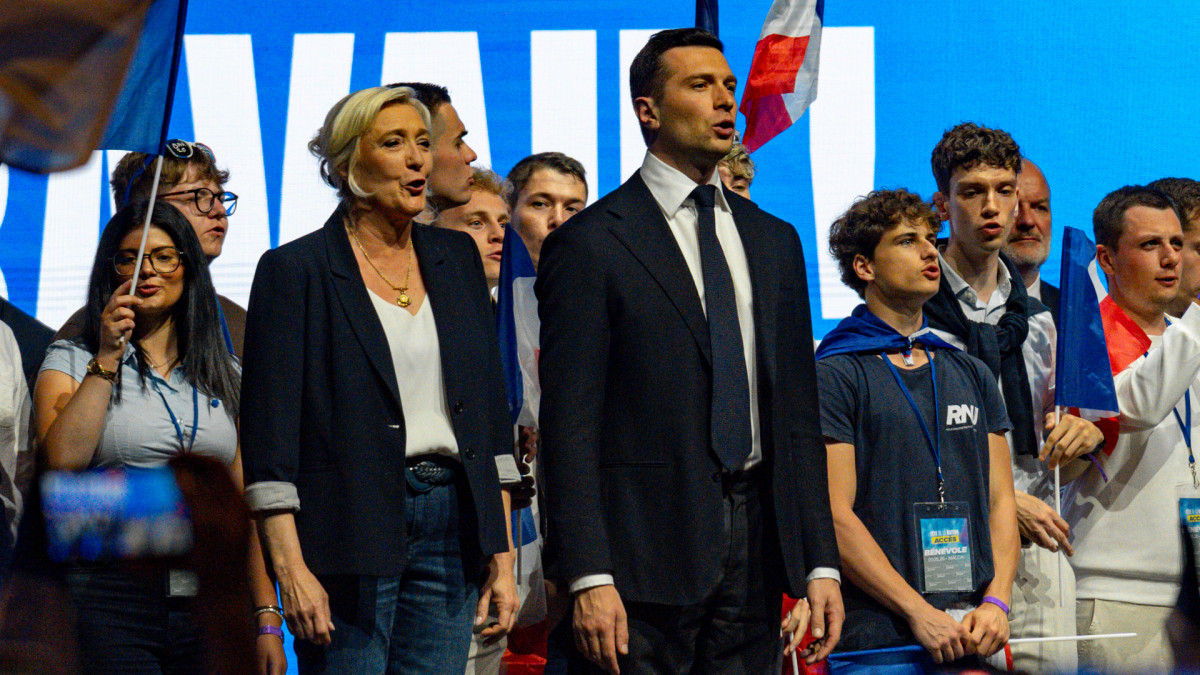
On September 18, Emmanuel Macron gathered at the Élysée Palace with the leaders of the parties represented in the French Parliament. The heads of intelligence and security briefed them on the deterioration of the international situation, including the intensification of Russian hybrid operations. The following day, Marine Le Pen and Jordan Bardella issued a joint statement condemning Moscow’s hostile actions against France and its allies.
The track record of its signatories lends weight to the declaration. The former National Front received in 2014 a loan of 9.4 million euros from a Russian bank. Le Pen defended recognizing Crimea as Russian territory and was received by Vladimir Putin during the 2017 presidential campaign. The invasion of Ukraine led the Rassemblement National (RN) to condemn the aggression, but it did not end its reservations about sanctions and support for Kyiv.
The statement begins by denouncing Russia’s decision to place under temporary administration the assets of French and European companies in Russia. After that, Le Pen and Bardella condemn the destabilizing operations against European companies and acknowledge that they seek to present support for Ukraine as the consequence of an escalation provoked by Russia’s own agents. They warn that France must not facilitate Moscow’s war aims and claim that its foreign policy is decided in Paris, not in Russia. A significant assertion of national sovereignty from people who for years defended a privileged relationship with the Kremlin. The same communiqué, however, expressly reserves for the RN the right to review the level and the conditions of French financial aid to Ukraine.
The question is not whether the RN has finally figured out who Putin is. The interesting point is that the intensification of Russian operations is making it harder to maintain an ambiguity that allowed certain European actors to relativize the threat from Moscow while upholding the defense of national interests.
“The intensification of Russian operations is making it harder to maintain an ambiguity that allowed certain European actors to relativize Moscow’s threat”
Russia has not only just now begun acting against Europe. The annexation of Crimea, the large-scale invasion of Ukraine, political meddling, cyberattacks and the instrumentalization of European energy dependence are precedents of a prolonged confrontation. None of this was unknown to those who argued for a rapprochement with Moscow. What has changed is the intensity of the threat and the risks that Russia seems willing to take. The gray area is darkening.
The attempted attack with an explosive-laden drone aimed at a Ukrainian transport aircraft at the German airport in Leipzig illustrates how far the limits of this confrontation are being moved. The RN’s statement links the operation to Russian intelligence services. In addition to this episode are the drone incursions into European airspace and other actions against strategic interests. Not all incidents carry the same degree of attribution, but their accumulation and the risk of casualties blur the boundary between hybrid pressure and open confrontation. The more this risk grows, the harder it becomes to treat Russian actions against Europe as a problem separate from the war Moscow is waging in Ukraine.
“Not all incidents have the same degree of attribution, but their accumulation and the risk of victims blur the boundary between hybrid pressure and open confrontation”
Even after February 2022, certain parties were able to justify their reservations about sanctions and military aid to Ukraine on grounds of economic costs or the risk of escalation. The Russian threat did not disappear from that discourse, but it remained subordinated to other interests.
The intensification of hybrid operations makes it harder to maintain that separation. If Moscow uses intimidation against European countries to weaken their support for Ukraine, the decisions about that support are part of the response to the threat, not a separate strategic debate. Recognizing Russian pressure and reviewing aid to Kyiv can be compatible positions, but their consequences cannot be examined separately.
That pressure is not leading all European forces to review their relationship with Moscow in the same way. In Germany, the AfD maintains its bet on normalizing relations with Moscow and questions the military support to Ukraine. While Le Pen and Bardella condemned the Russian operations, reports surfaced of preparations for a possible 2027 meeting between AfD leaders and Kirill Dmitriev, Putin’s economic envoy, to address the restoration of Russian gas supplies to Germany. The meeting would be conditioned on an agreed peace framework between Russia and Ukraine.
“Recognizing the pressure Russian and reviewing aid to Kyiv can be compatible positions, but their consequences cannot be examined separately”
However, Moscow’s condemnation does not clarify what support RN would be willing to sustain in the face of that same Russian pressure. The reservation about financial aid, as expressed in the communiqué, was preceded by even more explicit statements. In early September, RN vice-president Louis Aliot defended cutting the flow of French aid to Kyiv. Le Pen stated on September 16 that France could continue providing material and military training to Ukraine, but that France could no longer continue providing financial aid. Three days later, both leaders denounced that Moscow uses intimidation to weaken European support for Ukraine.
There resides the tension that the communiqué leaves open. The RN asserts its right to review how much and how France helps Ukraine, but that decision cannot be examined apart from its consequences on Ukrainian resilience, the terms of any negotiation, and Moscow’s calculations. A reduction in financial backing, without equivalent changes in the objectives or the Russian behavior, could alter both Kyiv’s negotiating position and the Kremlin’s expectations about European resistance. Maintaining military and financial support to Ukraine while keeping the diplomatic path open are not opposing objectives. Diplomacy is needed to find an exit from the war; Ukrainian resilience matters for the conditions under which that exit can be negotiated.
In the RN’s case, ambiguity may be shifting from describing the threat to choosing the tools to confront it. The scope of Le Pen and Bardella’s communiqué will be known not by the force of a condemnation, but by the decisions on Ukraine, sanctions and the costs of deterrence.
