
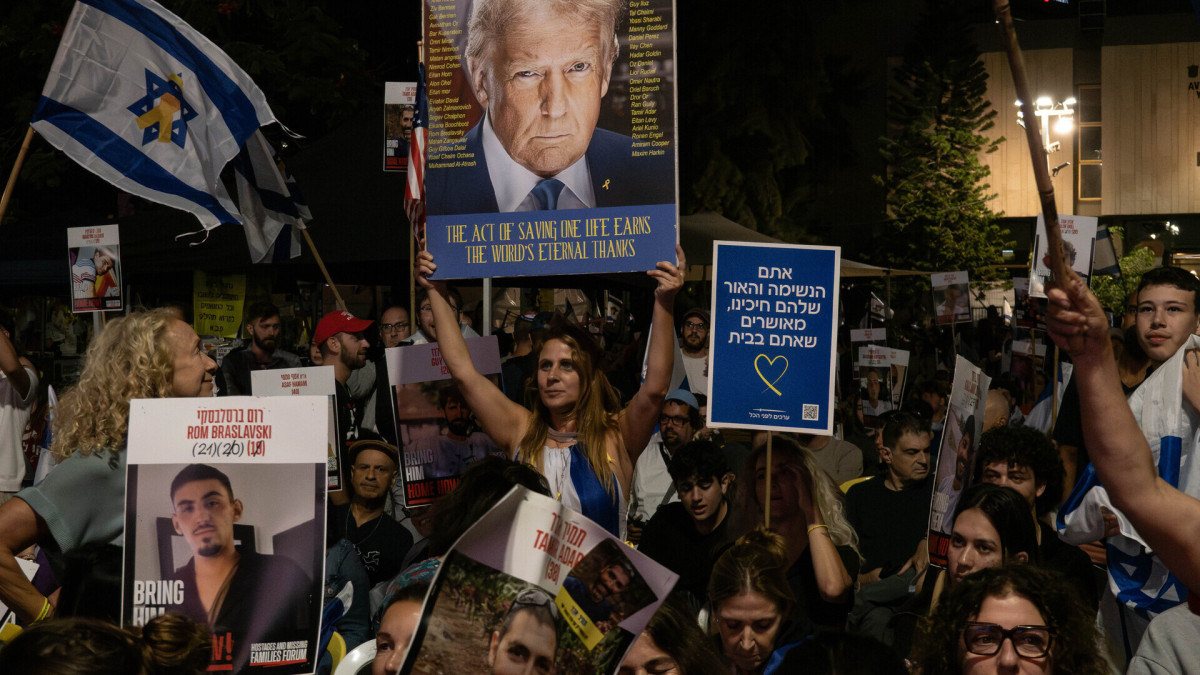
An anonymous phrase is often cited as saying that diplomacy is the art of writing tragedies with smiles. This week, after two years marked by pain and devastation —begun with the October 7, 2023 attacks and prolonged by relentless bombings and the Israeli occupation of Gaza— images of hope finally arrive from the Middle East. The acceptance by Hamas —the terrorist group that controls the Gaza Strip— of the peace plan promoted by the United States, which requires Netanyahu’s government to bow to international pressure, opens a slim sliver of optimism in a region that has grown all too used to tragedy.
As a professional who has dedicated his life to international relations, and as a firm believer in multilateralism as the best tool to preserve peace in any corner of the world, I have visited Gaza and the State of Israel on several occasions and have met many more times with public officials from the Middle East, geopolitics experts, and Western policymakers with a deep understanding of what has happened — and continues to happen — in the region.
Yet this is the first time I write about the terrible events we have witnessed over the past two years. Do not misunderstand me: I deeply value the efforts of those who, amid a drama such as this, have tried to explain the conflict with the greatest possible objectivity, and even of those who have expressed their views with passion and conviction. But the petty attempt to turn the suffering of Palestinians and Israelis into a weapon of polarization —as if it were just another cultural war within our own borders, while others endure the real war thousands of miles away— strikes me as simply repugnant. Both sides alike.
For this reason, now that, finally, international pressure seems to have achieved a cessation of bombardments, an opening of the Gaza Strip to reconstruction and the entry of humanitarian aid, as well as the return of hostages to their homes and the revival of hope for a someday just and lasting peace founded on the coexistence of two states, I believe it is appropriate, with calmness and without a spirit of confrontation, to put down on record a few reflections. Trusting that they may prove useful to those who wish to form an opinion on a matter that, in order to become history one day, requires us all to make the effort to understand it in all its complexity.
“The October 7 attacks sought to destroy the diplomatic instrument that has brought the greatest hope to the Middle East in the last decade: the Abraham Accords”
First and foremost, it is essential to condemn and lament the terrorist attacks of October 7. Not only because they represent an inhumane act of violence against the Israeli population, but also because their intention and execution were aimed at destroying the diplomatic instrument that has brought the region’s greatest hope in the last decade: the Abraham Accords. No one should be fooled; that horror was a clear attempt to derail the peace that the Abraham Accords carried.
These agreements, signed between Israel and the United Arab Emirates, Bahrain, Sudan, and Morocco, achieved something that seemed impossible: normalizing diplomatic, economic, and cultural relations between Israel and several Arab states, breaking decades of political isolation among them. Their success sparked the interest of other regional players: Oman, Mauritania, Comoros, Somalia, Djibouti, Indonesia, Pakistan, and, the elephant in the room, Saudi Arabia.
In this story, the main losers were Iran, which needs regional instability to strengthen its rivalry with Saudi Arabia and to use the West as a scapegoat, and Qatar, which benefits from maintaining an ambiguous stance. The interest of these two actors seems to be the only rational explanation for how Hamas, with its well-known ties to Tehran and Doha, managed in a single day what it had failed to achieve for years: to breach the defenses of one of the world’s best-prepared armies and to attack Israel with such virulence. The attack was not planned as a last resort to years of Israeli occupation, but as a deliberately planned military operation aimed at a specific outcome.
The right to defend oneself and international law
In second place, it is evident that Israel has the right to defend itself and to fight terrorism, but no state can place itself above international law. Israel is a Western democracy (even though in recent months it has shown clear signs of a profound democratic crisis) and precisely for that reason we must condemn without hesitation the disproportionate bombings, the blockades that prevent the arrival of humanitarian aid, the failure to comply with UN resolutions prohibiting illegal settlements in the West Bank, and the dehumanizing rhetoric of some of its ministers, recognizing them for what they are: repeated and systematic violations of international law.
“Historical reasons for Israel, its exhaustion in the face of terrorism, and its role as a sentinel against hostile powers such as Iran can be understood, but its illegal actions cannot be justified”
We can understand its historical reasons, its fatigue in the face of terrorism, and its role as a sentinel against hostile powers such as Iran, but we cannot justify its illegal actions or look the other way when limits are exceeded. To anyone with common sense —and there are many in Israel and Palestine, as there are in any place— the deaths of civilians on both sides pain us equally. For that reason, with even more reason, those of us who observe this horror from a distance have a moral obligation to express our sorrow for all victims with equal force. In offering condolences for barbarism there can be no sides.
The role of Trump and the United States
In third place, it is important to try to decipher the impact of these two years on the new international order. Trump entered the electoral arena promising to pull the United States out of the world and assuring that America was not there to solve problems that were not exclusively American. Not only that, but he went so far as to claim, in the most flippant and horrendous possible way, that his stance on Gaza was to build a vacation resort. Justifications like these are not acceptable for a president of the United States, or for anyone with decent standards.
“Trump is sufficiently unpredictable to make Europe take its own security seriously, and, at the same time, it seems that the U.S. is unwilling to abandon its role as hegemonic power”
Yet in the end, the United States lived up to its responsibilities by stepping in to curb the regional escalation when Israel bombed Iranian targets and Iran replied against Tel Aviv, forcing Netanyahu to restrain his excesses (even prompting him to apologize to Qatar from the Oval Office) and ultimately helping, alongside the Arab countries in the region, to negotiate a historic peace agreement that opens the door to hope. The fact that the president did so merely to win a recognized international prize does not, in any case, detract from the merit of the outcome. For this reason, I find it abominable to hear criticisms of the agreement from those who, after its signing and Hamas’s acceptance, feel deprived of the political “toy” that has yielded electoral gains in recent months. To them I offer my deepest repudiation.
And yes, the impact of all this on international politics is uncertain, but it leaves two lessons that seem contradictory: Trump is unpredictable enough for Europe to take its own security seriously, and at the same time it seems that the U.S. is unwilling to abandon its role as a hegemonic power and leader of the West too easily. We live in confusing times, which is why I do not understand the blunt certainty with which some people speak.
The tactic of Pedro Sánchez
Finally, a separate note must be made about how this issue has been treated by the government of Spain, my country. Although I strongly dislike it and would never justify it, I can understand the tactical need of Pedro Sánchez to use any incident as a tool of polarization to divert attention from the corruption cases surrounding him. However, my impression is that his stance has reached unsustainable levels.
The cosmetic dispatch of a navy vessel to “protect” the flotilla’s performance so that it would ultimately turn back, the call to boycott La Vuelta while exposing your own police to quell the protesters, and the shell game with legal concepts by someone who less than a year ago argued that certain definitions should be decided by the courts, will go down in history as a shameful example of the degradation level that this outgoing government has infused into Spanish politics.
In conclusion, the complexity of a matter so grave, with such importance for the lives of countless people and with profound repercussions for the course of world events, demands a degree of analysis far greater than what we have seen in many people over these two years. Yet, seeking a ray of optimism — and even though we still do not know how long peace in Gaza will last — it is time to celebrate that, after so much pain and tragedy, this peace agreement finally offers a reason to smile.
