
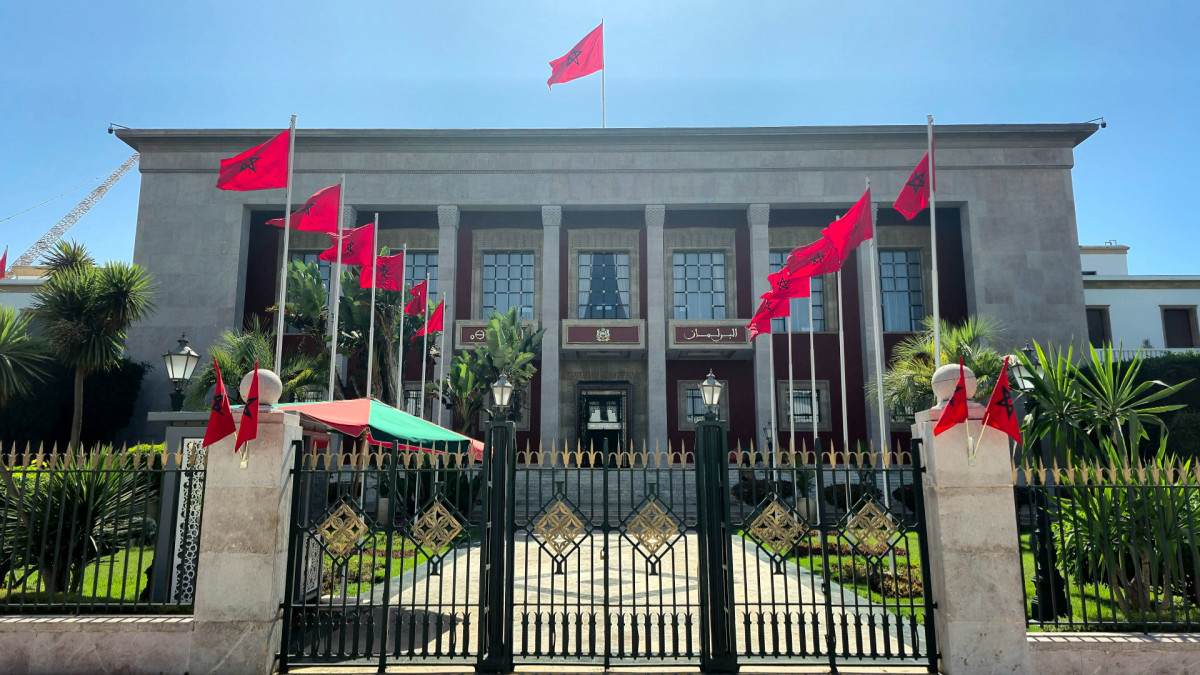
This Wednesday, September 23, Morocco holds legislative elections. From the ballot box will emerge a new Chamber of Representatives and, subsequently, the government that will manage a substantial portion of public policies in the coming years. There are 15.8 million registered voters to fill 395 seats. Of them, 45% belong to the rural areas. Demographically, those over sixty represent 29%; young people between eighteen and twenty-four make up barely 4%. Voter registration is not automatic, so that 4% does not correspond to their share of the population. Moroccan electors living abroad can participate by proxy voting, entrusting their ballot to a voter registered in Morocco.
The Ceuta crisis disrupted the pre-campaign for a few weeks and briefly brought Ceuta and Melilla back into the Spanish debate. As the elections approach, however, issues far closer to everyday life in Morocco have gained prominence, such as employment, housing, healthcare, education, and the cost of living. These are concerns that affect a young generation that has been highly visible in protests over the past year, yet it remains largely absent from the electoral roll.
“They have gained weight, problems far closer to everyday Moroccan life, such as employment, housing, healthcare, education and the cost of living”
The polls arrive at a moment of transformation in the economy and in territorial arrangements. The economy expanded by 4.9% in 2025, compared with the revised 4.4% for 2024, driven by domestic demand and agricultural recovery. Morocco exports cars, expands its port and rail infrastructures, and, together with Spain and Portugal, is preparing the 2030 World Cup. On the political level, there is an uncertainty about how this process translates into employment, public services and opportunities for territories and social groups that start from very different positions.
The power that does pass through the ballot box
The 2011 Constitution, approved after the protests of the February 20 Movement, broadened the powers of the Executive and Parliament. The king must appoint the head of government from among the members of the party that finished first in the elections to the House of Representatives. The Executive runs the Administration and has room to act in numerous economic and social policies.
“Elections determine who governs and with what supports, but not all policies are subjected to the same degree of change”
This margin is conditioned by the monarch’s very broad competences. Mohamed VI presides over the Council of Ministers, where strategic orientations of the state policy, the broad lines of the draft budget, certain appointments and military affairs, among other matters, are debated. Elections determine who governs and with what supports, but not all policies are subjected to the same degree of change.
The outgoing government led by Aziz Akhannouch has, since 2021, relied on a coalition formed by the National Rally of Independents (RNI), the Authenticity and Modernity Party (PAM) and the Istiqlal. Among the opposition forces, the Justice and Development Party (PJD), Islamist-leaning, is trying to recover part of the ground it lost after being reduced to 13 seats in 2021, having won 125 in 2016. The turnover of parties and the formation of parliamentary alliances matter, even though they occur within an architecture in which the monarchy retains a far greater capacity to guide than in European constitutional monarchies.
This formal distribution does not exhaust the way power operates. The majzén is a historical term still used today, with different meanings depending on the author, to refer to political, administrative, economic and territorial networks linked to the monarchy. It is not a parallel institution. Rather, it underscores that in Morocco influence and mediation do not flow solely through parties and representative institutions.
“In Morocco, influence and mediation do not circulate solely through parties and representative institutions”
Within the electoral contest, there is a strong territorial dimension. In many constituencies, personal trajectories, professional or family networks, and the ability of certain local notables to mediate between the Administration and the people carry weight. Likewise, the rural electorate’s weight keeps those forms of local presence highly relevant. This distribution of power defines the battleground on which the next government will be judged: foreign policy, security or Western Sahara show greater continuity between legislative terms; employment, healthcare, education, housing, social protection or regional investment depend more on government action.
The uneven geography of modernization
The territory where these elections are held has changed rapidly. The 2024 census placed the population at 36.8 million and the urbanization rate at 62.8%. Casablanca still concentrates a large portion of business and financial activity, while the north has gained much greater industrial and logistical weight than two decades ago.
One of the best examples of this evolution is Tangier. Tanger Med moved 11.1 million TEU in 2025, the unit equivalent to a twenty-foot container, and around 161 million tons of goods. That figure is almost double the 5.66 million TEU handled by Valenciaport in the same year. The terminals of the complex also handled exports of nearly 455,000 vehicles produced by Renault/SOMACA and Stellantis in Morocco. The port, industrial zones and road connections form today a corridor that extends toward Kenitra and Casablanca and is tightly integrated with European production chains.
Its product specialization is not limited to automobiles. Morocco was in 2024 the second-largest global producer of phosphate rock, after China. The phosphates connect interior mining basins with industrial complexes and ports, and occupy a central position in the country’s mining and chemical economy. That strength also depends on energy and inputs sourced from abroad.
“Inequalities are not arranged simply between coast and interior or between rural and urban”
In desert oases like Tata, economic possibilities are conditioned by water, agriculture and youth outmigration. In Souss, export-oriented farming and tourism sustain a more dynamic economy, though under strong water stress. Inequalities are not arranged simply between coast and interior or between rural and urban: metropolitan areas concentrate advanced services and skilled employment but also peripheral zones with housing problems and difficult labor markets.
According to the Haut-Commissariat au Plan (HCP) labor survey, in the second quarter of 2026, labor participation was 66.5% among men and 18.1% among women. Among youths aged 15 to 24, participation stood at 22.9%; among workers of that age, strict unemployment reached 27.2%, compared with the national 9.5%. The HCP introduced a new methodology in 2026, so these rates should not be compared directly with the former series.
The minimum wage adds another scale to material concerns. Since January, the interprofessional guaranteed minimum wage (SMIG) for the private non-agricultural sector is 17.92 dirhams per hour. Assuming the usual 191 hours per month, that amounts to about 3,423 dirhams gross per month, around 313 euros at the exchange rate of September 22. It is a nominal conversion, not a comparison of purchasing power, but it helps explain why prices, employment and public services occupy substantial space in the campaign.
“That young people represent only 4% of the registered voters does not describe simply a depoliticized generation; it also shows their distance from traditional partisan channels”
We should not forget the youth protests of 2025, which helped push some of these tensions onto the streets. The deterioration of health services combined with demands on education, employment, corruption and spending priorities. GenZ212 used Discord and other networks to coordinate protests and questioned the mismatch between spending on major events and the state of certain public services. That the youth group represents only 4% of the registered voters thus does not simply describe a depoliticized generation; it also reveals their distance from traditional party channels.
Morocco between Europe and Africa
Tangier Med, Kenitra’s factories, the phosphates or the Souss export agriculture share a common thread: they depend on markets and supply chains that extend far beyond Moroccan borders. The country’s internal transformation is linked to that outward integration.
The European Union remains Morocco’s main trading partner. The European Commission estimates goods exchanges at about 62,200 million euros in 2025. For Spain, that integration is particularly intense due to trade, investment and the proximity of production chains. Frictions appear in agriculture: access to the European market sustains export zones like Souss, while Spanish and French agricultural sectors periodically question differences in costs, regulation and conditions of competition.
In Western Sahara, trade and territory end up being inseparable. In October 2024, the European Court of Justice ruled on several issues regarding applying EU-Morocco agreements to the territory. In the case of labeling tomatoes and melons, it established that the origin must appear as Western Sahara and not Morocco, and placed the consent of the Sahrawi people at the center of its reasoning. Subsequently, the EU and Morocco approved a modification of the commercial protocols applied provisionally since October 2025.
“The ruling represented a clear advance for Rabat’s position, but not a formal recognition of its sovereignty over the territory”
The United Nations framework also changed in 2025. Security Council Resolution 2797, adopted on October 31, urged negotiations to be based on Morocco’s autonomy proposal and considered that genuine autonomy under Moroccan sovereignty could be the most viable option. The text represented a clear advance for Rabat’s position, but not a formal recognition of its sovereignty over the territory; it maintained the objective of a political solution that is fair, durable and mutually acceptable, guaranteeing the free determination of the Sahrawi people.
The United States has recognized Moroccan sovereignty over the territory since 2020, a decision that accompanied the normalization of relations between Morocco and Israel. Bilateral cooperation has since developed in defense, security and technology. The Gaza war has brought this foreign policy into domestic debate: protests against normalization have united Islamist sectors, left-wing organizations and other social actors. The state relationship with Israel thus faces opposition that parties can channel, even if they do not control its strategic direction.
The dispute over Western Sahara occupies a central place in Morocco’s relationship with Algeria, although the rivalry between the two states predates the conflict. Border disputes following independence and the competition for regional balance preceded the Saharan issue. That rivalry now projects itself toward the Sahel and West Africa: Morocco is expanding its business presence there and promoting an Atlantic connection for landlocked Sahelian states, while Algeria leverages its direct border with Mali and Niger and decades of diplomatic and security involvement.
“That border dependence broadens Morocco’s room for influence in its relationship with Spain and the European Union”
For Spain, that outward projection sits atop a much more immediate relationship. Border management requires daily cooperation from Moroccan authorities. This border dependence widens Morocco’s room for influence in its relationship with Spain and the European Union. The recent irregular entry of around 80,000 people into Ceuta, exceptional in scale, again highlighted that asymmetry and moved the bilateral crisis onto the European stage.
The European Parliament on September 17 approved a resolution calling for stronger protection of external borders, increased European support and intensified cooperation with Morocco on border control and returns. On September 22, José Manuel Álvarez announced a meeting in New York with Nasser Bourita to address pending returns and prevent new crossings in line with the vote.
Wednesday’s elections will hardly alter the broad directions of Moroccan foreign policy. Where the next government will have greater room for maneuver is in the issues that have run through the campaign and the mobilizations of recent years. Employment, housing, healthcare and education will be the terrain where it must respond to demands that economic growth and large-scale investments have not fully absorbed on their own.
