
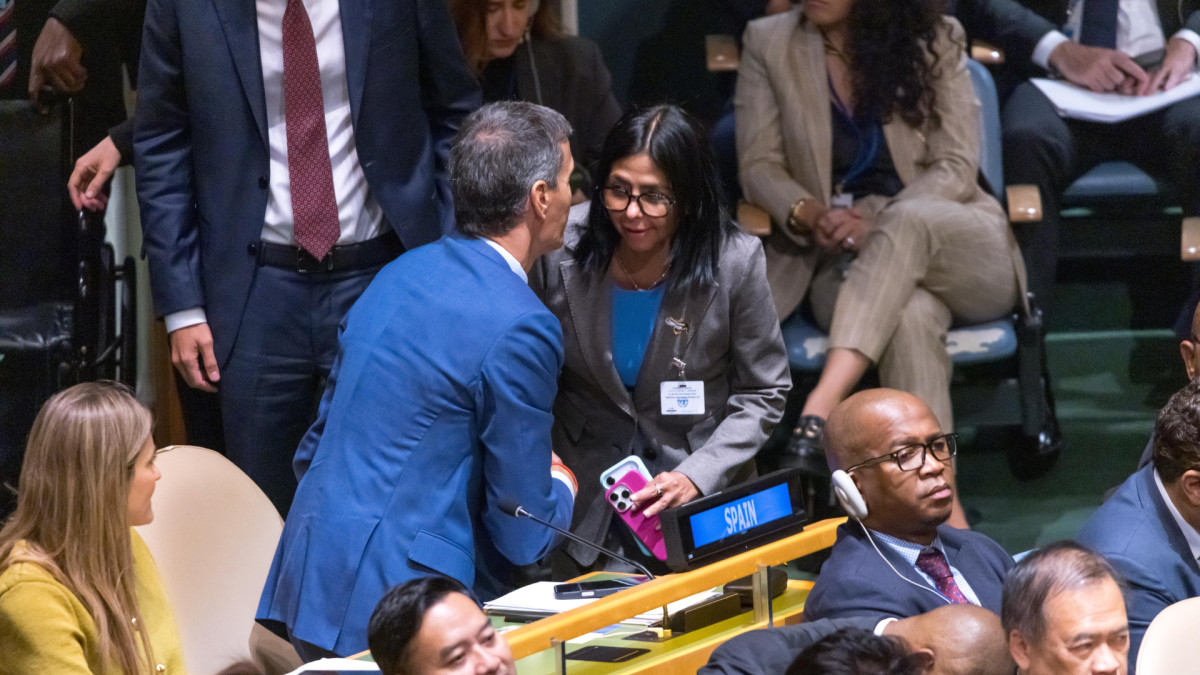
Delcy Rodríguez rose from her seat in the United Nations General Assembly and moved toward the Spanish delegation to greet Pedro Sánchez. The sequence, captured by Brazilian journalist Patrícia Vasconcellos, records a brief contact between the two leaders. Politically speaking, this rapprochement by the acting president can be interpreted as an attempt to advance the international rehabilitation of Venezuelan authorities. That same day, Delcy posed alongside the President of the United States, Donald Trump, with thumbs up, in a closed-door encounter.
In Spain it is easy to turn the greeting into yet another controversy about the Government’s relations with Caracas. For various reasons, the controversy has existed and will continue to exist, but from the standpoint of foreign policy it is important to understand what is at stake. In this case, keeping the dialogue open allows conveying demands and negotiating commitments, and, consequently, its usefulness should be measured by the results it yields for Venezuelans. Among all possible outcomes, one stands out: that they can freely choose those who govern them.
“Maintaining dialogue allows conveying demands and negotiating commitments, and, consequently, its usefulness should be measured by the results it yields for Venezuelans”
Today we add to Agenda Futura a new forecast from The Forecasting Machine that raises precisely that question: Will democratic elections be held in Venezuela before December 31, 2027? The estimate assigns a 32.8% to the affirmative scenario: roughly one in three.
The forecast is calculated by the aggregation of different artificial intelligence models from information and arguments that can be examined. In this sense, its usefulness depends on testing those reasons and revising them when the facts change. Therefore, this is a provisional assessment above 30% describing a plausible and sufficiently significant outcome to work toward.
Negotiations between the Government and the opposition keep open the possibility of an electoral outcome: on the table are political guarantees, institutional reform, and an eventual call for elections, while the proposal of July 24, 2027 offers a reference date and the United States maintains leverage to pressure Caracas. The technical margin would still allow organizing the elections if the agreements advance soon. However, the forecast continues to tilt clearly toward the “no”: there is no official calendar, the chavista apparatus retains institutional control and Washington has economic and energy incentives to preserve the current stability. Moreover, it is not enough to have a vote, but it would have to be held with democratic guarantees.
We held a historic meeting with the President of the United States, Donald Trump, where we discussed strengthening the bilateral relationship between our countries and advancing a cooperation agenda in strategic areas such as energy, mining, security pic.twitter.com/pyJ6FnQkBH
— Delcy Rodríguez (@delcyrodriguezv) September 23, 2026
Months of unrest in Venezuela
In January, the American scholar John Polga-Hecimovich described Delcy Rodríguez in Agenda Pública as a continuity figure subjected to two demands: satisfy the American government and maintain the backing of her chavista base. In the early stages of the year, Nicolás Maduro’s removal had altered the balance of power, but the factions that had sustained the regime remained present. That internal balance conditions today who keeps control of the institutions and what concessions they can accept.
“No basta con que haya una votación, sino que esta tendría que celebrarse con garantías democráticas”
An electoral opening as the one proposed for Venezuela imposes very concrete costs on those who govern. Accepting real competition implies that the status quo must accept that they could lose offices, influence, and the ability to decide over public resources. A negotiation will be more credible if it allows knowing what guarantees can make that possibility bearable and who is able to enforce them. Caracas’s willingness to receive investments or recover international interlocutors signals its priorities and is not detached from the democratic question.
One of the main investments, if not the fundamental one, is oil. Energy expert Henry Jiménez Guanipa analyzed Venezuela’s hydrocarbon reform, its relationship with U.S. easing, and opportunities for companies like Repsol. He also noted the need for institutional stability and legal certainty. The reopening of the economy could favor more predictable rules, but also generate revenue for Caracas and opportunities for its partners. If that arrangement works for its beneficiaries, the question remains how willing they are to risk it through an electoral competition.
“If that arrangement works for its beneficiaries, the question remains how willing they are to risk it through an electoral competition”
Meanwhile, Diego Lombardi, professor of Democracy and International Relations, warned in February about the fragility of stability sustained by external threats and weakened institutions. His analysis posed a problem still relevant: economic growth may precede institutional reconstruction. For material improvement to also contribute to democratizing the country, it requires agreements among local actors and a civil society capable of intervening. Stability and prosperity, by themselves, do not guarantee that evolution.
From the opposition operating within Venezuela, Stalin González has placed the problem on guarantees. In his conversation with Agenda Pública, he linked an election accepted by all to the building of reliable institutions and highlighted the renewal of the National Electoral Council as the last step in a democratic transition. The composition of the arbiter, the conditions to participate, and the acceptance of the results will allow checking how much power authorities are willing to share and what effective margin the opposition gains.
The push to set a date has already been concretized in a proposal. U.S. Senator Bernie Moreno has proposed July 24, 2027 and María Corina Machado has backed the initiative. A date can help coordinate demands and raise the costs of possible delays, but it will only gain weight if it translates into decisions by competent authorities and in preparations that can be verified.
“A date can help coordinate demands, but will only gain weight if it translates into decisions by competent authorities and in preparations that can be verified”
For Washington, the question is how much it is willing to demand in exchange for competitive elections. The intervention that ousted Maduro proved the capacity to alter power relations in Venezuela. If energy agreements and cooperation with Rodríguez satisfy the White House, the opposition will need support capable of keeping democratization as one of the conditions of that relationship. Europe should prepare to play that role.
Spain would have to push a European stance that ties diplomatic progress to verifiable commitments. That implies specifying what changes would allow sanctions to be eased and what assistance could facilitate elections with guarantees, in addition to backing those who defend rights inside the country. It also requires maintaining contact with the various opposing currents. European credibility would grow if all its interlocutors knew those conditions in advance and verified that they are applied consistently.
In April, we questioned Machado’s decision to reject a meeting with Sánchez during his Madrid visit. Her cause needed to broaden European institutional backing and avoid getting caught in Spanish party politics. The same criterion should now apply to the Government: contact with Rodríguez should serve to defend conditions under which the opposition can compete freely. Spanish interlocution will have greater value if it helps to bring Venezuelans closer together and sustain a shared democratic demand in Europe.
“The Spanish interlocution will have greater value if it helps to bring Venezuelans closer together and sustain a shared democratic demand in Europe”
Agenda Futura will track a few concrete indicators: changes in electoral authority, real possibilities of presenting candidates, voter registration, conditions for observing the process, and the international response to advances or setbacks. An announced date will be more credible when accompanied by decisions that enable its fulfillment. Those changes will also require revisiting the forecast’s arguments and their probabilities.
The greeting at the United Nations leaves an image of diplomatic access. Its usefulness will depend on whether Spain manages to use it to demand more concrete commitments regarding Venezuela’s future. Within fifteen months, the measure will remain the same: what capacity do Venezuelans have to elect and replace their rulers. Both Madrid’s policy and Caracas’s international normalization should be able to be evaluated by that criterion.
