
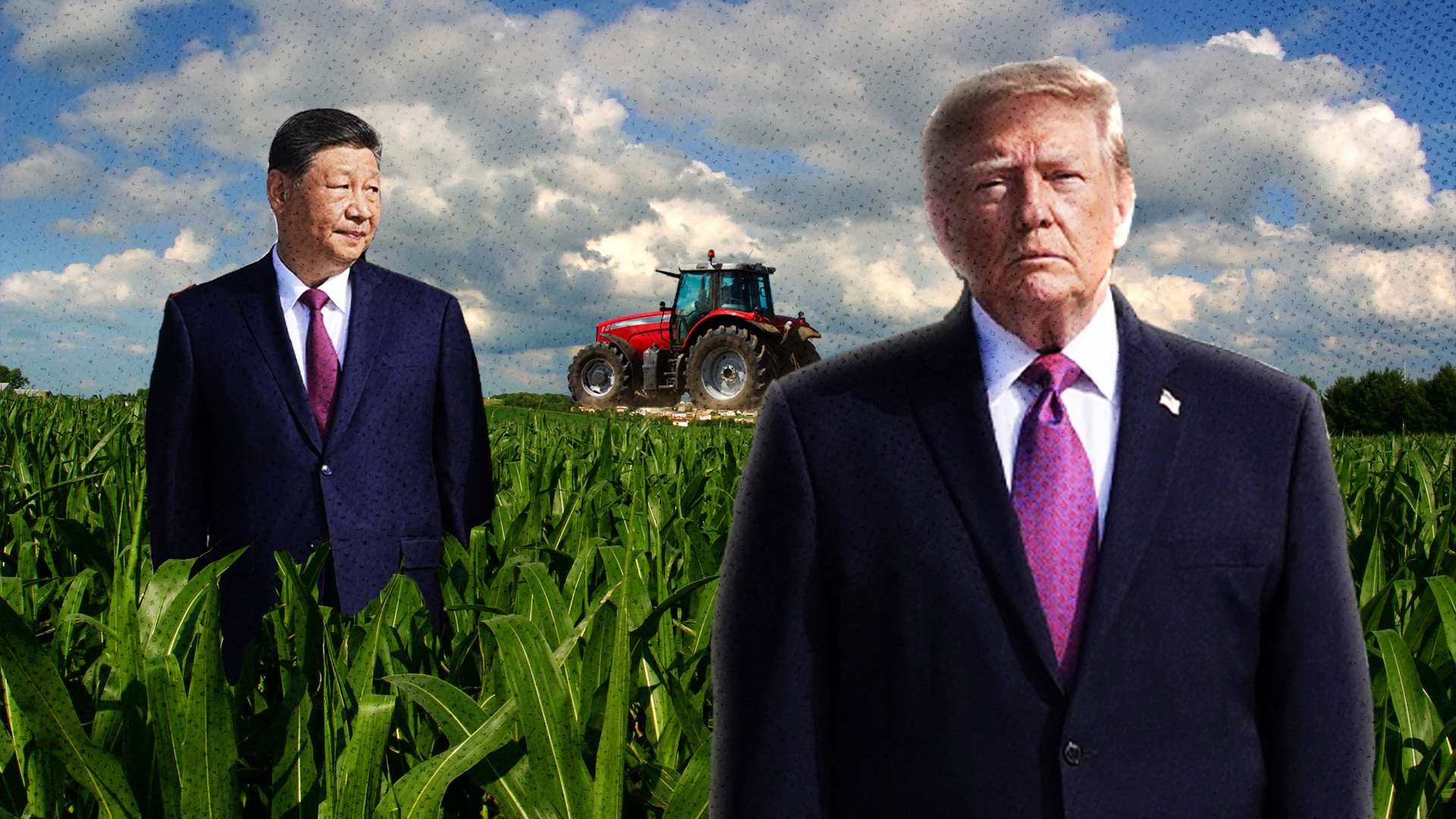
It was a direct consequence of President Donald Trump’s trade confrontations, a reality the Department of Agriculture itself now acknowledges.
When President Donald Trump began moving to raise tariffs and heighten tensions with America’s principal trading partners, he offered a notorious reassurance.
“Trade wars are good,” Trump tweeted on March 2, 2018, “and easy to win.”
More than eight and a half years later, both assertions have proven to be false. Although much of the debate around Trump’s trade battles centered on U.S. manufacturing, it is American farmers who have been placed at the forefront. For them, the tariff fights have translated into costly setbacks.
Don’t just take my word for it. Look at what the Trump administration’s own Department of Agriculture reported about the state of the “farm economy downturn.”
From 1990 through 2018, the United States enjoyed agricultural trade surpluses—exporting more farm products than it imported. Since the onset of Trump’s trade war, that pattern has reversed. That reversal spells trouble for farmers, whose overseas markets have tightened.
And all of this circles back to the confrontation with China.
“The sharp decline in U.S. agricultural exports…has been driven by decreased sales to China,” the report notes. American farm exports to China peaked in 2022 at $38.1 billion before dropping to $8.4 billion last year. That represents a 78 percent plunge in just three years—the period overlapping Trump’s return to the White House and the escalation of his trade war. “This single-country drop accounts for the majority of the recent contraction in overall U.S. export performance, and it marks one of the steepest market losses ever recorded for a major U.S. agricultural buyer.”
That conclusion comes from the administration itself.
How did this unfold? In March, the Peterson Institute for International Economics (PIIE) analyzed the sharp fall in American exports to China.
“Each time Trump raised tariffs—by 145 percentage points in early 2025, as well as during his first trade war of 2018–19—China retaliated with matching tariff increases, accelerating the U.S. export decline,” concluded PIIE senior fellow Chad Bown. “Less obvious were the broader Chinese policies that discouraged imports. Some encouraged Chinese firms to produce more. Others urged Chinese consumers to buy domestically. Most of those policies also harmed exporters in other countries.”
Meanwhile, farmers are being squeezed on the opposite end by rising costs—yet another ramification of the trade conflict. A new analysis from the Trade Partnership shows Americans have shouldered $355 billion in higher tariffs on Chinese goods since 2018, when Trump proclaimed the trade wars to be good and easy to win.
The discontent among American farmers regarding the trade war may well be the most overlooked storyline in current American politics.
It helps explain, for instance, why Republicans from agricultural states are suddenly pushing hard to persuade the White House to halt diesel exports in a bid to lower gas prices ahead of the midterm elections.
There is widespread consensus that such a move would be ill-advised, likely worsening global shortages and driving prices higher. That view is shared by a broad array of free-market nonprofits, oil-and-gas experts, and even Energy Secretary Chris Wright.
The only supporters of a diesel-export ban are Republicans from farming regions facing races in the near term. They are desperate to offer voters something—anything—that could invert the troubling polling trends. Nate Silver noted on his Substack on Thursday that the anticipated “blue wave” ahead of November’s election appears to be heavily concentrated in red states.
Regrettably for these Republicans, Trump created this predicament and left them with little room to maneuver. There is no straightforward remedy to the damage the trade war has inflicted on American agriculture. Banning diesel exports won’t solve it. A deal with Chinese President Xi Jinping, who is visiting Washington this week for talks with Trump, wouldn’t fix it either.
The only viable path to success would have been not to initiate a trade war eight years earlier and not to escalate it over the past two years.
Securing a victory was never easy. In fact, it looks like the United States is losing ground. And the outcome has certainly not been favorable.
