
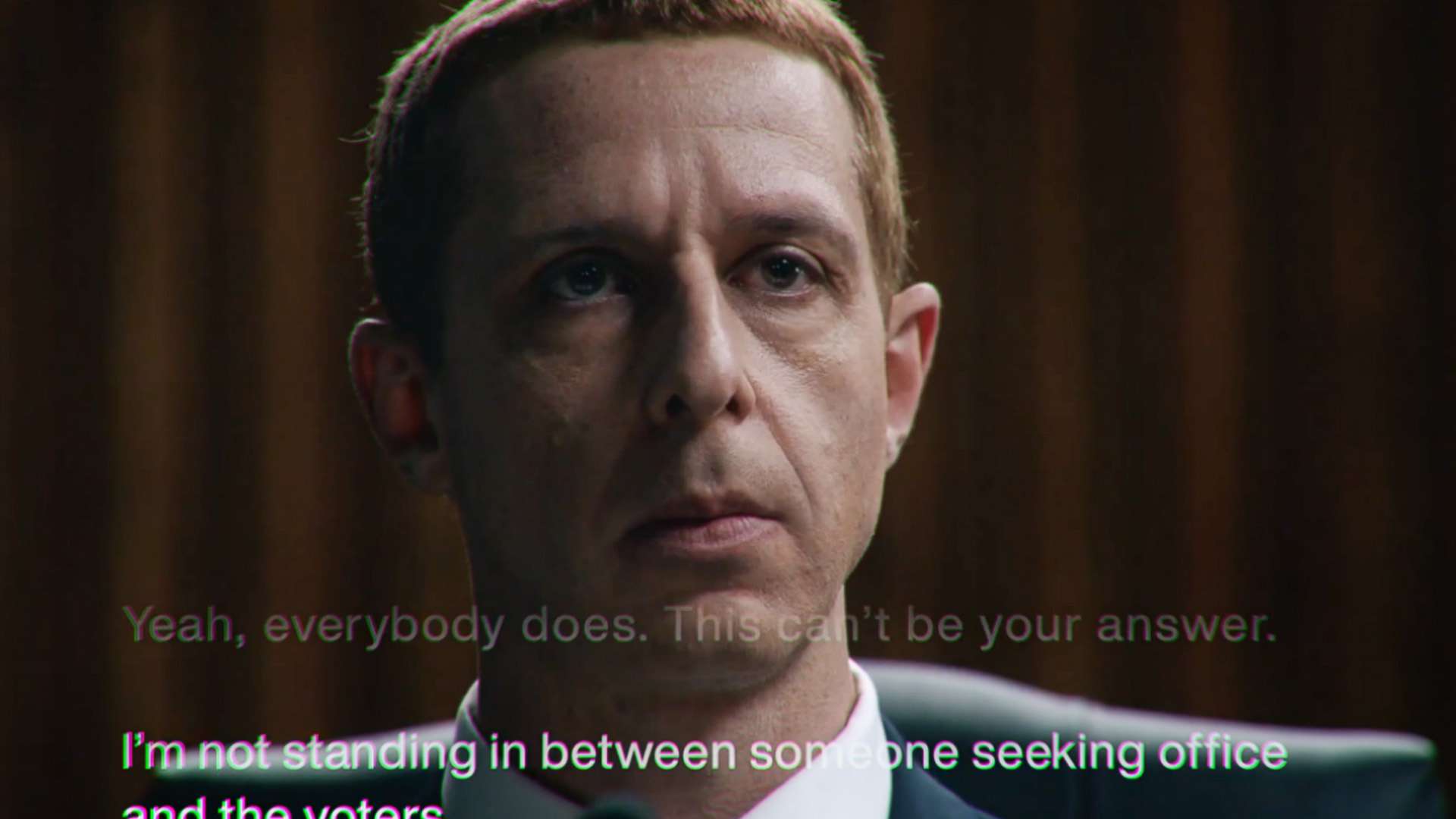
In the newest trailer for
The Social Reckoning
, the Zuckerberg‑like figure vigorously pushes back against arguments in favor of censorship.
I did not expect to find pleasure in The Social Reckoning, Aaron Sorkin’s forthcoming film that casts Facebook as a malevolent force. It acts somewhat as a follow‑up to The Social Network (2010)—an entertaining yet flawed and unfair portrait of Facebook founder Mark Zuckerberg—and centers on the so‑called Facebook Papers, a controversy many have nearly forgotten. Those documents involved whistleblower Frances Haugen publicly revealing that the company knew its social media products could harm certain users (notably teenage girls on Instagram). At the height of that news cycle, I dismissed it as a “big fat nothingburger,” given how weak the evidence appeared.
You are reading Free Media from Robby Soave and Reason. Get more of Robby’s on-the-media, disinformation, and free speech coverage.
Sorkin—whose own politics seem to fall mostly in line with the sort of overly idealistic, bland do-something liberalism that typified The West Wing, his best known piece of entertainment—is a passionate detractor of Facebook and Zuckerberg. In 2019, Sorkin went so far as to write an open letter to Zuckerberg (in the form of a column for The New York Times, of course), in which he accused Facebook of “assaulting the truth.” Over the course of the last two decades, from Network to Reckoning, Sorkin’s nuanced but mostly negative representation of social media and its impact on society has yielded to Jonathan Haidt-esque blind hatred; his forthcoming depiction of Zuckerberg (now portrayed by Jeremy Strong rather than Jesse Eisenberg) is intended as one-dimensional cartoon villainy.
Well, so much for those intentions. This certainly isn’t what Sorkin intended, but I found myself cheering Strong’s Zuckerberg in a recently released scene from the movie, in which the Facebook CEO marshals free speech arguments to rebut the histrionic apprehensions of Bill Burr’s character.
“I’m not the one who’s lying and I’m not stopping them from seeing someone who is…”
The Social Reckoning, a companion piece to The Social Network, is coming exclusively to theatres October 9. https://t.co/9BRuwifGIt pic.twitter.com/3nR1PhZUXC
— The Social Reckoning Movie (@TheSocialMovie) September 23, 2026
Precisely what Zuckerberg argued.
We don’t want the platform itself to be overly involved in deciding what is true and what is not, for the simple reason that this hasn’t worked very well in practice. There was a time when Facebook took dramatic steps to correct alleged wrongthink, empowering ostensibly independent (but in practice, extremely progressive) fact-checkers to police the site; this was a disaster that frequently resulted in legitimate political speech facing sanction.
Sorkin may not like it, but his side has lost this argument, and today the social media companies are less likely than ever to engage in heavy-handed moderation of political content. They trust the users to decide for themselves, for exactly the reasons Strong’s Zuckerberg lays out there. I take it that Sorkin thinks this is the villain’s perspective, but he may be surprised how many moviegoers disagree.
This Week on Free Media
I am once again joined by Amber Duke to discuss that much‑discussed Nikole Hannah‑Jones piece about her daughter’s experiences in New York City public schools.
Worth Watching
I also appeared on two podcasts that might interest newsletter readers. First, I spoke with Nico Perrino of the Foundation for Individual Rights in Expression to review my evolution from campus free‑speech correspondent to TV commentator, the Trump administration’s record on the First Amendment, and related topics. Then I joined my former Rising cohost Briahna Joy Gray for a discussion with Al Jazeera about third parties in the United States.
