
In the case of Lewis v. StopAntisemitism, a ruling issued on Friday by Judge Adrienne Nelson of the District of Oregon lays out the following background and ruling.
The plaintiff is a professional musician who has spent over thirty years teaching music privately. During the 2023-2024 academic year, she acted as an independent contractor at Valley Catholic Music School, offering private violin and cello lessons to Valley Catholic students in practice rooms across the K-12 campus. She also conducted strings classes for both students and members of the public at Valley Catholic’s summer program.
Before August 2024, the plaintiff posted opinions on geopolitical events—such as the Gaza war and its conduct by Israeli forces—on her personal Facebook page. These views were expressed entirely outside of the summer music program and the private lessons with her Valley Catholic students, and she did not discuss or share these views with those students.
StopAntisemitism is a national organization that highlights threats to Jewish safety and civil rights. Among its activities is the publication of recurring features that aim to inform the public about antisemitism expressed by public figures, educators, activists, and institutions, including a feature titled “Corrupting the Classroom.” Through this feature, StopAntisemitism posts publicly available statements by various educators, accompanied by commentary from the defendants about those statements. On August 21, 2024, StopAntisemitism published a “Corrupting the Classroom” feature focusing on the plaintiff on its X.com profile. The feature spanned multiple X posts and included screenshots of the plaintiff’s statements on her public Facebook account, archived links to those posts, and the defendants’ remarks about the plaintiff and her posts.
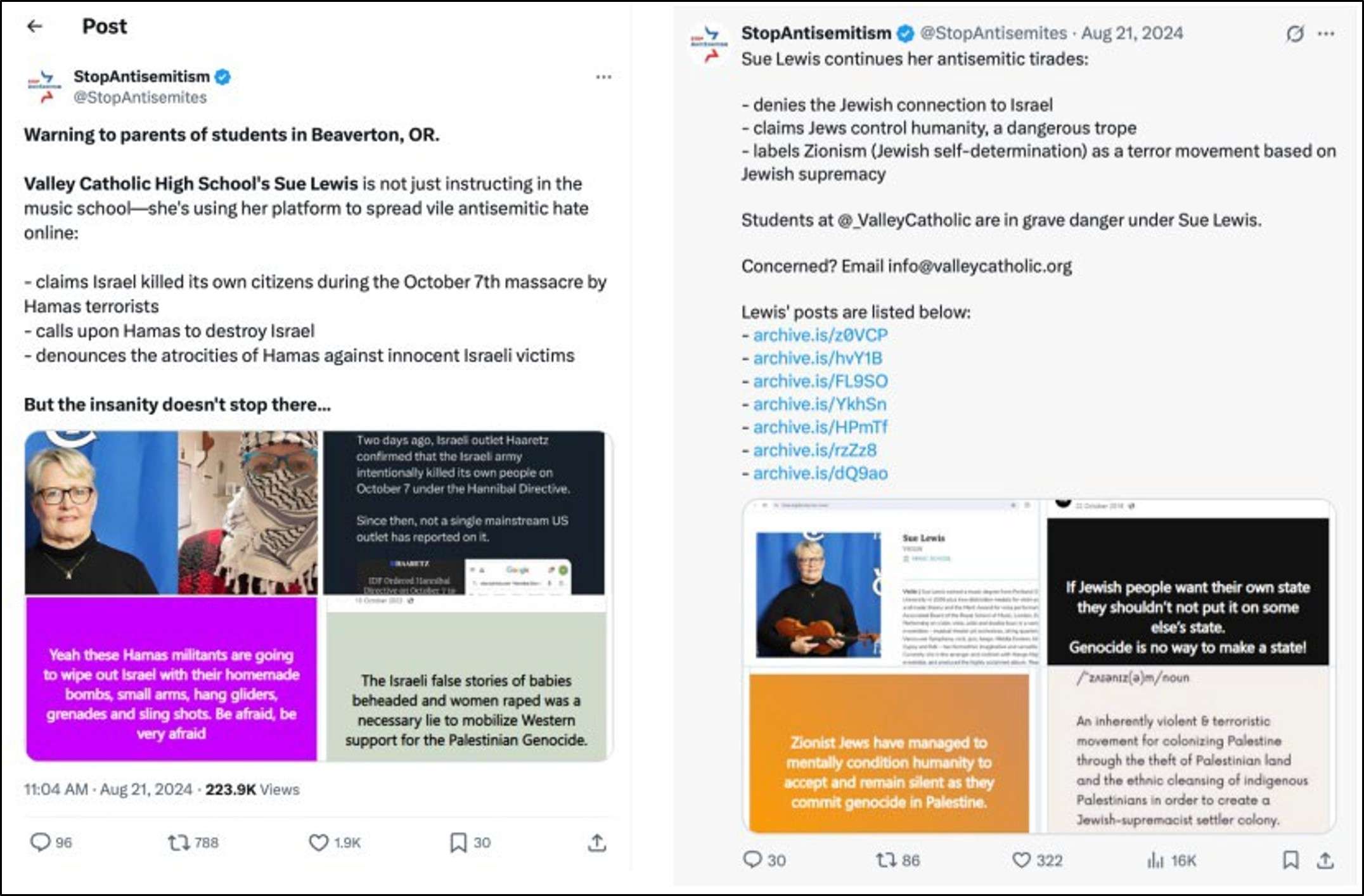
The defendants’ initial posts began with the warning: “Warning to parents of students in Beaverton, OR. Valley Catholic High School’s Sue Lewis is not just instructing in the music school—she’s using her platform to spread vile antisemitic hate online.” This was followed by a bulleted list asserting that the plaintiff “claims Israel killed its own citizens during the October 7th massacre by Hamas terrorists[, ] calls upon Hamas to destroy Israel[, and] denounces the atrocities of Hamas against innocent Israeli victims.” The next post opens with, “Sue Lewis continues her antisemitic tirades.” It is then followed by its own bulleted list stating that the plaintiff “denies the Jewish connection to Israel[; ] claims Jews control humanity, a dangerous trope[; and] labels Zionism (Jewish self-determination) a terror movement based on Jewish supremacy.”
The post concludes with the claim, “Students at Valley Catholic are in grave danger under Sue Lewis. Concerned? Email info@valleycatholic.org.” Below that final statement is an archived list of the plaintiff’s Facebook posts. Screenshots of StopAntisemitism’s posts are displayed below:

Four of the plaintiff’s archived posts prove especially pertinent to this motion. The first is a photograph, posted on February 16, 2024, showing the plaintiff wearing a black-and-white keffiyeh. The remaining four posts contain only text. The first post, shared on November 2, 2023, reads, “Yeah these Hamas militants are going to wipe out Israel with their homemade bombs, small arms, hang gliders, grenades and slingshots. Be afraid, be very afraid.” The second post, from October 22, 2018, proclaims, “If Jewish people want their own state they shouldn’t put it on someone else’s state. Genocide is no way to make a state!”
The third post, dated April 4, 2024, appears to present a dictionary-like definition of “Zionism” as “an inherently violent & terroristic movement for colonizing Palestine through the theft of Palestinian land and the ethnic cleansing of indigenous Palestinians in order to create a Jewish-supremacist settler colony.” The fourth and final post, from October 21, 2018, asserts, “Zionist Jews have managed to mentally condition humanity to accept and remain silent as they commit genocide in Palestine.” … In the wake of StopAntisemitism’s feature, the plaintiff reportedly “received a torrent of hateful comments and direct messages, some of which were violent and threatening, from strangers who had read” the posts.
On August 21, 2024—the same day StopAntisemitism published its feature—the plaintiff was informed by Valley Catholic that her contract for the 2024-2025 school year would not be renewed.
Defendants sought dismissal under Oregon’s anti-SLAPP statute, which allows for rapid dismissal of lawsuits that are legally meritless when they arise from speech on matters of “public interest.” The court agreed that the posts touched on such matters:
Although the parties contest the precise scope of the challenged posts, the result is the same whichever framing is used. Defendants contend the posts concern antisemitism, Israel, Palestine, and the Gaza war—topics the plaintiff concedes are questions of clear public interest. The plaintiff argues that the posts’ messaging is much narrower, confined to the plaintiff’s personal views on these issues. Nevertheless, as an educator, the public has an interest in educators’ positions on controversial topics, especially when those views are publicly posted for broad access….
The court then held that the claim itself was legally meritless:
[A]ll the challenged statements are protected opinions under the First Amendment….
The plaintiff challenges four statements here. The first is one bullet in a list under the heading “Valley Catholic High School’s Sue Lewis is not just instructing in the music school—she’s using her platform to spread vile antisemitic hate online.” The first challenged statement reads: (1) “calls upon Hamas to destroy Israel.” The second and third statements follow the heading “Sue Lewis continues her antisemitic tirades.” They state: (2) “denies the Jewish connection to Israel,” and (3) “claims Jews control humanity, a dangerous trope.” Fourth and finally, the plaintiff challenges a statement that comes after the second list of bullet points: (4) “Students at @_ValleyCatholic are in grave danger under Sue Lewis.” …
None of these statements, when read in context, assert objective facts. First, the overall tone of the defendants’ posts negates any implication that they were declaring objective facts about the plaintiff. Read in context, the posts clearly convey the defendants’ interpretation of the plaintiff’s own postings. The posts begin by stating that the plaintiff is “using her platform to spread vile antisemitic hate online,” and end with the line that “Lewis’ posts are listed below.”
Images of the plaintiff’s posts accompany the defendants’ commentary, as do archived links to the plaintiff’s original Facebook posts. When one considers the links to the plaintiff’s posts, the nature of the feature, the author’s evident motivation—StopAntisemitism is the named source in the challenged posts—and the unequivocally opinionated phrasing, the overall tenor strongly indicates that the statements reflect the author’s opinions about the words the plaintiff chose to publish online.
Viewers are invited to compare the plaintiff’s own posts with the defendants’ characterizations. If the defendants were asserting that the plaintiff had uttered the exact phrases in question, there would be no reason for them to include the plaintiff’s actual wording as well. Any concern about misquoting the plaintiff is dispelled by reading the plaintiff’s own statements….
The general tenor of the defendants’ posts leads to the same conclusion. “Divorced from their context,” the challenged statements “might convey the impression that the plaintiff identifies,” but when “looking at the entire statement,” the defendants are expressing their interpretation of the plaintiff’s words, not asserting that the plaintiff herself made the precise claims the defendants wrote.
Second, the defendants used hyperbolic language that undermines any impression of fact. Indeed, the entirety of the statements at issue consists of hyperbolic characterizations of the plaintiff’s posts—which becomes apparent when viewed in context. The wording itself is hyperbolic, describing the plaintiff’s posts as “antisemitic tirades” and accusing her of “spreading vile antisemitic hate online.” Even the phrase “grave danger” is hyperbolic and reflects the defendants’ view of the words the plaintiff shared. Courts have treated similarly extreme claims as rhetorical hyperbole when viewed in context….
Whether the statements could be proven true or false is a nuanced question but ultimately not decisive. “Although the plaintiff may be correct that the question of” what she called upon, denied, and claimed is “something that is capable of being proved true or false, the issue here is whether the assertions conveyed by the defendants’ statements are ones that are capable of being proved true or false.” Read in context as required by Neumann, the defendants’ statements reflect their interpretation of the plaintiff’s words and thus constitute personal viewpoints. Because “the expression of a personal viewpoint is not something that is susceptible to being proved true or false,” the defendants’ statements cannot give rise to actionable defamation….
The court likewise rejected the plaintiff’s claims for false light, tortious interference with economic relations, and intentional infliction of emotional distress on similar grounds; an excerpt reads:
“The same rationale that underlies” the Court’s decision on those claims “—the concern for the free-speech implications of penalizing political advocacy—applies with equal force with respect to [the tortious interference] … claim.” … [And d]efendants’ postings, which mix their constitutionally protected opinions with the plaintiff’s own words, are not extreme and outrageous as a matter of law. The plaintiff’s [intentional infliction of emotional distress] claim therefore fails as well….
Given the court’s ruling granting the anti-SLAPP motion, it appears probable that the plaintiff will be responsible for paying the defendants’ legal fees, as permitted by Oregon’s anti-SLAPP statute when such motions are granted; the precise amount would be determined in subsequent proceedings.
Abra Siegel (National Jewish Advocacy Center) and James L. Buchal (Murphy & Buchal LLP) represent the plaintiff.
