
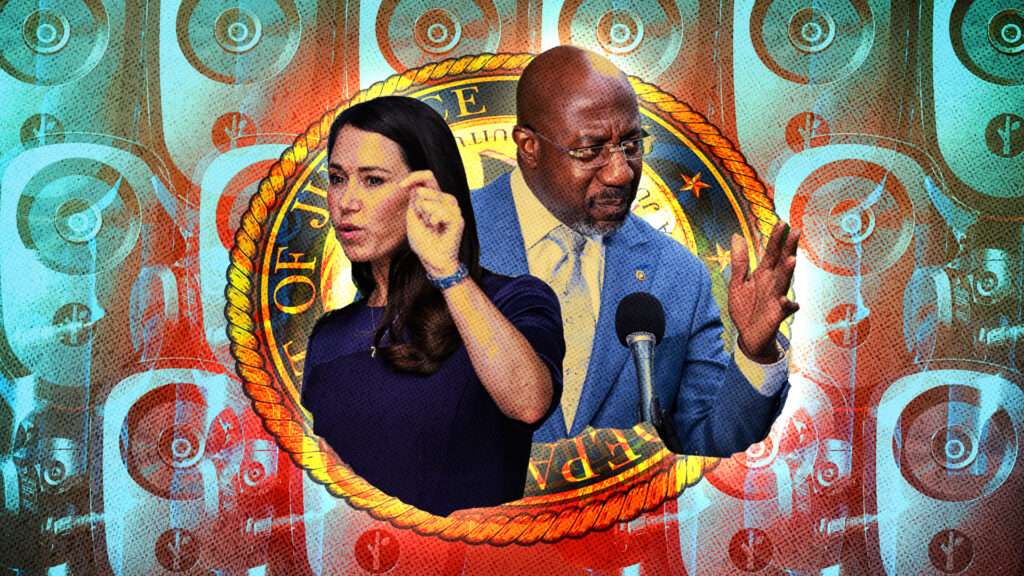
Sens. Raphael Warnock and Katie Britt might not seem like natural allies, yet they share a concern: people deserve stronger protections against police misuse of surveillance technology.
Automated license plate readers (ALPRs) keep making headlines. The devices placed along roadsides—commonly called “Flock cameras” after the company that dominates the market, Flock Safety—capture license plate images and store them in a searchable archive used by law enforcement. Although the technology has been around for a while, it has drawn intense scrutiny as numerous officers nationwide have misused the cameras.
Two U.S. senators from opposite ends of the political spectrum are raising questions about ALPRs and pressing for greater government oversight of how police deploy them.
“Although law enforcement agencies nationwide appropriately employ ALPRs for legitimate safety purposes—such as investigating violent crime and locating and recovering missing or abducted individuals—misuse of these systems undermines public trust in the technology,” wrote Sen. Raphael Warnock (D–Ga.) and Sen. Katie Britt (R–Ala.) in a letter to Attorney General Todd Blanche. “We therefore seek information on how the Department of Justice funds and oversees these systems to prevent misuse and ensure compliance with federal laws and regulations.”
The two senators may seem unlikely partners: for this Congress, Heritage Action rates Britt’s votes at 78 percent and Warnock’s at zero, while ProgressivePunch gives Warnock an A and Britt an F.
Yet both lawmakers believe the government must do more to shield people from ALPR abuse by police.
The concern is well-founded. The senators noted reports indicating that in dozens of cases nationwide, officers have inappropriately and, in some instances, illegally used ALPR technology to monitor and harass current, former, or prospective romantic partners.
Reason has tracked numerous instances of officers misusing or illegally deploying Flock cameras. Warnock pointed to a July piece by Reason reporter Autumn Billings, which found that in Georgia alone, officials had documented “at least 20” officers misusing the Flock database for personal reasons unrelated to investigations.
Alabama isn’t exempt: in recent weeks, several officers across the state have been found misusing ALPR searches.
According to LPR Maps, Georgia ranks fourth in the nation for ALPR deployments, and also has the highest number per capita, while Alabama sits sixth in per-capita terms.
“In total, at least 50 law enforcement personnel to date have been charged with, or accused of, using ALPR systems for unauthorized purposes,” Warnock and Britt wrote. “Such cases underscore the need for strong guardrails and safeguards—such as proper access controls, auditing, supervisory review, and meaningful penalties for intentional misuse—to ensure that ALPRs’ tracking capabilities cannot be exploited by rogue actors to threaten, manipulate, or harm unsuspecting victims.”
They also stressed that funding for these technologies should be paired with robust oversight to prevent abuse from occurring. “We urge the DOJ to provide guidance to state and local law enforcement on the best ways to prevent ALPR misuse.”
There are currently no federal laws governing ALPR use, and only a handful of states have enacted rules. Among those, the scope varies widely: Colorado allows license-plate images to be stored for up to three years, while New Hampshire restricts storage to three minutes unless a plate triggers a flag for further action. (The Institute for Justice, a public-interest law firm, has drafted model legislation that would require a warrant to access any images older than 24 hours.)
Warnock and Britt also inquired about the DOJ’s own use of ALPRs, whether audits have been conducted, and what safeguards exist to prevent misuse.
A 2024 Congressional Research Service report noted that several DOJ entities deploy ALPRs, including the FBI, the Drug Enforcement Administration, and the U.S. Marshals Service. However, the report also cautioned that it does not reflect a complete accounting, noting that publicly available agency documents with comprehensive ALPR usage details appear scarce.
Back in 2012, the FBI briefly paused ALPR acquisitions because, as one official put it in an email, the agency’s Office of General Counsel was “wrestling with LPR privacy issues.”
Warnock and Britt are justified in their concerns, particularly given the sheer scale of ALPR deployment—Flock Safety alone claims more than 120,000 cameras across 49 states.
Flock cameras don’t inherently spur bad behavior by officers, but without solid oversight they can enable it.
The two senators aren’t alone in this. This week, cybersecurity experts and civil-liberties advocates testified before the Senate, urging lawmakers to either ban ALPRs or impose stricter oversight.
