
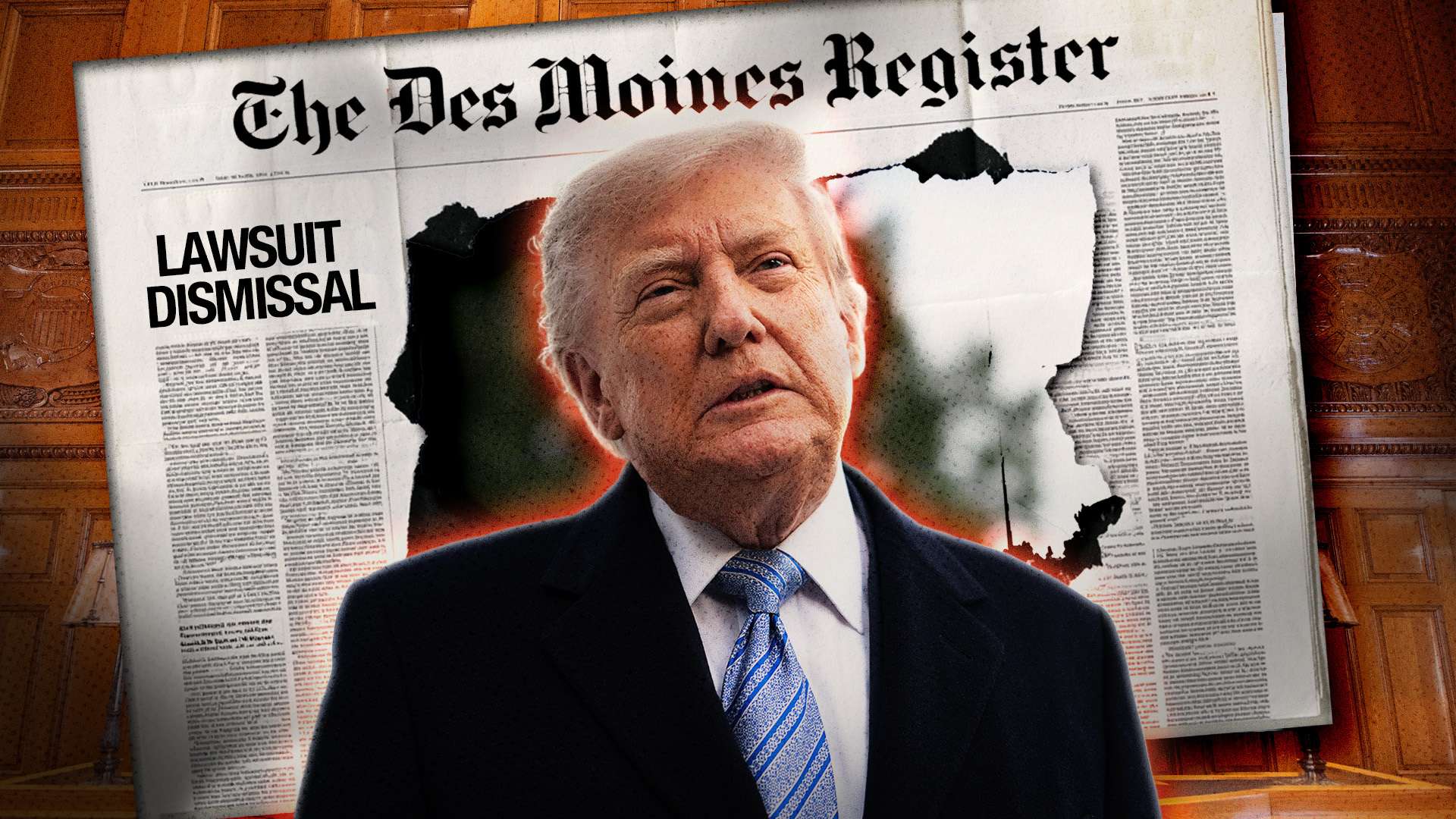
The dismissal of the president’s lawsuit against The Des Moines Register is a win for freedom of the press.
On Wednesday, an Iowa judge threw out a case in which President Donald Trump asserted, with considerable rhetoric, that The Des Moines Register engaged in consumer fraud by publishing poll results he disliked before the 2024 election. The controversial findings, which showed Kamala Harris, the Democratic candidate, ahead in Iowa, turned out to be far from accurate. Yet Trump contended that the forecast was not only inconvenient but also illegal.
Trump filed the suit in December 2024, contending that the poll violated the Iowa Consumer Fraud Act and seeking damages to cover the time and resources he said were spent to counteract the alleged harm caused by the Register‘s reporting. If such arguments were to prevail, they would imply that journalists could face civil liability whenever a story proved incorrect.
“At its essence, the Plaintiffs’ Petition aims to stretch Iowa’s statutory and common-law bounds, converting speech that enjoys the strongest protection under the First Amendment into a liability,” wrote Polk County District Court Judge Scott J. Beattie in his ruling. “After weighing the arguments, the Court must conclude that the protection is excessive and the reach too broad. The case must be dismissed.”
Beyond the Register, Trump also sued pollster J. Ann Selzer, who conducted the survey at the heart of the dispute. “This lawsuit was absurd from the start and should never have been brought,” commented Robert Corn-Revere, chief counsel at the Foundation for Individual Rights and Expression (FIRE), which represented Selzer. “The First Amendment does not permit any government actor, not even the president, to sanction people under a banner of ‘fake news.’ That may work as a campaign slogan, but it has no basis in the law.”
The fraud exception to the First Amendment, Beattie notes, requires a knowingly false statement intended to persuade someone to part with money or valuable property based on that misrepresentation. Trump’s suit, he concludes, fails to plead either element.
“A poll is simply an estimate,” Beattie observes. “It reports responses from a sample of voters and includes a stated margin of error. It rests on a defined methodology and concerns an event that has not yet occurred. Such things are not the type of statements that can be judged true or false under the fraud exception.”
Nor did Trump allege that he suffered any economic loss due to reliance on statements from the Register or Selzer. “The constitutional fraud exception covers lies intended to obtain money or property,” Beattie notes. “The misrepresentation must be made in the context of inducing the plaintiff to part with money or valuable property, based on that misrepresentation. None of that is pleaded here.”
Although Beattie found those deficiencies sufficient to end the case, he also examined the specific elements needed to prove a violation of the Iowa Consumer Fraud Act. He determined that Trump’s claims failed to meet those prerequisites and likewise did not satisfy common-law tests for fraudulent or negligent misrepresentation. “Each cause of action the Plaintiffs invoke requires a connection between these parties that the Petition never pleads,” he states.
Selzer’s poll and the Register‘s reporting of its findings are “fully protected political speech,” Beattie concludes, and the petition does not allege the elements that would push that speech into the fraud exception. “Independently, the Petition asserts no claim under Iowa law.”
Beattie dismissed Trump’s suit with prejudice, meaning the president cannot refile. Yet despite these fundamental shortcomings, Trump managed to entangle Selzer and the Register in litigation for nearly two years. “Such tactical claims are filed solely to impose costly litigation on perceived adversaries, not because they have any merit or a realistic chance of success,” FIRE remarks. “In other words, the lawsuit functions as a punishment.”
Beattie notes that last year Iowa lawmakers enacted the Uniform Public Expression Protection Act, which directs courts to resolve claims arising from the exercise of free speech on matters of public concern at the earliest feasible stage. The statute targets strategic lawsuits against public participation (SLAPPs) and requires unsuccessful plaintiffs in such cases to bear the defendants’ legal expenses. But FIRE contends that Trump “deliberately filed” his latest complaint “just hours” before the anti-SLAPP statute became effective.
In another Texas matter built on similarly far-fetched fraud theories, Trump successfully pressured Paramount to pay $16 million. He claimed CBS, which is owned by Paramount, had committed consumer fraud by editing a pre-election 60 Minutes interview with Harris in a way that made her appear somewhat more coherent. He asserted that this supposed fraud caused him “at least” $20 billion in damages.
After Trump filed the initial version of that suit in October 2024, CBS described it as “completely without merit” and pledged to vigorously defend it. Yet Paramount’s executives apparently viewed $16 million as a modest sum to mollify the president and avoid friction with the Federal Communications Commission, which had opened a preliminary inquiry into the Harris interview for possible “news distortion” and was weighing approval of Paramount’s merger with Skydance Media.
That settlement demonstrates the corrosive potential of frivolous lawsuits weaponized against political opponents. But unlike Paramount, the Register and Selzer chose to stand firm against Trump’s attempt to turn “fake news” into a civil wrong.
“This was never about consumer fraud,” FIRE states. “Nor was it about prevailing in court. Trump’s lawsuit sought to intimidate critics into silence by forcing them to spend time and money defending speech that is perfectly lawful.”
