
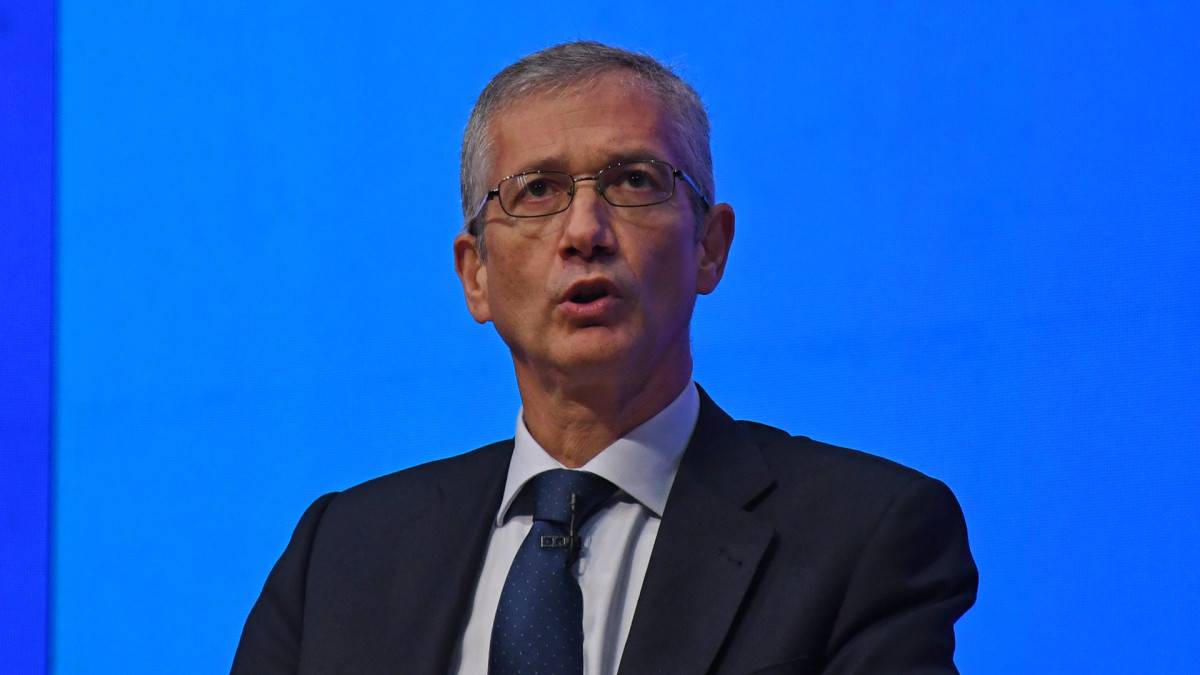
The “great renewal” of the European Central Bank’s (ECB) leadership, with up to three of the six seats on the Executive Board about to become vacant, has accelerated and Spain has decided to go after the Bank’s presidency, one of the most powerful and coveted posts in the European Union. The Spanish government under Pedro Sánchez backing Pablo Hernández de Cos as Spain’s candidate to replace the current president, the French Christine Lagarde, places Spain before the historic opportunity to take for the first time the reins of the euro area’s top monetary policy authority, a milestone comparable to achieving the presidency of the European Commission, or even of greater value if the mandate at the helm of the ECB coincides with economic turbulence.
“The bet puts Spain before the historic opportunity to take for the first time the reins of the euro area’s top monetary policy authority”
The candidacy of Hernández de Cos, General Manager of the Bank for International Settlements, enjoys undeniable prospects of moving forward, given his good reputation in Frankfurt and his strong standing among analysts and bankers. But Spain’s bet in favor of Cos is not without risk because two of the three vacancies on the Executive Board appear to be reserved for Germany and France, so Spain only has one shot in a context in which middle and smaller countries could push back against the overwhelming dominance of the larger members.
For the moment, the Netherlands has reinforced its bet on Klaas Knot after Sánchez publicly backed Hernández de Cos. A heavyweight rival for Cos who anticipates a clash between the Dutch hawk’s profile and the Spanish’s orthodox, and technocratic, prestige.
The race for the future ECB presidency has accelerated in the face of the pressing impression that Christine Lagarde will step down from that post before the end of her mandate, scheduled for October 31, 2027.
The ECB president has already signaled several times her willingness to relinquish part of her mandate, which would allow the EU to choose the future presidency before a possible victory in France of Marine Le Pen’s eurosceptic party.
To that unexpected replacement of the French one is added the departure from the Executive Board, also earlier than planned, of the German Isabel Schnabel. The major bargaining is joined by the end of the term of Irishman Philip Lane, the Bank’s Chief Economist, which expires on May 31, 2027.
The unwritten, but evident, plan is to share all three posts at once and as soon as possible so that the ECB enters with a completely renewed leadership in a year as electorally charged as 2027, in which elections are planned in several euro-area countries, notably France, Spain and perhaps Italy.
“The plan is to have a completely renewed leadership in a year as electorally charged as 2027”
The premature departure of Christine Lagarde, if confirmed, gives Spain a golden opportunity to seize one of the European Union’s most relevant posts, a position so far held by only three countries: the Netherlands, France (twice) and Italy. The Spanish prime minister, aware of the magnitude of the challenge, on Wednesday asserted the suitability of Hernández de Cos for the post, one of the names that had been most touted as a possible contender but which until now had not enjoyed clear and indispensable backing from his government’s side.
“Of course he [Hernández de Cos] has my support,” Sánchez said in an interview in New York with Bloomberg TV, one of the world’s leading financial channels. The prime minister praised “the capabilities, the knowledge and the leadership” of Cos and stated that “it would be very positive not only for Spain, but also for Europe as a whole, to have someone like him at the head of the central bank.” The bid for the ECB presidency is on the table and Spain is the first country to launch it so clearly, which may indicate the government’s confidence in pushing it through.
“The bid for the ECB presidency is on the table and Spain is the first country to launch it so clearly”
Spain had so far been playing with several open bets, knowing that the ECB’s planned leadership changes would open three vacancies, including the presidency, but over a period of several months (from May to December 2027). The government’s declared objective was to capture one of the three available posts to end Spain’s absence from the ECB’s Executive Board, which began after Luis de Guindos left on May 31 of last year.
The timetable rushing may work in Spain’s favor because it has caught Germany off guard, the other “big” country that has never occupied the ECB presidency and had hoped to take Lagarde’s mantle. And Germany’s Chancellor, Friedrich Merz’s fragile political position, does not seem to encourage him to fight for a European post that could lead to another resounding defeat.
Nevertheless, Spain should not count its chickens before they hatch. The former governor of the Dutch central bank, Klaas Knot, may win the backing of countries favorable to a very restrictive monetary policy. And benefit from a possible Berlin-Paris agreement to divide the other two vacancies, with the post of chief economist as the most coveted piece. In that scenario, the trick would remove the current Dutch member, Frank Elderson, from the Executive Board, giving Spain the chance to compete for a consolation prize and return to the Bank’s leadership.
The fragility of Sánchez’s government and its lack of clear allies in Brussels does not bode well for Cos either. Besides Spain, only two euro-area countries (Malta and Lithuania) have governments led by socialists. As evidenced during the Ceuta crisis, Sánchez cannot count on many gestures of support and understanding from his European Council colleagues, who are responsible for choosing the next ECB president. Spain has good odds of securing the ECB presidency, but it remains to be seen whether the European Council will decide.
