
Spain has three maritime façades and thinks like a land power. That is the diagnosis that emerges from looking, at once, at the gas heating Spanish homes, the batteries China manufactures at the gates of Ceuta, and the containers that no longer unload in Algeciras. All three phenomena, though distinct, share the same lesson that Madrid and Brussels resist learning.
Energy vulnerability is most evident on the domestic front. Spain repeats, almost like a mantra, that it has diversified its gas sources since 2022. And it is true, but only halfway. Algeria was its first supplier in 2025, accounting for 34.5% of imports, and in the tensest months of 2026 that figure has surpassed 42%. Since November 2021, moreover, that dependence runs through a single pipeline: Medgaz, linking Beni Saf to Almería under the Mediterranean, after Algeria closed the pipeline that crossed Morocco as diplomatic retaliation for the Western Sahara controversy. The Algerian Sonatrach controls 51% of that gas pipeline and, incidentally, 4% of Naturgy: Spain does not depend on “Algerian gas” in the abstract, but the flow is fed in no small part by the territorial dispute between two neighbors. The impact on energy supply is triple: volume, continuity, and price. Closing the valve would be both a commercial decision and, above all, a geopolitical one.
“Spain does not depend on ‘Algerian gas’ in the abstract, but the flow is fed to a large extent by the territorial dispute between two neighbors”
Similarly, dependence does not improve when we widen the focus. Spain imports Russian gas — 13.6% of its purchases through early 2026, compared with barely 5% for Italy — and remains, according to the network operator Red Eléctrica, an energy island, with only 2.8% of electrical interconnection with France versus the 15% Brussels demands for 2030. Spanish diversification has not replaced one dependency with many. Rather, it has swapped one pipeline for another, left a backdoor to Russia ajar, and continues without building the electric export corridor to Europe that has been promised for two decades.
Morocco Turns Europe’s Southern Border into an Industrial Hub
The second weakness is no longer Spanish, but European, and shares the same underlying geography. Brussels imposed tariffs of up to 35.3% on Chinese electric cars to protect the continental industry. And China, following the same logic with which Sonatrach turned a pipe into political influence, found a crack: Morocco. At least six Chinese manufacturers linked to the battery industry — Gotion High-Tech, BTR New Material Group, and Tianyouwei among them — have announced or launched projects in the country since 2023, drawn by low costs, an automotive ecosystem that already assembles 500,000 vehicles annually for Stellantis and Renault, and an advantage that no European tariff can touch: Morocco exports cars to the European Union without paying duties when they meet the origin rules of the bilateral agreement. According to the European Policy Centre, half of all Chinese investment directed to the Middle East and North Africa already lands on Moroccan soil. The “Made in Europe” label is not eroded by factories in Shenzhen, but by factories ninety kilometers from Tarifa. The euro-African bridge with Chinese capital strengthens the industrial cluster, creates added value (batteries), and transforms assembly into a strategic node in the value chain of electric mobility. Let us not misinterpret the diagnosis, because it is not a Moroccan trap: it is a rational industrial strategy of a country that understood earlier than anyone what it means to play its geographic cards well. At this point, the most timely question is why Brussels continues to view its southern border as a perimeter to monitor rather than as an extension of its own industrial boundary.
“Let us not misinterpret the diagnosis, because it is not a Moroccan trap: it is a rational industrial strategy of a country that understood earlier than anyone what it means to play its geographic cards well”
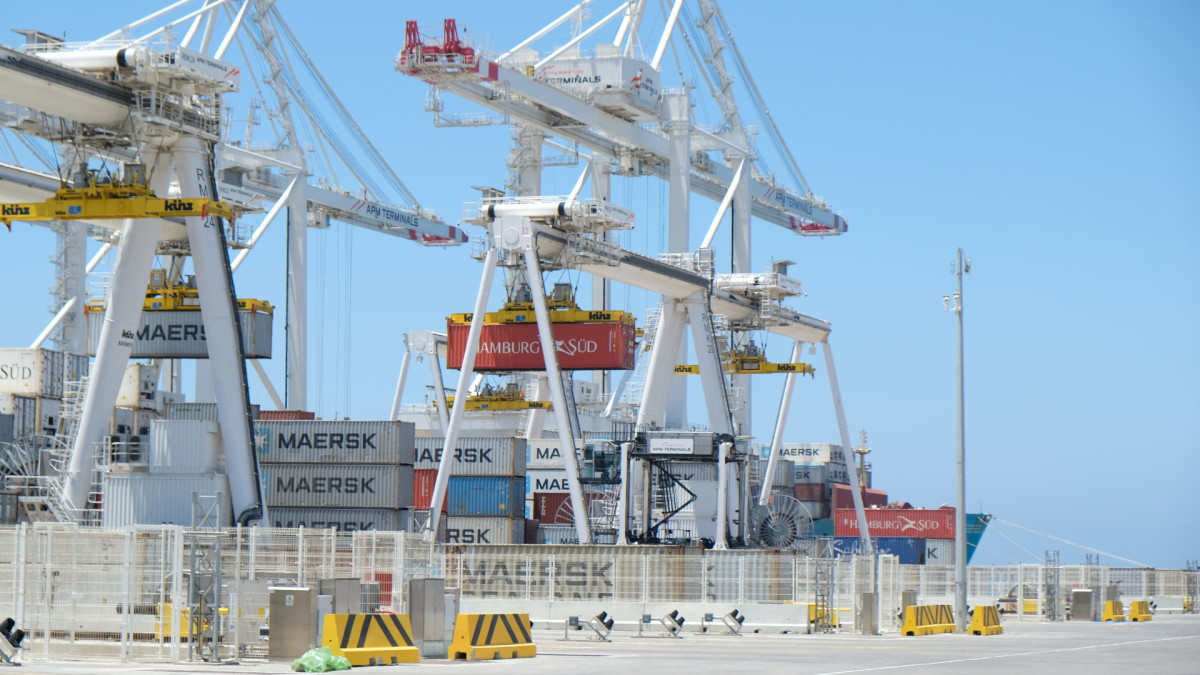
And here is where both vulnerabilities converge in the same interpretive error. The reflex answer is usually to repatriate, reindustrialize, build at home what is imported today: the logic of the “shipyard factory.” But that is the battle of last century. The best illustration of this is in the Strait: Tangier Med doubled in 2024 the container traffic of Algeciras (10.24 million TEU versus 4.7 million) and became the leading port in all Africa, in part because the EU’s own “green rate” for shipping, which in 2026 already taxes between 70 and 100% of a vessel’s emissions, pushes traffic toward a port that is only ten kilometers from the Peninsula, but outside that jurisdiction.
Morocco, moreover, will inaugurate between 2026 and 2027 a third major port, Nador West Med, with expandable capacity to 5.5 million TEU. And the clearest example of that possible value leakage would literally travel through Spanish waters without touching them: the submarine cable Xlinks, which would transport Moroccan renewable electricity to the United Kingdom — 8% of its electricity demand — would cross Spanish territorial waters on its 3,800-kilometer route without Spain capturing a single megawatt of that flow. Spain would be a transit territory, while the axis would carry the value. The project today faces financial and regulatory problems, but it could find supporters: will Spain’s geopolitics be able to intervene in its development?
Our southern neighbors are powerful because they have leveraged their production to become strategic nodes. There is no alternative Algerian supply, and there is no better interlocutor between China, Africa, and Europe than Morocco, a political regime that guarantees stability. Beijing’s consensus does not question political conditions. The supply chains of deglobalization reward those who occupy the hinge position, not those who manufacture cheapest. And it is prudent not to oversimplify: Algeciras remains the twelfth-ranked port in the World Bank’s port efficiency index, ahead of Rotterdam or Antwerp. The Spanish port has not lost capacity, but it has fallen behind in volume to a neighbor who decided years ago to look at the sea with state intent.
“The supply chains of deglobalization reward those who occupy hinge positions, not those who manufacture cheapest”
Alfred Thayer Mahan, the American naval strategist, wrote more than a century ago that nations do not become great by the territory they occupy, but by their capacity to control the maritime communications that cross it. He did not speak of warships for the sake of naval power, but of a way of looking at the map: the sea not as a border to defend, but as a flow to govern. Spain has the busiest strait in the world and has spent decades viewing it as a migratory problem rather than as the geoeconomic asset it is. Algerian gas, Chinese batteries in Morocco, and the cable that could cross Spanish waters are not three crises to be solved with more diplomacy or more tariffs: they are the same symptom. Mahan did not merely tell the United States to build more ships. He told it to decide, once and for all, whether it wanted to be a nation with the sea or a nation in the sea. Spain still has not answered that question.
