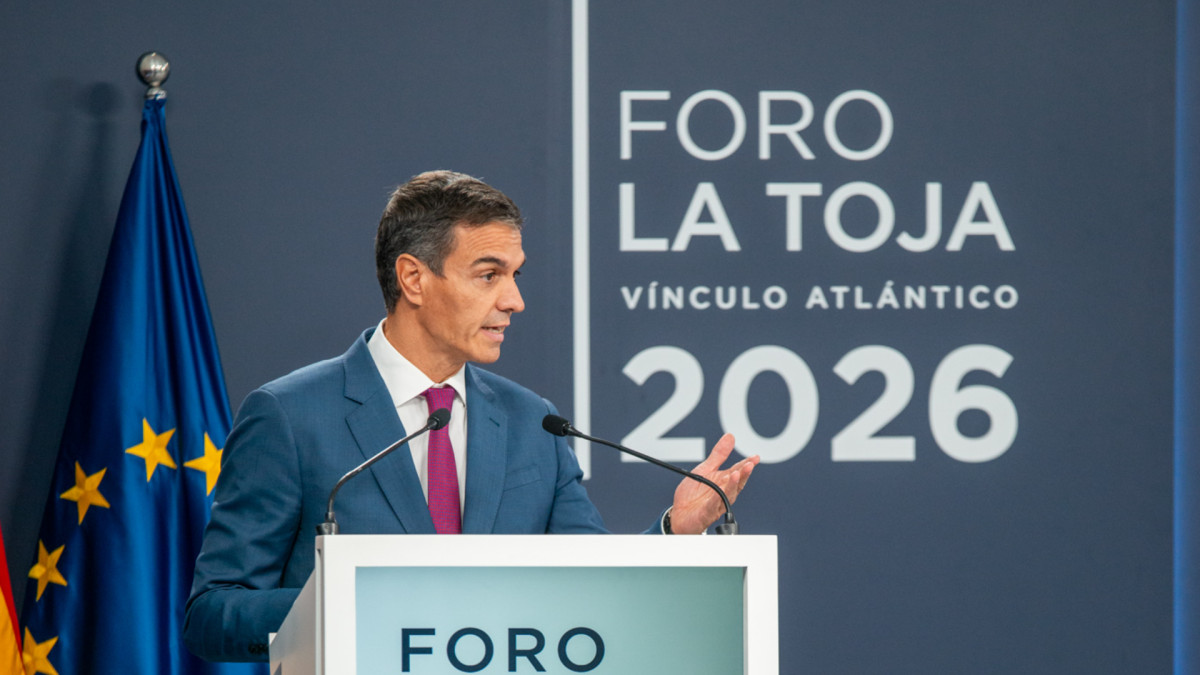
That the global society inhabits a world in disorder is already a given at La Toja. The title of this new edition of Foro La Toja served as the starting point for the inaugural address of the Prime Minister, Pedro Sánchez. In an international setting defined by the accelerating transformations and the erosion of traditional institutions, the head of government opened his remarks by asking who really benefits from a world in disorder, before addressing some hot issues on the national agenda, such as Ceuta or the housing crisis.
“When the will and the desire for international concertation lose normative force, the public space is left at the mercy of brute force and of weapons”
When the will and the desire for international concertation lose normative force, the public space is left at the mercy of brute force and weapons, the president said. In that deregulated ecosystem, victory invariably falls to those who possess greater material capacity to impose their terms unilaterally. Likewise, the erosion of international norms directly affects the socio-economic sphere: when shared rules and workers’ rights are weakened, “the winner is the one who has the most power to impose their conditions”, he lamented.
Rebelo de Sousa, Felipe VI and Pedro Sánchez. Photo: Foro La Toja
The Breakdown of International Law and the Principle of Humanity
The president suggested that the breakdown of the international order responds to an ambitious strategy. After referring to current conflicts such as the invasion of Ukraine, the genocide in Gaza, or the war in Iran, he broadened the scope and noted that wars have claimed more than 150,000 lives in the last year, while the number of forcibly displaced people worldwide has now climbed to 117,000,000.
“No wall or barrier, no matter how high and impenetrable it is intended to be, will manage to contain the desperation of people to achieve a better life”
Before King Felipe VI and the President of the Xunta, Alfonso Rueda, Sánchez made an explicit reference to the Ceuta border to illustrate the limits of punitive responses to global dynamics. “No wall or barrier, no matter how tall or impervious it is, will manage to contain the desperation of people to achieve a better life,” he noted. Defending human dignity above physical barriers constitutes, in the president’s words, the very substance on which international order must be built.
Geopolitics, the Climate Emergency, and the European Union Framework
On the international plane, the address focused on Europe’s position vis-à-vis the great powers and the global transformations. Trade relations with China occupied a large portion of this analysis, marked by the current imbalance in trade. Sánchez defended openness to trade and foreign investment, but also the need to rebalance the ledger and revisit the relationship with the Asian giant to reduce strategic dependencies. This greater European autonomy would require, in his view, a much more ambitious EU budget and the strengthening of bilateral alliances such as the Treaty of Friendship with France, whose ratification in the Spanish Senate was also addressed in his speech.
In another vein, the climate emergency appeared as a top-order threat to which Sánchez refused any backsliding. Climate change, he noted, not only has environmental consequences but “kills and impoverishes”. The president defended the need to maintain the course of the ecological transition in the face of an Europe that is not ready to bear the economic and social costs of inaction.
“Sánchez supported openness to trade and foreign investments, but also the need to rebalance the balance”
The volatility in strategic hubs for hydrocarbon supply, such as the Strait of Hormuz, reinforces for the head of government the urgency of accelerating the deployment of clean energy, which he contrasted with dependence on these critical points under the formula “facing Hormuz, sun, water, and wind”.
Economic Growth, Social Safeguards, and the Housing Challenge
Turning the analysis to the national macroeconomic situation, the president highlighted the “admirable resilience” demonstrated by the Spanish economy in an adverse international context. In an environment of European uncertainty, the figures illustrate a successful model capable of sustaining growth. Spain has concentrated the creation of 85% of the wage employment in the entire euro area, managing to place employment at historic highs while generating better-quality jobs.
“The president highlighted the ‘admirable resilience’ demonstrated by the Spanish economy in an adverse international context”
The political premise of the “no to war, yes to social shields” is, in fact, a summary of the president’s idea of maintaining the State’s investment effort to protect the middle and working classes against external shocks. Within this framework of public protection, housing was discussed. The Prime Minister made a direct appeal to political forces to put aside ideology and partisan confrontations in housing management, defining the right to an affordable home as “a matter of pure humanity” on which social cohesion must be built.
Democratic Governance of AI Against the Tech Oligarchs
The final segment of the speech was devoted to the responsible deployment of artificial intelligence and to the need to establish public counterweights to the accelerating pace of technology. Against those who defend the neutrality of technology, Pedro Sánchez argued that it is not immune to the values and interests of those who develop and use it. In this line, he defended the need to establish fair rules and to govern the digital transformation according to the democratic principles.
“Responding to this industrial revolution from paralysis or fear would be an absurd error, but just as absurd is abstaining from regulating its impacts”
The president warned against the temptation to hand over technological self-regulation to the very corporations of the sector. Responding to this industrial revolution from paralysis or fear would be an absurd error, but equally absurd is to refrain from regulating its impacts. “We cannot wait for every limit to be crossed”, he warned.
To ensure that innovation serves the common good, the governance framework proposed by the Government rests on three normative pillars: a permanent public scrutiny, a tight governmental oversight, and the imposition of criminal responsibilities when the actions of technological tools violate citizens’ rights. The defense of fair rules of the game thus threaded through an intervention in which Sánchez linked economic stability and social justice with the capacity of democratic institutions to govern the great transformations of our time.
In partnership with