
Europe remains searching for a way to respond to a Russia that blends conventional warfare with drones, disinformation, sabotage and migration pressure. Svetlana Tsikhanouskaya, a Belarusian opposition activist and politician, analyzes that challenge from the vantage point of a country that, under Alexander Lukashenko, has become part of the Kremlin’s playbook.
For the leader of the Belarusian opposition, the issue goes well beyond Belarus’s political future: “Belarus is a European security question”. Europe, long accustomed to peace, must learn to respond more firmly when Moscow tests its limits, she argues.
In this exchange at the La Toja Forum, Tsikhanouskaya weighs the weaponisation of migration, frictions in the transatlantic relationship, the role of the United States and the path forward for the war in Ukraine. She also warns of the risk of new provocations on Europe’s eastern flank — “don’t panic, but be prepared” — and explains why a peace settlement that leaves Belarus subjugated to Russia would not resolve the problem. She highlights Spain’s backing of Belarusian democratic forces and recalls that “when Belarus has needed help, Spain has been there”.
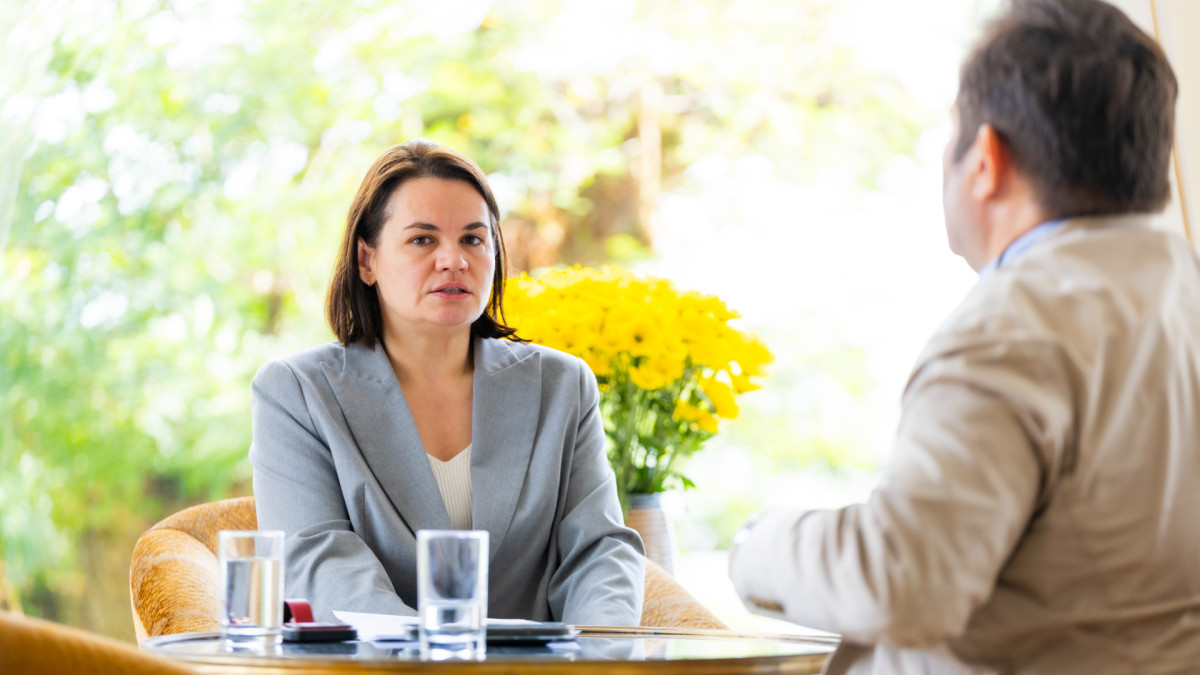
Svetlana Tsikhanouskaya during her conversation with Agenda Pública at the La Toja Forum. Photo: Agenda Pública / Yanka Soto
There is something Europe still seems unable to resolve: how to respond effectively to Russian hybrid warfare. As a Belarusian, you know Russia very well and you know what Russia is capable of. Perhaps you can help us understand both countries better and, more importantly, how Europe should respond.
With a free, democratic and independent Belarus, Europe would be far stronger. Because we share a border with Russia and have endured Russian domination for so long, we have substantial experience in resisting Russian subjugation and hybrid assaults.
The current situation is that Belarus, due to [Alexander] Lukashenko’s policies and his alliance with [Vladimir] Putin, has become part of these hybrid attacks against Ukraine and, of course, Europe. As long as Lukashenko remains in power, there will be constant threats emanating from Russia through Belarus toward the European Union and NATO borders.
It is deeply painful to witness migrants being used to press the borders; to see drones crossing over Lithuania, Poland and Latvia; to watch the regime disrupt airports with smuggling balloons, and to observe Russian and Belarusian propaganda trying to poison European minds with populist narratives.
I also understand that if — or when — Ukraine wins this war and Belarus gains freedom, it will be much easier for Europe to confront these hybrid attacks.
“It is very painful for me to see migrants being used to put pressure on the borders; to see drones flying over Lithuania, Poland and Latvia”
As for the broader question of how to shield Europe, I don’t possess a simple answer. The most powerful people in the world are considering it. But after living beside Russia for so long, I know one thing: Russia will not stop until stopped. And the only force capable of stopping Moscow is a strong, capable, decisive and bold Europe.
Russia is better prepared for hybrid warfare because Europe grew used to living in peace. European institutions were built for peacetime. Europe was unprepared for escalation or provocation because, for many years, its policy toward Putin rested on appeasement and a business-first approach.
Yet, we eventually learned that Russia is not a trustworthy neighbour or partner. In fact, it is not a partner at all.
Europe therefore confronts new challenges. But I believe everything begins with ordinary people and their governments. Belarusian society is different: we know who our enemy is and we know what we are fighting against. We do not need to convince Belarusians that Russia poses a threat.
“Russia is better prepared for hybrid warfare because Europe became accustomed to living in peace. European institutions were built for peacetime”
One tactic employed by Russia is to overwhelm ordinary people with information — to flood the public square with data to the point where truth and fabrication become indistinguishable. Over time, people withdraw from politics altogether. That is precisely the objective of Russia and of the Belarusian regime.
That is why it is essential to devise new ways of engaging people in politics and equipping them with reliable information. Everyone has a role to play: businesses, the media, AI companies, governments and civil society organizations. We must find ways to bring people back into politics and rekindle their interest in global events.
Let’s talk about the weaponisation of migration. You are well aware of how the Belarusian government has used migration as leverage against Poland. Recently, in Spain, we have seen something that raises a number of the same questions. Do you see similarities between the weaponisation of migration on Europe’s eastern border and what could occur on its southern border?
Migration itself is already a major challenge for societies. But when it is orchestrated or weaponised, it becomes a double burden. At our borders, we know how the system works. People are flown in and steered toward the frontier, where attempts are made to push them across.
What these regimes aim to achieve is to divert the attention of governments and societies from fundamental questions — peace versus war, democracy versus dictatorship — and redirect it toward migration. They also compel governments to divert resources toward managing the migration emergency.
In our region, for example, the war in Ukraine rages on. Resources spent handling an artificially produced migration crisis are resources and political energy that cannot be directed elsewhere, including toward supporting Ukraine. That is part of the objective.
“What these regimes want to achieve is to distract the attention of governments and societies from fundamental questions — peace and war, democracy and dictatorship — and redirect it towards migration”
At the same time, these regimes prey on human beings and human lives. There is always a moral dimension to this problem. Democratic societies debate endlessly about how to assist people while also preventing migration from being instrumentalised. On the Belarus border, for instance, walls have been erected.
For authoritarian regimes, however, human life means little. They are willing to use people as instruments to pressure and blackmail democratic nations. I’m not sure there is an easy method to resist this. On one hand, you sometimes must negotiate with the responsible states to prevent such scenarios. On the other hand, dictators do not necessarily want to negotiate. They want to humiliate you. They want you to come to them asking for concessions and, ultimately, to compromise your principles.
This is part of the clash between democracy and dictatorship. Any signs of indecision will be perceived as weakness by authoritarian regimes, emboldening them. We can already see that this is not solely about migrants. There are many different forms of hybrid aggression. They are constantly testing how far they will be allowed to go. If there is no response, they take another step.
Consider, for instance, the drones that recently landed on Lithuanian soil. There was no particularly strong Western reaction. No one was injured and nothing catastrophic occurred. But the message Russia might receive is: we can push one step further.
What happens next? A building is demolished? And after that? People are killed by drones? At what point will there be a response strong enough for Russia to understand that this is unacceptable?
These operations also seek to fracture governments, parliaments, political parties and societies. We can observe the rise of populist forces across Europe. Yet populists often propose closing the issue instead of solving the underlying problem. That is not a viable path forward.
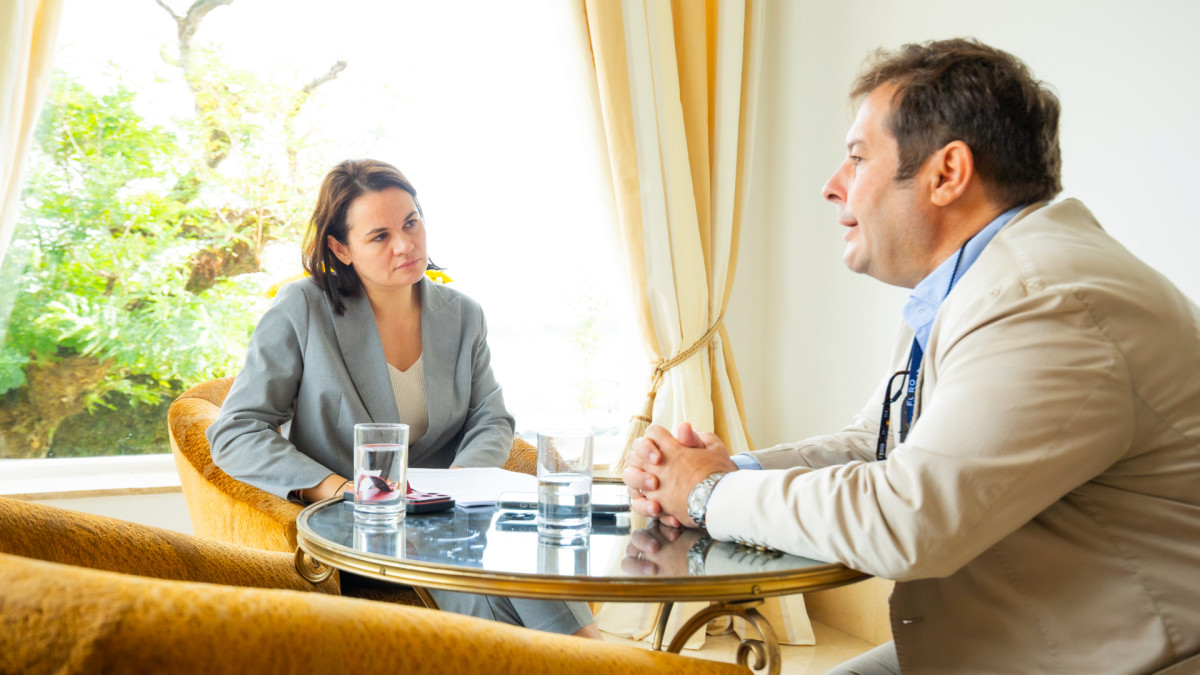
The Belarusian opposition leader speaks with Marc López Plana about the transatlantic relationship and the future of Belarus. Photo: Agenda Pública / Yanka Soto
How does Washington’s approach shape your strategy in Belarus and, more broadly, Ukraine and Eastern Europe?
First and foremost from a Belarusian vantage point, we are grateful to the United States for its efforts to secure the release of political prisoners. That humanitarian track is continuing.
“These operations are also attempts to divide governments, parliaments, political parties and societies”
Around five hundred people have already been released from Belarusian prisons. Of course, Lukashenko keeps detaining new individuals, so it can feel like a revolving door. Nevertheless, five hundred lives have been saved for the moment, and we urge the United States to continue these efforts.
As for Ukraine, we need Ukraine to prevail in this war and we welcome American attempts to initiate negotiations. We see U.S. representatives traveling to Russia and Ukraine to try to organize a process.
But what matters to us is that any peace should be enduring and just — not merely a temporary pause that allows Russia to regroup and strike again. I want to believe that Americans ultimately share that goal.
Of course, we all see the fluctuations in the transatlantic relationship. Reactions to that turbulence vary. Some view it as disastrous for the transatlantic community — and in many ways it is. Others argue that it has forced Europe to recognise that it must become stronger on its own merits.
We can already see movement in that direction: Europe is taking a much more serious look at its own defense and how to shield itself if, for instance, the United States reduces its commitment to European security.
In that sense, this turbulence has reinforced Europe’s resolve to act from a position of greater strength. Nevertheless, I believe the world would be safer if transatlantic unity were preserved and strengthened. What matters most is that shifts in the U.S. stance should not divide the European Union.
Take Belarus. U.S. engagement with the Lukashenko regime over the release of political prisoners has sparked a debate in Europe: perhaps Europe should also start talking to Lukashenko. That would be a dangerous path.
We urge our European partners to stay steadfast, principled and decisive toward Belarus. There should be no appeasement and no legitimisation of the regime.
“What is particularly important is that changes in the US position should not divide the European Union”
American sanctions can be used as leverage to secure the release of political prisoners. But Europe has a complementary role: Belarus is a neighbour. A free, independent and democratic Belarus is also in Europe’s security interests.
Our approach thus combines two elements: American sanctions can aid in freeing individuals, and European sanctions should help liberate the country itself.
Let’s talk about Spain and its support for the Belarusian democratic movement.
It may sound surprising to some, but Spain has emerged as one of the strongest supporters of Belarus and its democratic forces.
Geographically distant, Belarus might not seem a natural Spanish priority. Yet the solidarity shown by the Spanish government, parliament and, I hope, Spanish society has been notable.
First, Spain has consistently aligned itself with the European Union’s Belarus policy, including sanctions and political pressure on the regime.
Our strategy has two aims: to press the regime while helping Belarusian society become stronger. We are not asking anyone to fight instead of us. We are asking for help so that we can become stronger and more resilient ourselves.
But Spain has taken steps that are, in some respects, unprecedented. Many Belarusians who were forced to flee due to repression continue to suffer transnational repression. One tool used by the regime is to strip Belarusians abroad of valid documentation. We cannot renew our passports.
In Spain, thanks to Foreign Minister Albares, specific instructions were introduced allowing Belarusian citizens to use expired documents when renewing residence permits. This is an extremely important measure.
“Spain has consistently aligned itself with the European Union’s policy towards Belarus, including sanctions and political pressure on the regime”
There is also the matter of political prisoners. Thousands remain imprisoned. Some have been released thanks to American diplomatic efforts, but many of those released are immediately expelled from Belarus. Democratic forces then have a responsibility to help them start a new life because many have lost everything.
We established the International Humanitarian Fund, to which Spain has contributed twice. That money genuinely saves lives. It funds physical and psychological rehabilitation, housing and relocation. We have also opened the Mission of Democratic Belarus in Madrid to represent Belarusians in Spain and to provide an organized focal point for the diaspora. That was also possible with support from the Spanish Ministry of Foreign Affairs.
Prime Minister Sánchez has been highly supportive and vocal about Belarus. I have met him several times. We are also trying to imagine the future of Belarus.
After the Franco era, Spanish society had to undergo its own process of democratic transition and reconciliation. Belarus will eventually confront similar questions, and we want to learn from the Spanish experience about how such a process can be managed.
Our cooperation, therefore, operates on many levels: experts, human-rights defenders and political institutions.
I understand perfectly well that Spanish citizens cannot think about Belarus every day. You have many problems of your own, and crises abound globally. But when Belarus has needed help, Spain has been there.
We will not forget that. And when democracy eventually prevails in Belarus, Spain will have been a part of that story.
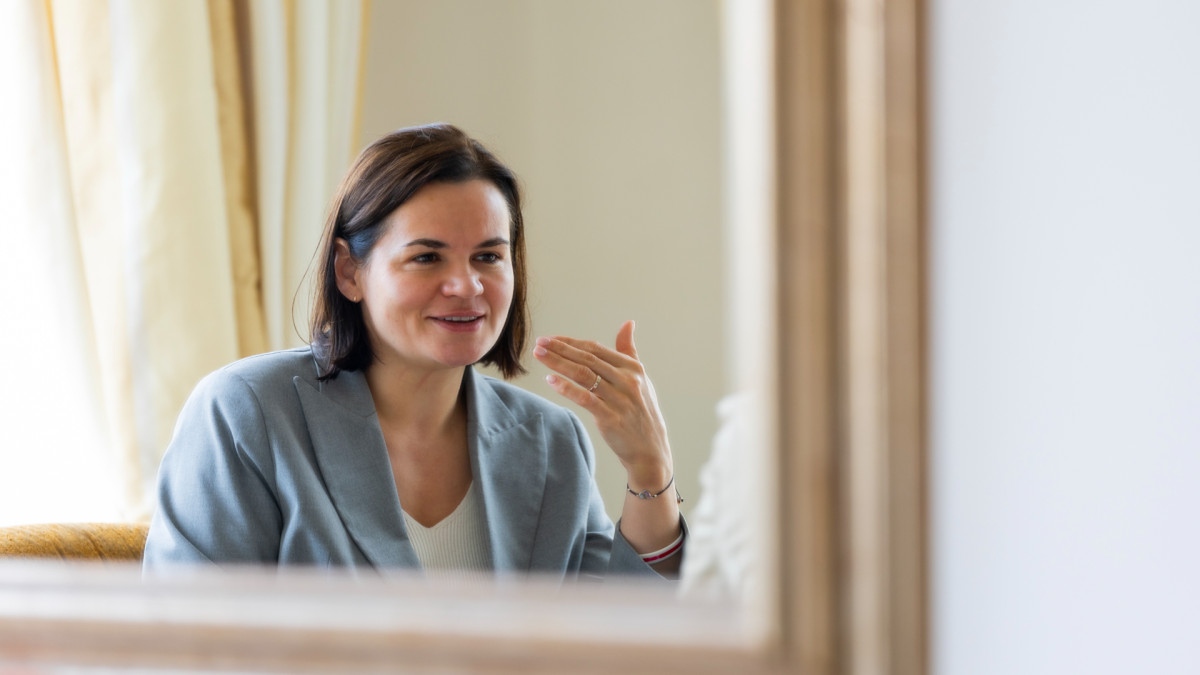
Tsikhanouskaya discusses Spain’s support for the Belarusian democratic movement and the opposition’s next steps. Photo: Agenda Pública / Yanka Soto
Let me ask you about your own next steps. How are you operating today — and how do you intend to operate in the coming years — to achieve democracy in Belarus?
Belarus remains, to some extent, a hostage of broader geopolitical developments — most notably the Russia-Ukraine war.
The regime in Belarus participates in the conflict because it lets Russia deploy missiles, nuclear weapons and military infrastructure from its territory. No one knows whether provocations or escalations along the EU border could eventually occur.
Belarusian society and the democratic movement are firmly opposed to Lukashenko’s regime. We stand with Ukraine, and we want a European future for Belarus.
Our task today is to preserve unity and continue building the institutions and instruments needed to resist the regime both inside the country and abroad. I am proud of what we have achieved.
In 2020 we witnessed a massive democratic uprising. It was brutally crushed. Putin supported Lukashenko, and today Putin and Lukashenko are extremely close allies. It is no longer realistic to imagine separating them.
For six years Belarus has endured intense repression. In many respects, people live under conditions reminiscent of the Stalin era. More than 900 individuals are currently imprisoned for political reasons, and at least half a million have been forced to leave the country due to repression. Yet we have managed to establish alternative institutions of power in exile.
Independent media that were destroyed inside Belarus have resumed operations from abroad. About 70 percent of their audience remains inside Belarus. That tells us something important: people remain interested. Despite fear and repression, people inside the country continue providing information and data to democratic institutions.
We have also formed formal links with the European Union, the United States, the United Kingdom, Canada and others. We have become part of international political structures. Today there are, politically speaking, two Belaruses: a regime serving Russian interests, and a Belarusian society that wants a European future and seeks to become a reliable partner for Europe rather than a perpetual source of insecurity.
Despite having very limited space and resources, we have managed to keep Belarus on the international agenda. We continue to remind the world about our struggle and about political prisoners. And after Russia’s invasion of Ukraine, we have also shown something else: Belarus is no longer merely a human-rights or humanitarian question. Belarus is a European security question.
“Belarus is no longer simply a human-rights or humanitarian question. Belarus is a European security question”
A free and democratic Belarus serves Europe’s national and collective security interests. Only with a free Belarus can Europe’s eastern border become truly secure. Ukraine’s victory is therefore essential. If the war ends in a frozen stalemate or Ukraine is defeated, the status quo in Belarus could be frozen for decades. Russia would continue to subjugate and gradually absorb our country.
So my question to Europe is whether it is prepared to be bold and decisive enough to defend its own interests in a free and democratic Belarus.
We need more than words of solidarity and condemnation. We require practical and technical support, political backing and assistance for Belarusians living abroad. We need the resources and energy to carry on this struggle. Supporting democratic Belarus is not charity. It is an investment in European security.
At present, understandably, much attention is directed toward a possible Russian-Ukrainian peace agreement. Yet Belarus is frequently treated as a separate question to be tackled later. Our message is clear: you cannot postpone Belarus until the day after a settlement in Ukraine. If the Belarusian question is not addressed alongside Ukraine, you risk delaying the next escalation. Russia will not forget Belarus. Russian subjugation of Ukraine and Belarus is part of the same strategic problem.
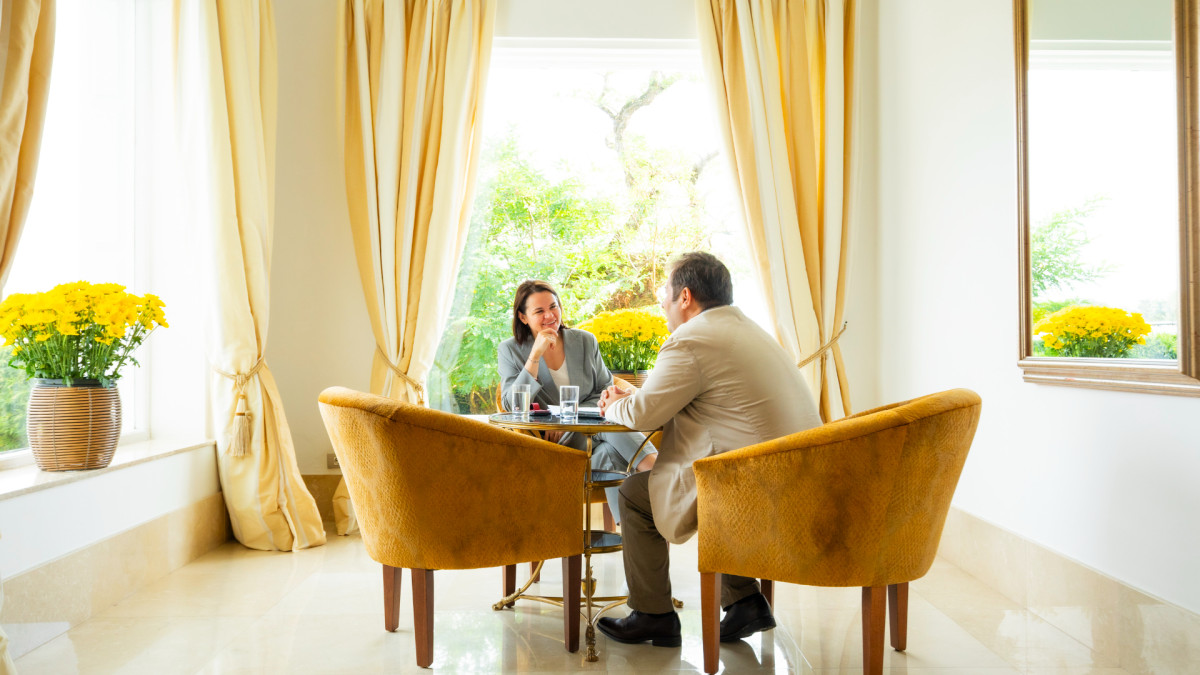
Tsikhanouskaya and López Plana discuss European security and the risk of Russian escalation. Photo: Agenda Pública / Yanka Soto
Do you think Putin could launch a military strike against one of the Baltic states in the near future? Some experts see this as the next move.
As I always say: don’t panic, but be prepared. Much rides on whether Europe stays united. Look at the drones over Lithuania; there was no strong reaction, and Russia could read that as a green light to push further.
I lived in Lithuania for five years before moving to Warsaw. When the war began, people were already discussing whether Lithuania or other regional states could be attacked someday. The main issue was military readiness, and that situation has improved considerably since then.
“Don’t panic, but be prepared. A great deal depends on whether Europe demonstrates unity”
Yet there is another challenge: society. I recall people asking whether, in the event of an attack, our partners would truly come to defend us. There was real uncertainty about that, and that feeling is dangerous because it signals that citizens may doubt the alliance’s strength. Perhaps that doubt exists not only in society but also among politicians.
If Russia senses weakness or disunity, it may decide to test Europe. Experts often mention the Suwałki Gap, for instance, but we must recognise that modern warfare involves many fronts, not solely a land invasion. Russian soldiers do not always need to cross a border: there are drones, cyber operations, sabotage, and other forms of attack.
In Belarus, new military infrastructure is being built that would not be necessary if the country were not preparing for possible conflict. There are devices capable of redirecting drones and boosting intelligence activity along the EU borders. Does this imply provocations or escalation are possible? Yes. Does it mean we can be certain they will happen? Of course not.
You know Russian society far better than I do. Is there a point at which that society might stop embracing Putin’s policies?
Russia has never invested enough in its people. Even before the war, there was a wide gap between the wealth amassed by businesses, oligarchs and Putin’s inner circle and the resources allocated to ordinary citizens.
Furthermore, imperial attitudes remain deeply rooted in large segments of Russian society. Many people believe the war against Ukraine is justified. Propaganda is now preparing them to view Europe as an adversary and to contemplate a broader confrontation.
The narrative goes: we are a great country; how dare they challenge us? People influenced by these imperial ideas may support confrontation. Changing that mentality could take decades, perhaps generations. But for that process to even begin, Russia must first be defeated in its bid to subjugate its neighbours.
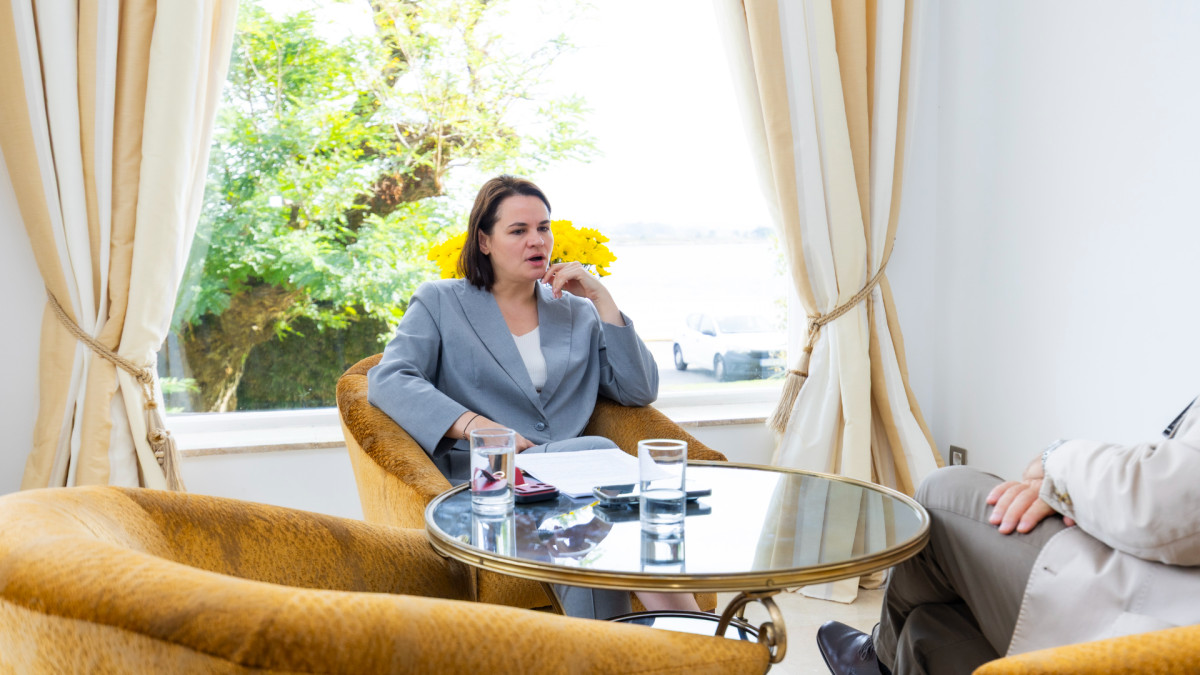
Tsikhanouskaya responds on the sanctions impact and the wartime economy in Belarus and Russia. Photo: Agenda Pública / Yanka Soto
You spoke about the oligarchs. Could economic pressure and sanctions eventually shift their stance toward Putin? They are losing access to markets and assets. Might that translate into political influence?
Assessing Russia directly is difficult because the Belarusian and Russian contexts differ. I can speak more confidently about Belarus. Of course, businesspeople dislike it when normal commerce breaks down. But dictatorships construct systems that protect the regime.
Even powerful businesspeople can be kept in line through fear. Security services operate on behalf of the regime; the courts function in a vertical manner; and at any moment a businessman can be arrested and imprisoned. We have seen this in Belarus.
“Businesspeople are unhappy when they cannot trade normally. But dictatorships build systems designed to protect the dictator”
At the same time, some businesspeople tied to the regime can continue to earn money alongside the dictator. War can destroy some economic opportunities while creating others.
In Belarus, for example, the war has generated significant economic opportunities for parts of Lukashenko’s system because Belarusian enterprises are producing military equipment and supplies for the Russian war machine.
So while some oligarchs or companies may lose money due to sanctions, others may benefit from the wartime economy. A similar dynamic may be at play in Russia, though I cannot judge the Russian situation with the same clarity.
Thank you very much.
