
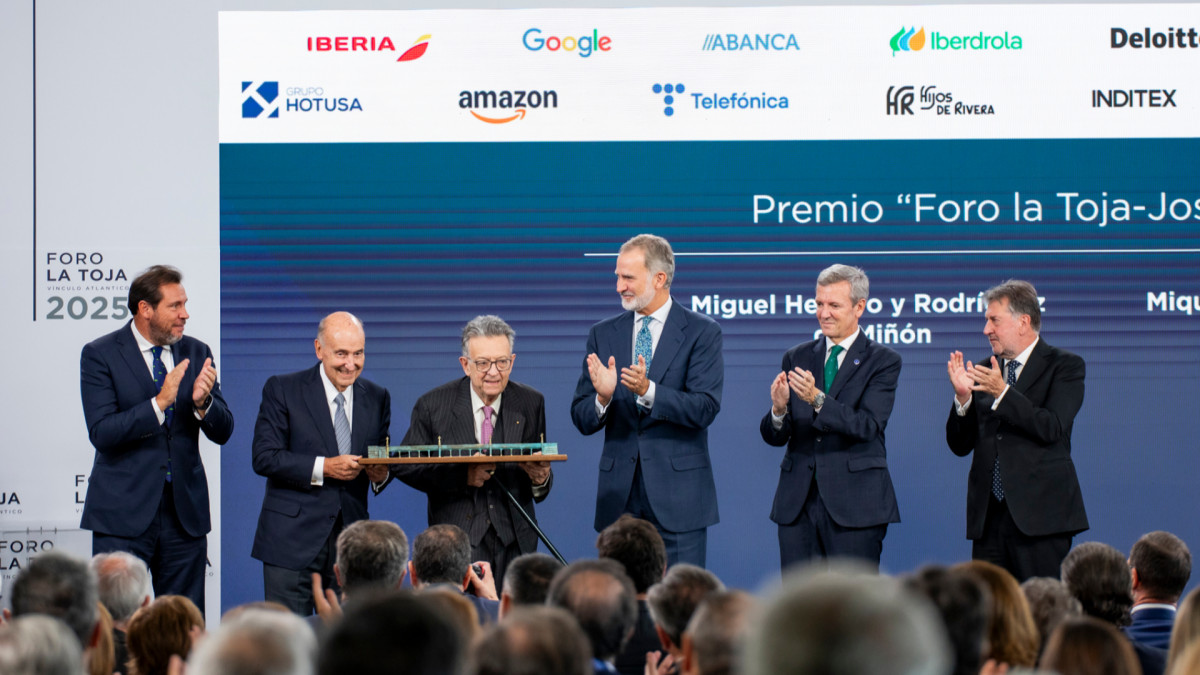
The seventh edition of the La Toja Forum has opened with an unavoidable commitment: to understand that “the world order, some would call world disorder, is changing.” These were the words of King Felipe VI at the inaugural ceremony on Illa da Toxa, where he participated alongside Alfonso Rueda, the president of the Xunta de Galicia; Miguel Herrero y Rodríguez de Miñón and Miquel Roca, the fathers of Spain’s 1978 Constitution; and Amancio López Seijas, president of the Foro La Toja foundation.
Citing the Italian Antonio Gramsci, Felipe VI stressed that “when the old world dies, the new one takes time to appear” and warned that “in the chiaroscuro, monsters emerge, and that chiaroscuro could define us today.” In the face of this challenge, which the rest of the speakers also agreed on, the king highlighted multilateralism as a path of escape or illumination for democracies. “When the chiaroscuro threatens, we must reinforce and adapt multilateralism”, he reiterated.
“We cannot allow disenchantment or loss of cohesion to push us back or surrender to chaos”
For the monarch, the challenge lies in stemming the current trend, at a moment when “multilateralism is shifting toward multipolarity.” To illustrate this, he referred to the degradation of international institutions such as the United Nations (UN) and, shortly after attending the UN’s latest General Assembly in New York, lamented that it is “subjected to a large campaign of discredit.” In the same vein, he acknowledged that perhaps some form of reform might be advisable to overcome the “certain fatigue” that the United Nations could be suffering from. “We cannot allow disenchantment or loss of cohesion to push us back or surrender to chaos,” he explained.
In this retreat, he argued, Europe, as an international actor, should begin to reverse the situation: “The EU needs to be heard and to serve as a firm voice in defense of those values.” Finally, the head of state backed moderation and dialogue when advancing and building this new paradigm, noting that “neither radicalism nor division provide solutions”.
The King Felipe VI during the inauguration of Foro La Toja. Photo: Agenda Pública / Yanka Soto
Just before the king’s intervention, amid loud applause, the Josep Piqué prize was awarded to the two living fathers of the 1978 Spanish Constitution, Miguel Herrero y Rodríguez de Miñón and Miquel Roca i Junyent.
T
Herrero playfully remarked with the claim that he was “limping,” but the Constitution “is not lame nor does it limp.” He defended the work of the drafters of the text and the spirit that conceived it. He also defended the important role that Spain can play on the international stage: “We are a euro-atlantic country because we have inescapable ties with the euro and the Atlantic”.
Roca, for his part, continued with the theme of dialogue and moderation, pointing out that “we were and we are capable of accepting each other in our diversity.” “However painful the differences may be, we must do it and we will do it,” he insisted before stating that “democracy is a pact” and that “sometimes it is difficult, but more difficult is not trying”.
A Strong Europe
In the hours leading up to the prize presentation, López Seijas emphasized precisely that the La Toja Forum seeks to “build a new social contract”, promote that Europe become “a geopolitically relevant actor with a strong and autonomous defense” or strengthen and maintain ties with America “beyond contingent circumstances”.
In this vein, from the Galician sensibility, the president of the Xunta de Galicia, Alfonso Rueda, appealed to understanding, noting that “there will always be a clash between those who strive to tighten bonds and those who strive to break them,” but “there will be no world order that pleases everyone without bonds that sustain it.” “The European Union is the most grandiose, ambitious, and feasible project today,” he added.
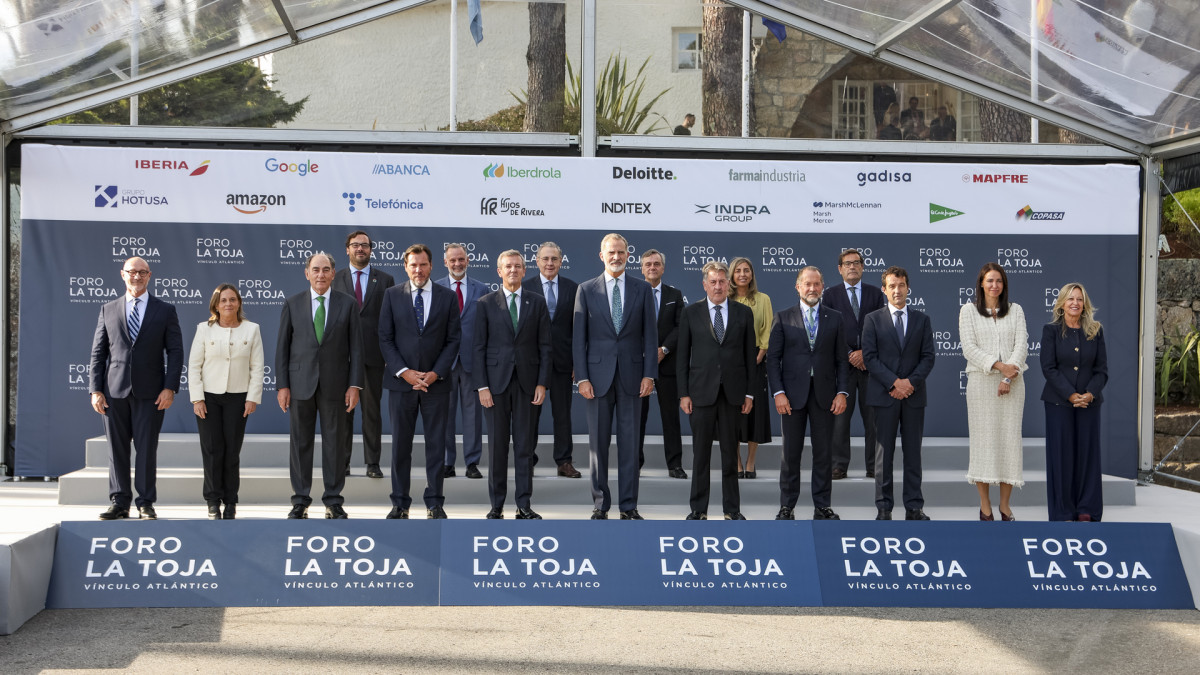
Authorities and sponsors of Foro La Toja. Photo: Agenda Pública / Yanka Soto
Ignatieff: “We Find Ourselves in a Gray Zone”
After the welcome ceremony, the writer and scholar Michael Ignatieff took part in a conversation with former government vice-president Soraya Sáenz de Santamaría. The 2024 Princess of Asturias Award for the Social Sciences, who had already discussed the crisis of liberal democracy in , agreed with some points of Felipe VI’s intervention. “We are not at war, but we are not at peace either; we find ourselves in a gray zone,” he warned. After these gray and dark zones, the discussion turned toward a diagnosis of the present and the prospects for the future.
“The liberal and democratic Europe is suddenly alone in a hostile world, facing many challenges at home”
“The liberal and democratic Europe is suddenly alone in a hostile world, facing many challenges at home.” This was Ignatieff’s description of the day-to-day life of the European Union today, to which one should add its relationship with the United States, which, in the thinker’s view, could carry out “the greatest act of self-destruction in history” as a contemporary empire.
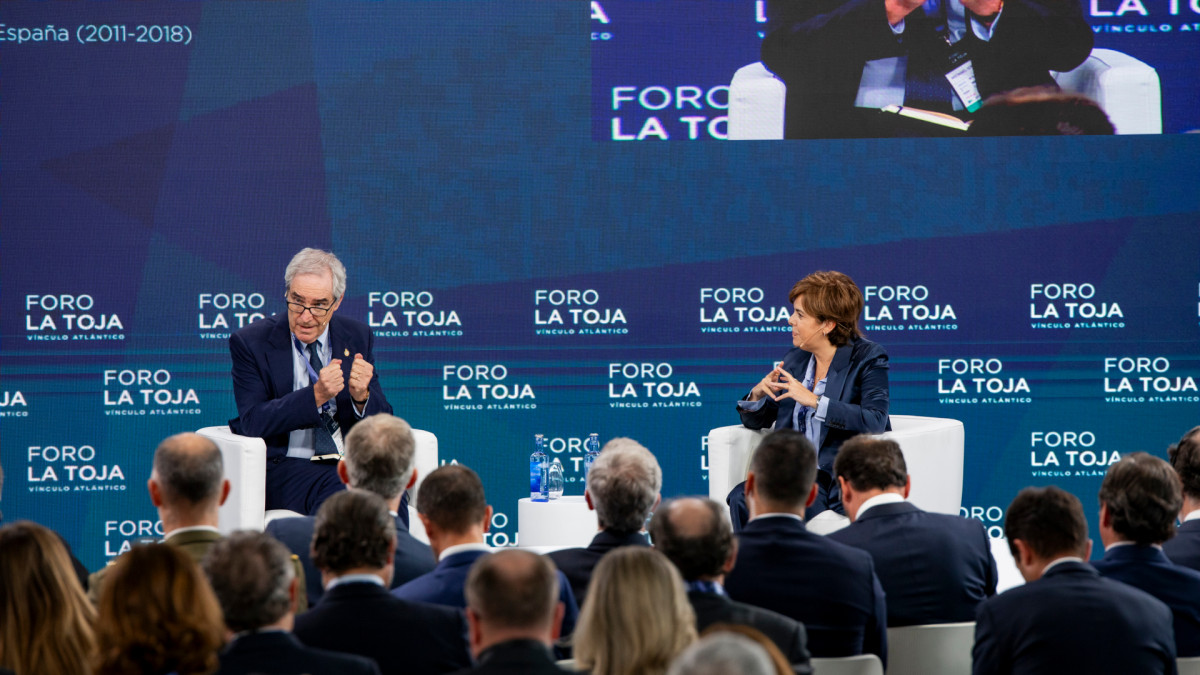
The writer Michael Ignatieff in conversation with former vice-president Soraya Sáenz de Santamaría. Photo: Agenda Pública / Yanka Soto
In his view, there are very concrete issues that Europe must address. “Defense, capital markets, and energy” are, for him, the defining elements of Europe’s future, without taking his eye off a flank where we have “an authoritarian China and a Russia that does not leave that authoritarian turn”.
Finally, setting aside external threats, the former leader of the Canadian Liberal Party stressed the urgency of abandoning internal European debates. “It is important that Europe stops that fratricidal competition and focuses on open societies, free markets”.
A lo largo de estos días, seguirá compartiendo crónicas del foro desde la Illa da Toxa y entrevistas con algunos de los principales ponentes.
En alianza con

Natalie Foster
I’m a political writer focused on making complex issues clear, accessible, and worth engaging with. From local dynamics to national debates, I aim to connect facts with context so readers can form their own informed views. I believe strong journalism should challenge, question, and open space for thoughtful discussion rather than amplify noise.