

Social media engagement is waning, and what remains has moved from interactive dialogue to passive scrolling.
Back in 2019, Representative Alexandria Ocasio-Cortez (D–N.Y.) appeared in a clip where she danced on a rooftop with friends. The reel sparked a flood of opinions on Twitter after an anonymous account implied in a widely circulated post that it exposed her as a “clueless nitwit.” AOC was just beginning her first term in Congress, Twitter was a cauldron of sensationalism, and that video might even feel like a quiet time capsule, signaling the carefree, early era of social media and the Millennial Internet.
As the clip circulated, few paused to question why AOC was dancing on that rooftop. But I understood instantly. She was echoing the moves of my own friends.
In March 2009, someone compiled vintage footage of Brat Pack actors dancing, synced it to a track by the art-punk group Phoenix titled “Lisztomania,” and uploaded the montage to YouTube, then a four-year-old platform. A cohort of Brooklyn friends, my friends, decided to recreate the viral moment on a graffiti-drenched waterfront rooftop in Williamsburg, performing the parts of Molly Ringwald and her Brat Pack peers themselves, posting it under the banner “brooklyn brat pack mashup.”
Before long, it became a viral sensation. People across the United States—and then worldwide—began producing and sharing their own Brat Pack mashups, captured from rooftops and other outdoor spaces in Houston, San Francisco, Scranton, Madrid, Moscow, Nairobi, Taipei, Amsterdam, and dozens of other cities. Most were amateur efforts, filmed by friends for the sheer joy of participation. My friends’ clip eventually racked up more than 550,000 views, though most others drew far fewer.
AOC’s dancing clip was part of the craze. Though it exploded online in 2019, it had actually been filmed in 2010 when she was a Boston University student. It was a frivolous online prank, barely noticed at the time. Only after she ascended to Congress, and the video became fodder in political battles, did it reach a million views.

When AOC, my friends, and everyone else created these clips, no one was monetizing this material. The aim was simply to participate. The objective was to enjoy the moment. We were young, and so was social media.
Much of early social media carried that same vibe. It was cheesy. It fostered collaboration. It often seemed inconsequential. People posted pictures of themselves “planking”—lying face-down in odd places, like a kitchen counter—just to belong to a trend. They poured ice water over themselves and shared it, supposedly for Lou Gehrig’s disease awareness but mainly because it was the thing to do. They posted old photos on #ThrowbackThursday, compiled favorite accounts on #FollowFriday, and shared the latest BuzzFeed personality quiz for the week.
Hashtags marked weddings, parties, and conferences, enabling everyone at an event—or those following online—to see all the photos and updates. If you ran into friends, made new acquaintances, or simply spotted someone you knew at a gathering, you had to snap and post a selfie. Bloggers eagerly embraced the platform, crafting lengthy responses to one another and scrutinizing each post as if in a vast virtual workshop for writers.
Politicians either ignored or celebrated this new medium. Some campaigns, Obama’s most notably, appeared excited about using it to reach younger audiences who didn’t respond to mailers or cable news.
This was the early Millennial Internet. It thrived on fresh technology (smartphones, social networks), a new generational ethos (document everything), optimism, earnestness, venture capital, connection, and possibility. It was odd and beautiful, yet fleeting.
By the mid-2010s, the landscape had changed. What would come to be known as “cancel culture” began to take shape. We started tracking the day’s “main character” on Twitter. Political activism and MAGA rhetoric began to drown out mashups, cute animal videos, and casual selfies. Social updates started to feel like “content” instead of merely “my friends’ posts.”
Still, fragments of the earlier internet persisted. Even toward the end of the decade, it felt normal to have a wedding hashtag and to post #Caturday photos.
Happy #caturday morning from Gem pic.twitter.com/lVMmtR13oI
— Elizabeth Nolan Brown (@ENBrown) June 1, 2019
This was the late Millennial Internet. It grew more serious, more enraged. Politics began to dominate, with lawmakers summoning tech CEOs to hearings.
Yet social media still felt genuine. It remained a space for community and collaboration. Yes, there were professional influencers, but posting remained largely a pastime for amateurs.
The Millennial Internet was approachable, personal, and above all, participatory. People spoke to one another. It could be performative, but it often felt authentic—an ongoing dialogue among friends—and a place where real relationships could form.
The Millennial Internet is now a thing of the past. The social platforms as they once existed are no longer social. They resemble traditional media more than the freewheeling early days, functioning as a one-way, top-down broadcasting system rather than a decentralized, open marketplace of voices. There are positives to this shift, of course, but we are sacrificing much of the internet’s vitality, utility, creativity, and fun in the bargain.
Much of the blame for these changes has been pinned on corporate choices surrounding algorithms, ads, and moderation. Some point to the COVID-19 era, to influencers, to Elon Musk, or to TikTok, MAGA, or “woke” politics as culprits.
There is at least a kernel of truth in these claims. Yet politics has certainly played a central role in wrecking social media’s vitality. The true narrative behind the decline of the Millennial Internet is one of government meddling, coercion, and soft—or outright—censorship. These very factors now threaten the last remnants of social media’s golden age.
‘Decline, Fragmentation, and Enduring Polarization’
One glance at the X app or Facebook reveals that social platforms aren’t literally extinct yet. Even on the most staid networks, people still flirt, argue, post pet pics, and express opinions without bothering to read the linked articles.
Yet the data sketch a story of decline. A growing share of users, especially those in the younger (18–29) and older (65+) brackets, abstain from social networks altogether, as shown by Petter Törnberg of the University of Amsterdam in his March 2026 study “Shifts in U.S. Social Media Use, 2020–2024: Decline, Fragmentation, and Enduring Polarization.”
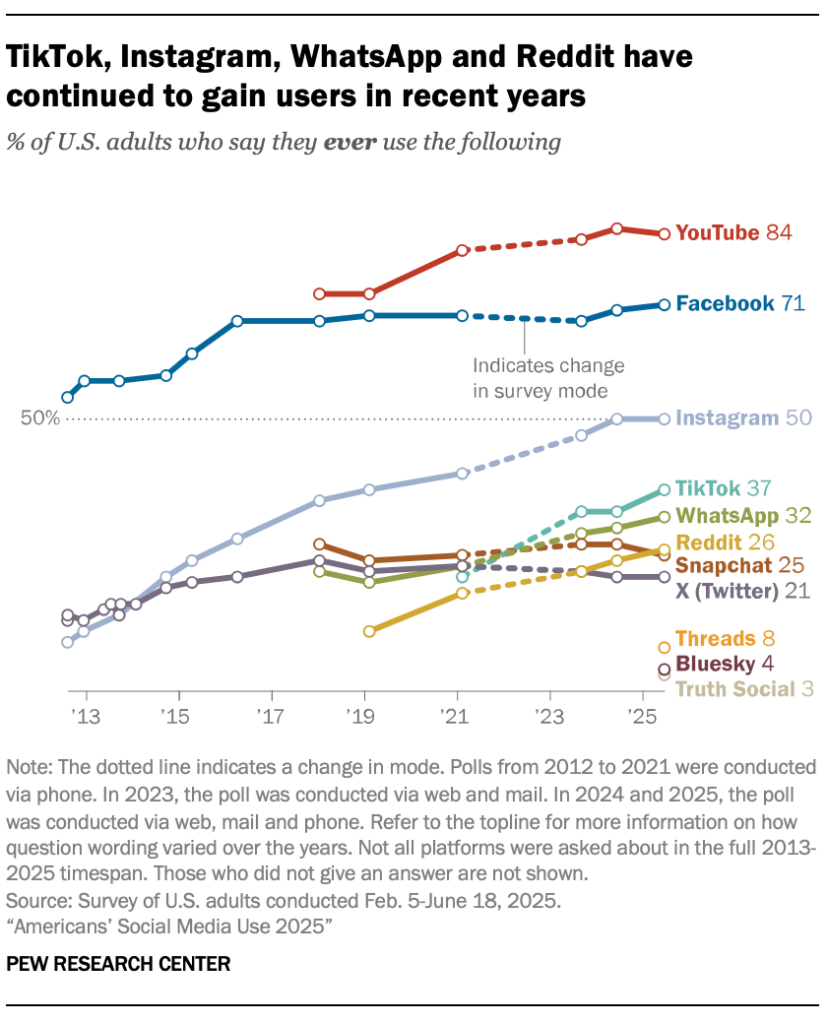
There are clear signs of stagnation and decline across the board. In Pew Research data on American adults, the share who have ever used Facebook has risen only marginally from 2016 to 2025 (from 68% to 71%). Twitter/X usage peaked around 2018 at 24% and has fallen since. Snapchat usage also declined from its late-2010s peak.
There is even evidence suggesting fewer people who actually log in regularly. Törnberg’s research indicates that visits and posts on Facebook and Twitter/X dropped by nearly half between 2020 and 2024. A June 2026 survey by the data-removal firm Incogni found that more than half of respondents post less now than five years prior.
Even active use feels different from a decade ago. A 2025 Financial Times analysis of online behavior found fewer people using social networks for the social tasks that once pulled them in—keeping up with friends, meeting new people, engaging in creative expression. A 2025 Morning Consult poll showed users were far more likely to turn to social media for entertainment (57%) daily than for posting (33%), with Gen Z responses at 74% versus 31% respectively.
The Millennial Internet, with its emphasis on community and dialogue, is effectively extinct. Social media as it once existed is no longer social. It has shifted toward a broadcast model—largely one-way and top-down—rather than the decentralized, participatory space it used to be. There are benefits to this transition, certainly, but it comes at the cost of the internet’s vitality, practicality, inventiveness, and enjoyment.
Most of the transformations can be traced to corporate strategies about algorithms, advertising, and content moderation. Some attribute the shifts to the COVID-19 era, to influencers, to Elon Musk, or to platforms like TikTok, or to political movements such as MAGA or woke culture.
There is some merit to these claims. But politics has played a decisive role in the unraveling of social media’s appeal. The true tale behind the decline of the Millennial Internet is one of governmental involvement, pressure, and either subtle or overt censorship. These very dynamics now threaten the last vestiges of social media’s golden era.
‘An Aggressive Regulatory Effort’
Tech journalist Taylor Lorenz, author of Extremely Online: The Untold Story of Fame, Influence, and Power on the Internet and the creator of the Substack newsletter User Mag, describes social media’s decline as the outcome of an assertive government push to curb online speech.
“It was incredibly difficult before the internet and even more so for social media to reach large audiences,” Lorenz notes, “and social platforms gave the public the ability to speak and connect freely. Governments and those in power quickly realized that freedom could be a liability when they sought to maintain control.”
CEOs of tech companies didn’t suddenly decide to regulate content more strictly; that shift followed sustained political pressure from lawmakers and bureaucrats over many years.
Political actors began to view social media through a new lens in 2016, when Donald Trump won the presidency. Many in politics and media could not reconcile that outcome, so they blamed platforms for misinformed and meddling content—Russian bots, misinformation, and the tech industry itself. They urged social networks to curb the spread of problematic content. In response, platforms like Facebook reduced the visibility of political news and external links, creating a void that influencers—primarily driven by engagement metrics—filled.
The political impulse to police speech did not quiet the volatility or polarization; it redirected it away from traditional media into the social arena.
With each new challenge that baffled pundits and policymakers, a consensus formed that the responsibility lay with Big Tech. Leaders from both major parties pressed for tighter controls on online speech, blurring the line between suppressing harmful discourse and addressing the underlying social issues that speech sometimes signaled.
Some efforts were explicit, such as the 2018 Allow States and Victims to Fight Online Sex Trafficking Act (FOSTA). Purportedly aimed at curbing prostitution ads and trafficking, FOSTA pushed platforms to suppress a wide array of sexual content. In the wake of FOSTA and the crackdown on sex-work sites like Backpage—and amid regular political hype about online exploitation—platforms increasingly avoided content related to sex work or even general sexual topics.
FOSTA, along with the government’s pressure on sex-work friendly sites and politicians’ emphasis on “sexual exploitation” online, left social networks skittish about frank discussions of sex, pushing them toward more sanitized spaces where adults now write about sex as s*x or seggs to dodge moderation rules.
Algospeak—creative euphemisms to discuss sensitive topics without triggering automated moderation—became common. Terms like “corn” for porn and “unaliving” for suicide illustrate how people adapt language to get around filters.
The influence of government pressure extended beyond direct rules. Lawmakers frequently summoned tech leaders to hearings and demanded accountability for teen suicides, mass shootings, and political violence, sometimes signaling that platforms should crack down on “hate speech” and misinformation. In other cases, authorities instructed platforms to address perceived threats in specific episodes, such as during the COVID-19 era or anti-ICE protests.
Even well-intentioned moderation—targeting hate, eating-disorder content, or fringe COVID theories—presents a dilemma. Content moderation at scale is inherently error-prone, and filters often ensnare discussions about sensitive topics or debates that could be beneficial to vulnerable individuals seeking help.
Moderation decisions—whether automated or human—are political by nature, forcing tech platforms to pick sides in contentious debates. This has led to punishments for users whose views fall on issues that evolve over time, such as the COVID-19 lab-leak hypothesis, or debates about gender that rest more on values than on objective right or wrong.
Political pressure also shaped public expectations, making us more likely to see social media companies as arbiters of truth rather than as simply public squares where diverse ideas collide, including provocative or controversial ones.
Platforms didn’t have to comply with every government directive, but as officials offered “guidance,” they also threatened to use antitrust actions to break up major tech firms or filed lawsuits against them. They warned about revoking Section 230 protections, which shield many online services from legal responsibility for user-generated content—an important shield for social networks. Across the political spectrum, leaders have proposed revising or limiting Section 230, often conditioning protections on maintaining a supposedly neutral space or excluding certain topics like firearms or drugs.
It’s little wonder platforms began curbing content that drew political concern. And the more aggressively they restricted content, the more the public expected them to curb any objectionable speech.
‘Kids Are Different Because We Closed the Schools’
The COVID-19 era marked a turning point for the Millennial Internet. With social distancing, quarantines, and classroom closures, social networks became the main stage for social life and cultural conflict. Quickly, people began attributing social ills to the platforms themselves—ranging from declining test scores to increased loneliness and worsening mental health—rather than to the extraordinary circumstances of the pandemic.
“Kids are different because we closed the schools, and they weren’t socializing,” argues Katherine Dee, a writer on internet culture who rose to prominence on Twitter as @default_friend and now runs the Substack newsletter default.blog. “It’s not as if generations suddenly became dumber or less social due to their parents’ iPhones.”
Yet the explanations tying social media to teen distress have stuck, despite their shaky foundations. Fueled by lockdown-era discontent with screen-heavy living and decades of politicians’ skeptical rhetoric about tech firms, many have come to blame digital platforms for everything from spikes in teen suicide to declining birth rates.
Evidence supporting a direct cause-and-effect relationship is scant. Studies showing minor effects—such as a statistically insignificant shift in anxiety or depression after a six-week Instagram hiatus or a slight drop in reading time over decades—are often amplified as proof that social media is poisonous, while studies showing neutral or positive outcomes are largely overlooked. When studies show only correlations, not causation, these are touted as proof of danger, as if heightened screen time among already distressed teens could not be a symptom rather than a cause of their trouble.
Public sentiment has coalesced around the belief that social platforms are harmful for teens and for society at large, even when evidence is inconclusive.
Politicians and mainstream media have weaponized the idea of social media’s dangers to induce shame about the habit, Lorenz suggests, which may in turn drive people to retreat from these platforms.
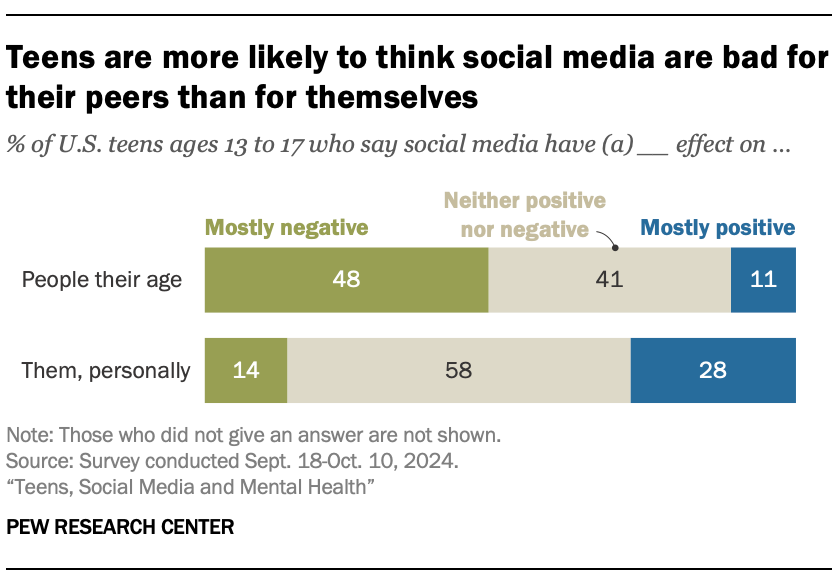
At minimum, data indicate that the constant messaging about “brain rot” from media and officials is shaping public opinion. A 2025 Pew Research Center survey of teenagers found that only 14 percent felt social media is mostly negative for themselves, while 48 percent believed it to be mostly negative for their peers. The share seeing it as harmful for others rose by 16 percentage points since 2022, aligning with a period of intense political and cultural focus on social media’s impact on youth. Psychologist Jacqueline Nesi, writing in her Techno Sapiens Substack newsletter, claimed that teens may be more likely to report harm because they’ve been told that social media is dangerous, even if they don’t perceive it in their own lives.
Politicians have exploited this diffuse discontent with social media to push sweeping reforms.
The most prominent of these is age verification. The specifics vary widely: some proposals would bar minors from using social platforms entirely; others would permit 16- or 17-year-olds while excluding younger users; others would allow minors with parental consent or impose strict account limits. Regardless of the model, all would require platforms to verify a user’s age, which would entail collecting documentation or performing facial scans to distinguish adults from minors.
Age-verification laws have already passed in several U.S. states and in other nations. Australia barred younger teens from social media in 2025, France followed suit in 2026 (though the measure was overturned by the country’s high court), and the U.K. has plans to implement similar rules, with the European Union weighing its own version.
In the United States, at least 11 states have enacted laws restricting minors’ social-media access or mandating parental consent. Some rulings have blocked these, but others suggest they could withstand constitutional scrutiny. A Louisiana federal appeals court ruling even cited the Supreme Court’s approval of a Texas parental-verification law for porn sites, treating it as a precedent for broader age-verification efforts.
Several of these schemes could effectively lock teenagers out of social platforms and would also end anonymity—a hallmark of many platforms since their inception. That shift could chill provocative or politically sensitive speech or discourage some individuals from posting altogether.
In a Carnegie Mellon University experiment, participants who were asked to verify their age with government-issued IDs tended to discontinue participation at rates of roughly 22 to 28 percent.
Plans to bar minors or to impose strict verification have garnered bipartisan support. As part of Project 2029, a coalition of Democrats proposed a nationwide ban on users under 16. A bill by Senator Ruben Gallego (D–Ariz.) would restrict many underage users from social platforms unless they obtain parental consent. Other lawmakers have floated ID-check requirements at app stores, by AI firms, or even at the device level. Adam Candeub, Trump’s pick to head the Justice Department’s antitrust division, has argued for moving beyond traditional economic thinking and weighing how social platforms might make people less happy when applying antitrust powers.
The Kids Online Safety Act (KOSA), a Senate-pending bill, has earned broad support across party lines. It would impose a “duty of care” on platforms to protect minors from a wide array of harms (unlike the House-passed KIDS Act, which did not include this provision). But it would chill speech. Ari Cohn, free-speech counsel for TechFreedom, described KOSA as creating a “papers please” regime that would force every user to identify themselves before speaking online, undermining the constitutional right to read and speak anonymously and enabling political retaliation against unpopular ideas.
For decades, attempts to punish platforms for speech have stumbled due to Section 230 and the First Amendment. Since 2022, however, many lawsuits have targeted social networks under theories of unfair competition or negligent product design. Plaintiffs argue that it’s not the content itself they object to, but the endless-scroll design, the recommendation algorithms, or platforms’ failure to warn users about potential harm—often ignoring that the content is a contributing factor to a user’s response.
This strategy has yielded some courtroom wins, most notably in New Mexico, where a state court ordered Meta to pay $567 million for violations of the Unfair Practices Act, finding that Meta’s platforms “significantly interfere with public safety, public peace, and public comfort.” (Earlier in the same case, a jury fined Meta $375 million.)
Meta and other social networks also face a raft of “social media addiction” lawsuits in federal courts, brought by thousands of plaintiffs including hundreds of school districts and 29 states. In the first major verdict, a jury found Meta and Google liable for millions in damages to a now-20-year-old who contends that YouTube and other platforms contributed to her mental health challenges. In August, Meta settled with the 29 states, admitting no wrongdoing but agreeing to pay $16.68 billion and to implement significant changes for minors’ accounts, including a two-hour daily limit.
Outcomes like these could open the door to endless litigation against platforms, enabling anyone claiming social media harmed them to sue, and giving state prosecutors leverage to demand stricter identity verification or tighter content controls.
Today, social media may feel prudish and heavily surveilled. But it appears poised to deteriorate further.
‘Just Passively Scrolling’
People continue to communicate digitally, yet they increasingly prefer semi-private spaces—such as Discord, WhatsApp, and Signal—over large public networks. It’s a partial return to the era when chat rooms and message boards dominated the web.
Some users have migrated to newer, more specialized public platforms like Bluesky or Truth Social, but the numbers are modest. Even Threads, Meta’s Twitter-like platform launched in 2023, has a limited reach, with just 8 percent of respondents in a Pew poll reporting any usage.
In the old Twitter era, the guiding notion was that politics should be a chorus of everyone shouting into a shared, chaotic void—an unusual historical oddity that likely won’t return.
That departure may carry benefits. But the peak days of Twitter and Facebook felt more navigable; it was easier to locate people and to reach them. Participation was straightforward: post a few photos or compose a handful of lines of text.
TikTok has stood out as one of the few enduring growth stories for social platforms this decade, yet it operates in a much more passive fashion. “Although theoretically anyone can upload a quick TikTok, that still represents a higher barrier than composing a quick tweet,” notes tech writer Julian Sanchez, who runs the Non-Content Substack newsletter. Among adult TikTok users, only about half have ever posted a video, per Pew Research.
TikTok feels more like a streaming service than a social network, Smith adds, describing it as “an experience closer to Netflix than to Twitter.” He doubts that TikTok is truly social media in the traditional sense.
Meanwhile, Facebook, Instagram, and YouTube have tried to imitate TikTok’s format with short, vertically oriented videos—YouTube’s Shorts and Meta’s Reels—prominently featured in feeds. Even for users who want to avoid them, these clips now appear in feeds where acquaintances’ latte photos or daily campaigns can overshadow content from people they actually follow.
Today’s average social-media user tends to be “just passively scrolling,” according to Dee. She views this as not inherently negative, likening it to background TV. Still, she is certain the Millennial Internet is definitively over—and that the social networks as they existed in her early twenties are likewise over.
Even the notion of cultivating a social-media following—or using platforms to keep tabs on a specific circle of people and organizations—may be fading, as feeds tilt toward content chosen by algorithmic gatekeepers rather than the posts of those a person actually follows.
‘Don’t Be Weird About This’
It’s 2026, and a new AOC clip appears. This time, it shows her injecting fertility drugs to freeze her eggs.
Posting this has placed AOC at the center of today’s most heated culture-war battleground: debates about when, whether, and how women should pursue motherhood. It also offers a glimpse into how far the social web has drifted from its earliest days.
Her TikTok-style vertical video appears not on her Instagram’s permanent grid but as a fleeting “story,” a format where comments usually stay private messages to the poster. It is part of a long-running sequence in which AOC speaks directly to the camera—treating social media like a soapbox or a reality show rather than a shared, interactive arena.
As she unpacks various medical tools for egg freezing, she jokes, “Maybe I should start an ASMR egg-freezing channel.” (ASMR, essentially, is about sounds that create tingling sensations.) “I think they banned those on YouTube,” she quips with a smile.
That’s not entirely accurate. While ASMR content remains largely allowed, YouTube did ban several prominent ASMR creators this year for allegedly violating its “sex and nudity” policy by linking to sexually oriented content elsewhere. “It’s our job to keep YouTube a safe space for everyone,” the platform reportedly told the banned creators via email.
After years of government lobbying, social media now flaunts a safety-first ethos, which often translates to speech restrictions. But the networks aren’t social in the old sense. They aren’t growing, they lack cohesion, and they aren’t cool. “In my age group…being constantly online is kind of cringe,” remarks 26-year-old New York Post columnist and Cato Institute fellow Rikki Schlott. Her cohort has adopted different norms around social media than the one I grew up with. At dinner, she says, most people keep their phones face-down and only retrieve them if someone explicitly says, “I have to check something.”
Many millennials share a sense of disillusionment. “Social media became noticeably less interesting,” wrote Kate Lindsay in a January note for Embedded, describing a future she called “Social media dies in 2026.” Instead of seeing the rise of social networks as a line on a graph that only goes up, she envisions it as a temporary blip rather than a watershed moment.
Some of this shift feels inevitable: technology evolves, young people mature, and tastes shift. Yet the internet’s transformation has also been shaped by politicians like AOC.
“Don’t be weird about this, even though I know you will be,” AOC says in the fertility-drug video, addressing the audience directly. It’s a challenge that could be directed at politicians who comment on social media as well.
AOC, who has been floated as a potential candidate for the 2028 Democratic presidential nomination, remains fluent in digital politics. Like Trump, she has mastered using the platform to advance political goals while advocating for greater government reach and oversight of the tech sector. She has called social media a “public health risk to everyone” and has frequently argued for breaking up tech giants. Trump, for his part, has urged repealing Section 230, attempted to ban TikTok (though he reversed course later), and implemented policies to scrutinize the social-media status of visa applicants. Taken together, these stances—multiplied across levels of government—have eroded the open, free-wheeling web and propelled it into its current decline.
The Millennial Internet was imperfect. It was earnest, silly, quirky, amateur, and occasionally swept up by mania and mob rule. Yet it existed as a virtual space where gatekeepers’ grip loosened, and people could connect, comment, and create with limited censorship or oversight. We may recall its flaws and how it progressed into a more conventional, top-down broadcasting medium. But we should also remember it as an era of extraordinary—and largely squandered—freedom.
