
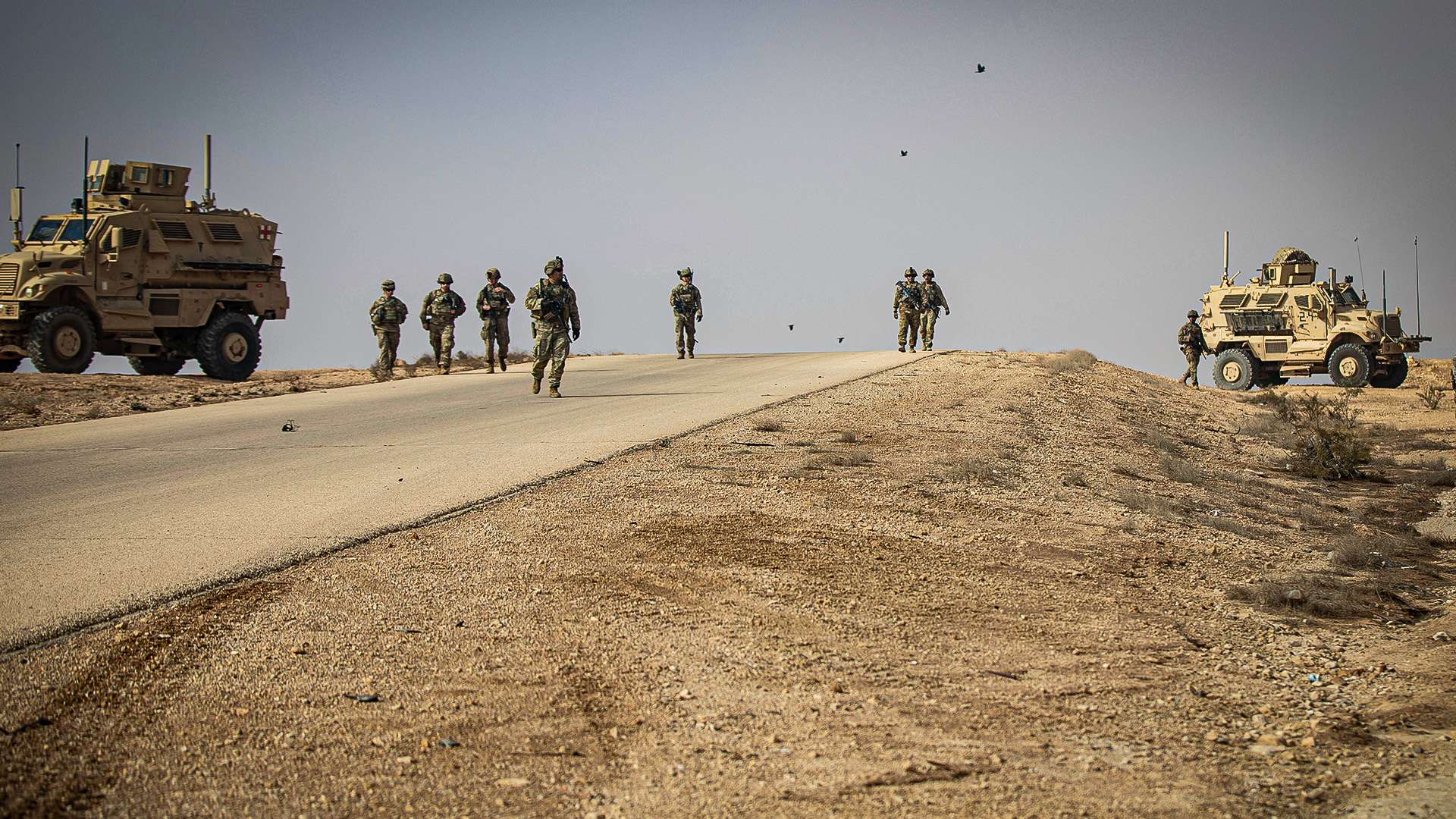
Ending more than two decades of involvement represents progress, yet tens of thousands of troops remain stationed in the war-torn region.
In northern Iraq, at the Erbil Air Base, a notable moment unfolded: the United States carried out its final withdrawal from the country.
The mass exit signaled the close of over twenty years of American involvement in Iraq, which began when President George W. Bush dispatched roughly 150,000 troops to topple Saddam Hussein’s regime in 2003. Despite Bush’s famously premature victory declaration in May 2003, tens of thousands of American forces endured eight more years of combat against insurgents amid a destabilized landscape. That conflict resulted in the deaths of about 4,500 U.S. soldiers and more than 120,000 Iraqi civilians. The United States pulled the last of its personnel out in December 2011, marking a brief hiatus in intervention. Merely three years afterward, thousands of U.S. troops re-entered the country as part of Operation Inherent Resolve (OIR)—an international coalition designed to confront and contain the Islamic State group (IS) within Iraq—to bolster Iraqi and Kurdish soldiers, a presence that has continued for the last twelve years.
The Islamic State had surrendered all territorial footholds in Iraq by late 2017, a development that complicated the rationale for maintaining the OIR, as the coalition increasingly focused on training and advisory roles. At the same time, American forces in Iraq found themselves increasingly targeted by Iran-aligned militias, a major concern for both Washington and Baghdad.
Jon Hoffman, a Middle East scholar at the Cato Institute, told Reason that U.S. bases in Iraq have largely become magnets for attacks backed by Iran. He contends that the OIR overstayed its declared objective of defeating IS and drifted into counterproductive territory.
Keeping troops in the country “puts terrorist organizations within striking distance,” Hoffman notes. It also “fuels many of these grievances that help recruit anti-U.S. factions.”
This argument has particular resonance in light of the October 7, 2023 assault on Israel and the broader Middle East upheavals that followed. The Congressional Research Service reported that from October 2023 to February 2024, U.S. bases in Iraq and Syria faced more than 60 drone and missile strikes, most launched by Iran-aligned militias in Iraq, many of whom belong to the Popular Mobilization Forces (PMF).
These attacks provoked retaliatory actions, pushing parts of Iraq back into a state of conflict. After a wave of strikes in 2023, Iraq’s prime minister condemned the Iran-aligned militias and the United States, stating that such assaults “infringe upon Iraq’s sovereignty.” This led the Biden administration to negotiate a plan in 2024 to end the OIR in Iraq. The Wednesday withdrawal fulfilled that agreement.
“October 1 will mark a new chapter for the Iraqi state, with the country free of any foreign military presence and full sovereignty over its territory,” Iraqi Prime Minister Ali al-Zaidi asserted in a statement.
While al-Zaidi has welcomed the departure of foreign troops as a boost to Iraq’s sovereignty, some analysts fear it could also undercut it. “The militia issue is chronic and will remain a major threat to the sovereignty of the Iraqi state,” Kamaran Pahlani of the Middle East Peace and Security Forum in Kurdistan told Reason.
His concerns are well-founded; the PMF in Iraq numbers roughly 238,000, a figure comparable to the Iraqi Armed Forces, and earlier deadlines for disarming the militias have been postponed. The withdrawal could also present challenges for the Kurdistan Regional Government (KRG), whose people endured genocidal violence at the hands of IS when it rose to power.
“The conditions are different now, but the fear remains,” Pahlani adds.
These worries could be addressed beyond continued military occupation, though. “The United States has substantial tools at its disposal beyond security and war,” Pahlani argues. Hoffman concurs, noting that for the KRG’s concerns, “This is a diplomatic matter; this isn’t a military one.”
That view has traction. The years since the initial invasion have shown that securing Iraq’s internal sovereignty and dismantling sectarian militias may not be a task for the U.S. military to perform—or even to preside over indefinitely. “The notion that we must stay in the Middle East to shape the region’s politics is a recipe for perpetual entanglement,” Hoffman cautions.
Although Wednesday’s withdrawal means the United States is temporarily out of Iraq, Washington has increased its footprint elsewhere in the neighborhood. The OIR remains active, now headquartered in Jordan. Some 50,000 additional troops stationed across multiple bases—from the Mediterranean to the Persian Gulf—were deployed in the region as of August to contend with the ongoing Iran conflict. Defense Secretary Pete Hegseth has recently extended these forward deployments well into 2027. All of this activity makes it likely the United States will re-enter a long-term conflict in some form. As Hoffman observes, “Our very military presence in the region makes it far too easy to default to the use of force.”
Even so, the withdrawal is a constructive development; every U.S. service member not deployed in the Middle East is one fewer target for adversaries, one fewer occupier likely to radicalize locals, and one fewer instrument of power for the government to wield.
