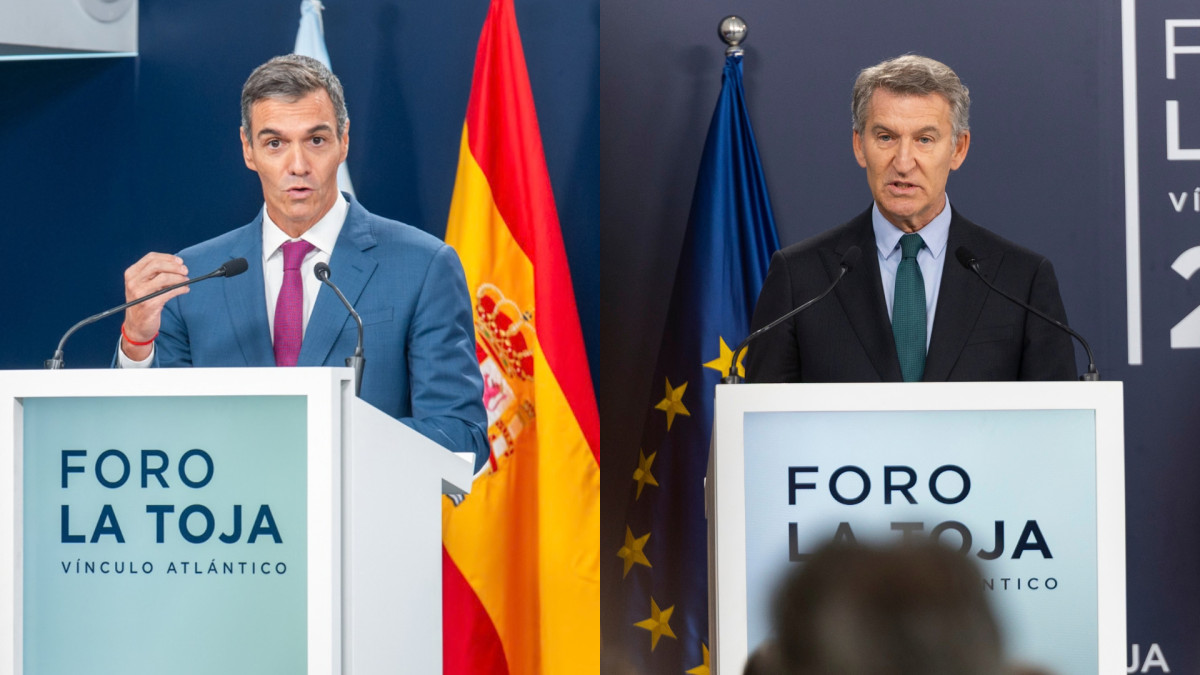
The La Toja Forum had chosen for its 2026 edition a deliberately international slogan: “A world in disorder.” Pedro Sánchez decided to take it literally. Alberto Núñez Feijóo, by contrast, began almost by explaining why he did not intend to. “With the domestic landscape we have, perhaps before trying to order the world we’d better take a look at home,” said the leader of the Popular Party. That difference contains an important part of the political distance between the two main Spanish leaders. And, above all, two radically different interpretations of the moment Spain is going through.
The two interventions pursued different objectives. Sánchez tried to insert Spanish politics within the great international transformations. Feijóo wanted to pull the Government out of that scenario and force it to answer for its domestic governance. The president is interested in a broad playing field: Ukraine, Gaza, Ceuta, China, climate change, artificial intelligence, energy, inequality or housing can be presented as manifestations of the same problem, the one that appears when rules disappear and power ends up in the hands of the strongest. The PP leader took the discussion to another terrain. Budgets, emergency decrees, debt, inflation, housing, judges and institutional quality underpin his argument that, before aiming to govern world disorder, Spain must resolve its own. La Toja thus witnessed a dispute over determining what should be the political question of the coming months.
“La Toja asistió a una disputa por determinar cuál debe ser la pregunta política de los próximos meses”
The thread of Sánchez’s intervention was an idea that explains quite well the evolution of his political discourse: the left must also talk about order. But it must do so by taking ownership of the concept and modifying its meaning. Order, he argued, consists of establishing rules that prevent the most powerful from unilaterally imposing their conditions. That definition allows him to move from international law to workers’ rights, from Ukraine to economic regulation, or from big tech to housing. The logic remains: when rules are missing, the one with more power wins.
The framework proves especially useful because it links foreign and domestic policy. The breakdown of international rules explains Russia’s invasion of Ukraine and the war in Iran. Global inequalities appear as a catalyst for migratory flows toward Europe. A greater energy dependence strengthens the arguments to accelerate the ecological transition. And the difficulties in accessing housing justify public intervention to correct the imbalance between those with resources and those who lack them. Even Ceuta entered that discursive architecture: no wall, Sánchez argued, can indefinitely contain the desperation of those seeking a better life.
Feijóo started from another place. The fundamental problem of Spain, according to his discourse, lies in the breach or deterioration of national rules. His approach to La Toja and to the Popular strategy centers on institutional normality. Budgets, Parliament, the Council of Ministers, the Judiciary and limits to decree law appeared during his intervention as parts of the same political accusation: in his view, the Government has turned the exceptional into the ordinary and has subordinated institutions to the Government’s survival needs.
“Las desigualdades globales aparecen como catalizador de los flujos migratorios hacia Europa. Una mayor dependencia energética refuerza los argumentos para acelerar la transición ecológica”
From there came the most concrete institutional proposal of his intervention: to seek a legal formula so that, after a first budget extension, the inability to pass new accounts would lead to the dissolution of the Cortes and to elections. Beyond its potential legal viability, the measure helps to understand well the political framework of the leader of the PP. The parliamentary flexibility that the Government assumes as a consequence of a period of fragmentation becomes, in popular discourse, an anomaly. Feijóo intends that the absence of certain instruments of governance serves as proof of political fatigue. That distance became even more visible when housing came into play.
Sánchez has turned the housing crisis into a matter he seeks to place above party boundaries. In La Toja he even defined access to housing as a matter of “pure humanity” by demanding support for his decrees. The choice of words is significant. The discussion stops revolving solely around supply, regulation, taxation or legal certainty and takes on a moral and generational dimension. By framing it this way, the pressure on the PP and Junts is also transferred to explaining their vote: how to justify opposition when access to housing is one of the main concerns of a large part of society.
Feijóo rejected that shift and kept the problem in the economic realm. Spain has grown by several millions of inhabitants while building insufficient housing, generating, in his diagnosis, an offer crisis that regulation cannot solve. In response to the government’s two decrees, he summed up his answer in a single sentence: “The housing problem is solved by building housing.” The debate is framed from two different starting points: protecting those who have difficulty accessing a home and the need to increase supply, investment and legal certainty.
“La flexibilidad parlamentaria que el Gobierno asume como consecuencia de una época de fragmentación se convierte, en el relato popular, en una anomalía”
Also revealing is the choice of topics. Sánchez dedicated a substantial portion of his intervention to Europe. He defended an open but more balanced relationship with China, greater strategic autonomy, a more ambitious EU budget and the Treaty of Friendship with France, whose ratification has become entangled in the Spanish political confrontation. He also spoke of artificial intelligence as a matter of democratic power: technology, he argued, is not neutral and the companies that develop it cannot set their own limits.
In Feijóo’s discourse, Europe and the world mostly served as a backdrop to the domestic argument. External influence, he argued, depends first on internal credibility: institutional quality, democratic stability and economic strength. There is foreign policy, but it occupies another place in the hierarchy. Sánchez turns to Europe to explain part of what happens in Spain; Feijóo presents Spain’s functioning as a prerequisite to play a meaningful role in Europe.
They don’t even share the political time frame from which they speak. The prime minister crafts a narrative of continuity. The apparently unrelated events are part of, in his discourse, a historical transformation that requires maintaining social shields, deepening the energy transition, regulating artificial intelligence, intervening in housing and strengthening Europe. His economic argument — Spain growing and creating jobs in a difficult European context — serves to present that continuity as proof of resilience.
The opposition leader’s intervention looks toward a rupture. Feijóo spoke of a “crossroads of models”: one he calls populist and another he defines as reformist. From there he chained criticisms on taxes, debt, inflation, wages, infrastructure and housing. The objective was to place the political moment near the end of a cycle and present what comes next as a task of reconstruction.
That is why the La Toja speeches matter more for their structure than for any of their isolated proposals. Spain is entering a phase in which the Government and the opposition no longer argue solely about who manages better some shared problems. Even before arriving at solutions, they disagree on the diagnosis.
“España entra en una fase en la que Gobierno y oposición ya no discuten únicamente sobre quién gestiona mejor unos problemas compartidos. Antes incluso de llegar a las soluciones, discrepan sobre el diagnóstico”
In Sánchez’s account, Spain is showing the capacity to govern in an extraordinarily fragmented era and to protect society against shocks from outside. The risk he identifies is that global disorder —military, economic, climate or technological— ends up imposing the law of the strongest. Feijóo’s diagnosis begins within Spain’s borders: a form of governance that he regards as institutionally degraded, economically misguided and politically exhausted.
There is, however, one word that runs through both interventions: rules. Sánchez calls for them in facing Russia, market imbalances, the large tech companies and the concentration of economic power. Feijóo demands them in the functioning of the Government and makes them concrete in budgets, parliamentary procedures, separation of powers and limits to the use of decree law. Both seek to occupy the space of stability, though they locate the origin of disorder in different places.
That probably marked the main dispute of La Toja: deciding where the disorder lies today that Spain must solve first. Sánchez looks toward a world where the old rules are disappearing and he calls for a state and a Europe strong enough to protect citizens. Feijóo directs attention to Madrid and argues that any external ambition loses credibility while the country’s internal functioning is not rebuilt.
“Feijóo dirige la atención hacia Madrid y sostiene que cualquier ambición exterior pierde credibilidad mientras no se recomponga el funcionamiento interno del país”
They are, moreover, discussions designed for different political moments. Sánchez sought to show that there is still an agenda to develop; he delivered his speech before learning that the housing decrees would fall. Feijóo aimed to install another question: whether this Government should continue to develop it. He did so, moreover, knowing that Sánchez is considering calling elections. That difference helps to understand, more than any figure or concrete accusation uttered at La Toja, the terrain on which the government and the opposition are framing the stretch of political work ahead.
En alianza con