
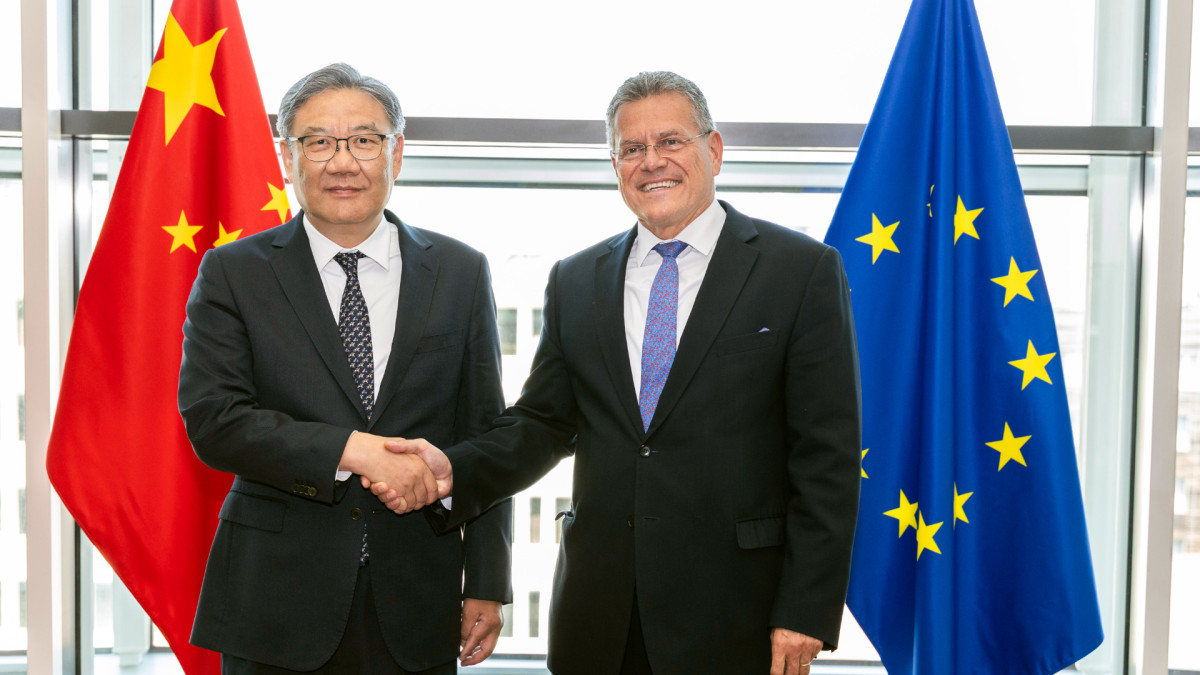
Maroš Šefčovič, Commissioner for Trade and Economic Security, is visiting Beijing this week, where he meets his Chinese counterpart, Wang Wentao. This is no ordinary meeting. When the European Commission and the Chinese government agreed to begin serious technical-level negotiations before the summer, the Slovak commissioner set in this October gathering a deadline to achieve tangible progress. Ursula von der Leyen, president of the European Commission, reiterated this in mid-September, during the State of the Union address (SOTEU) held in Strasbourg.
No one wants a trade war with China. Not even in the offices inhabited by the scarce Chinese hawks that populate the European capital and who for years have been warning of the impact that the real tsunami of Chinese exports could provoke on European industry. The sense, however, is that Šefčovič and his team have walked into a dead end, continuing as before is no longer an option, and that the European Commission and the Member States may face a difficult choice between losing all credibility in a negotiation or risk a very harsh trade war.
“The sense is that Šefčovič and his team have walked into a dead end, continuing as before is no longer an option”
But the situation has become urgent. The European industry is at stake at a critical moment in which the new wave of Chinese exports is concentrated exactly in sectors key to Europe: machinery, the chemical industry, and, above all, the automotive sector, the most visible. The projections circulating in the major European capitals point to a rapid deindustrialization of Europe, with all the economic, social, and political ramifications that would entail. The Union is under a commercial siege. Little by little, Berlin and Paris, the EU’s key players, have awakened to the risk of the China Shock 2.0 and have shifted their position, showing a greater willingness to take action.
If Šefčovič does not return from Beijing with the tangible results he demanded, or if these do not show that China is genuinely willing to change the current dynamic, the European capitals face a dilemma. They can pretend that there was never an October deadline and consider that the European Commission should keep negotiating. That would amount to repeating the paralysis that explains how we arrived at the current point of no return. They have the middle option of giving Brussels a bit more time, while demanding that the European executive present new tools of trade defense, which the Commission already discussed before the summer, that could include quotas and other types of measures. The governments of France and Germany are also proposing new ideas in this area of trade defense.
“The Union is under a commercial siege. Little by little, Berlin and Paris, the EU’s key players, have awakened to the risk of the ‘China Shock 2.0’.”
China has not yet shown any signs of being willing to make serious concessions. The problem driving China to these trade practices is multifactorial, and in Brussels they are not even sure that Beijing can resolve the underlying real problem, which ranges from currency to weak domestic demand, obviously including subsidies. For its part, the Chinese government is responding in a very hostile way to any debate about developing tools for trade defense, to deter member states from closing their markets.
The last option is a enough is enough, with immediate hard measures. The main problem for the Union in its unbalanced trade relationship with Beijing concerns two interrelated issues: lack of will and lack of credibility; the latter stems from the former. The EU has more than enough tools to press China effectively and defend itself against the trade practices of the Asian giant. Its domestic market is its main instrument. With a country that desperately needs to export and for which the European market remains fundamental, the EU only has to find enough unity to wield that lever.
The Spanish View
Negotiations were launched before the summer, after a European Council in which the Twenty-Seven could no longer keep dodging one of the main crises facing the club’s economy. The Spanish government, one of the bloc’s closest to Beijing, argued during the meeting for the need to establish a structured dialogue with the Asian giant to avoid a trade conflict. Government sources welcomed that the European Commission embraced that vision with the dialogue between Šefčovič and Wang, but they were less confident when asked an uncomfortable question: what happens if that negotiation yields no fruit? When do we stop talking about the issue and move to taking protective trade measures? Because that is the sense held by many within the European Commission: that China always shows willingness to talk and discuss, without reaching
“The EU has more than enough tools to pressure China effectively and defend itself against the trade practices of the Asian giant”
Spain, a significant destination for the growing Chinese investment in Europe, has little appetite for the situation to change too much. The view from the Ministry of Industry is that while Beijing’s investments should be subject to clear conditions, they are largely very positive and help to sustain industrial activity in places that were losing it. They defend it in Madrid and also in Brussels, in an environment increasingly hostile to China. While the Spanish government sees options to create jobs and attract investments, other partners are on the losing side: their companies lose leadership, the technological edge, and the global position to their Chinese competitors. Also in the European market.
