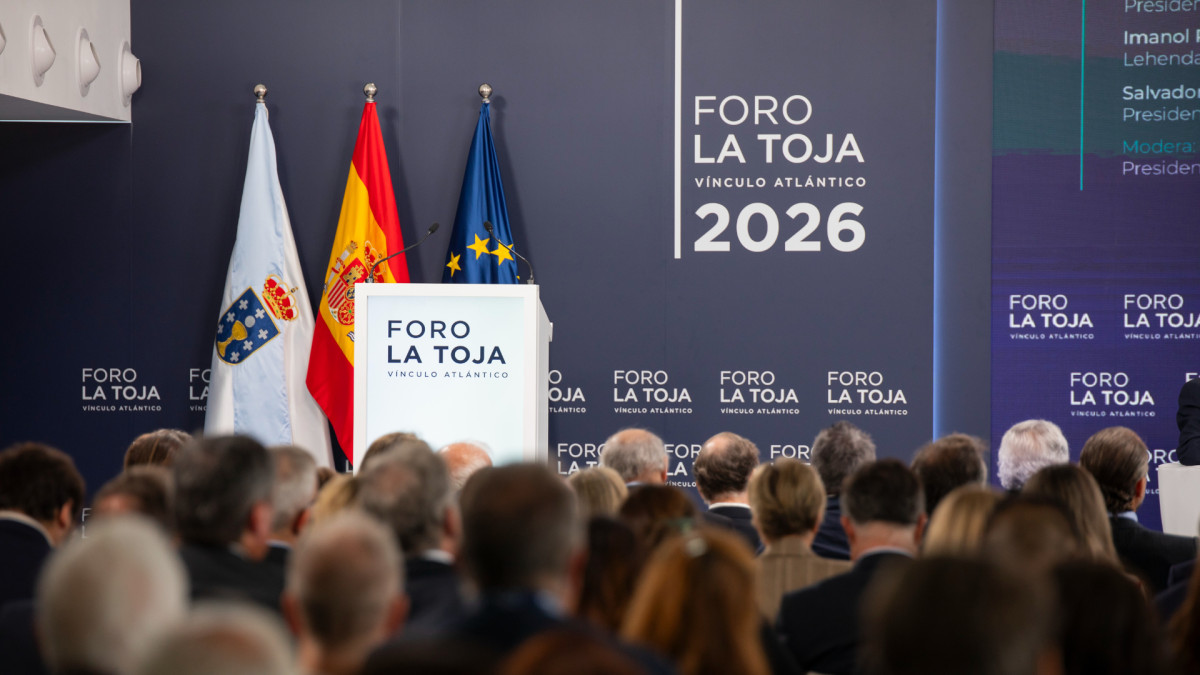
For the first time, the La Toja Forum has been accompanied by a survey to gauge the public’s sentiment on substantive issues at both the national and international levels. The study, conducted by Sigma Dos, covers a wide range of topics: economy, artificial intelligence, industry, energy, NATO, crime, and borders, all pointing toward common ideas. It sketches a trend in which a substantial portion of Spaniards appears to be embracing a protection-oriented stance.
The survey, conducted between September 1 and 8 among 1,516 residents of Spain, raises questions about some of the major dilemmas reshaping European politics: who should protect industry, how to guarantee borders, what role the State should play, how to address the technological revolution, and where to position Spain in an increasingly competitive world.
Economically, 63.6% regard Spain’s economic situation as bad or very bad, while 54.9% describe their own personal economic situation as good or very good. It is a relatively common paradox that reveals a gap between personal experience and collective perception. In this sense, Spain can show positive macroeconomic figures while coexisting with a widespread sense of fragility. The gap widens when income is taken into account: among those in the low or lower-middle socio-economic brackets, 59.5% consider their personal economic situation to be bad or very bad; among those in the middle-high or high brackets, 73.2% rate it as good or very good.
“Spain can present positive macroeconomic figures and, at the same time, live with a widespread sense of fragility”
Economic policy thus faces a problem that cannot be solved solely through aggregate growth. There is a portion of the population for whom uncertainty is not an abstract perception. And the international context has penetrated that everyday experience as well: 81.2% report having economically felt the impact of wars. Fuels appear as the primary effect, followed by inflation and the cost of living and the shopping basket. Geopolitics has ceased to be something that happens far from home.
The Demand for Protection Restores the State’s Prominence
The sense of vulnerability may be linked to another significant finding of the survey: the return of the State. 63.3% think it should intervene in industry, compared to 25.9% who oppose such intervention. But at the same time, 62.2% believe Spain does not sufficiently protect its industry.
The 36% combines precisely both positions: they want public intervention and consider the existing industrial protection to be insufficient.
“It’s not so much a demand for more State, but rather a requirement to increase state capacity”
This directly connects with the European debate on strategic autonomy, reindustrialization, and economic security. After decades in which much of European industrial policy consisted of building a single market and improving trade openness, public opinion seems to accept with relative ease that public authorities intervene to preserve productive capacities. The old debate between the State and the market is being partly replaced by the discussion of the capacities a country cannot or should not relinquish.
Regarding energy, this topic shows a dispersion of consensus among respondents. Asked about their preferred energy source, renewables remain clearly the first option, at 61.5%, compared with 27.7% who point to nuclear. But when the question becomes specific and asks whether Spain should build new reactors, society is nearly split: 43.6% in favor and 42.8% against. It is an interesting snapshot of an energy transition in which decarbonization begins to coexist with other priorities: security of supply, industrial competitiveness, and autonomy.
“It is an interesting snapshot of an energy transition in which decarbonization begins to coexist with other priorities: security of supply, industrial competitiveness, and autonomy”
Where the demand for protection is even more evident is in artificial intelligence. The technological optimism is far from dominating public opinion. A 67% view its impact on privacy as negative, a 56.6% on the protection of minors, and a 43.2% on the media. The health sector represents the clearest exception: 43.7% perceive a positive impact there.
But perhaps the most politically important figure is another: 82% believe that current legislation does not adequately protect against potentially harmful uses of AI. The figure is remarkably cross-cutting and reaches even 86.1% among 18- to 29-year-olds. Nor is the main fear, as might be expected, job destruction. 59.1% mention misinformation and manipulation of public opinion; followed by lack of control or regulation (38%), fraud and crime (36.4%), privacy (31%), and, at 30%, displacement of workers and technological dependency.
There is a clear signal here for Europe. Technological regulation does not seem to respond solely to concerns of Brussels elites. There is a substantial social demand for rules. In this context, it is important to prevent that protective impulse from simply turning into restriction and to ensure that Europe can regulate while continuing to innovate and develop its own capabilities.
“The 82% believe that current legislation does not adequately protect against possible harmful uses of AI”
The same logic intensifies when the survey turns to security. 61.3% argue that Spain has a serious problem with organized crime and 72.8% perceive that insecurity has risen over the last five years. But it is worth carefully observing how citizens explain this phenomenon. 71.5% cite penalties, recidivism, or judicial delays, while 40.5% point to immigration. The attribution of the phenomenon to immigration rises to 66.3% among Vox voters, compared with 33.9% among PSOE voters and 22.8% among Sumar voters. That is, there is a cross-cutting concern about security, but not a common diagnosis of its causes.
Ceuta translates that concern into national security terms. 74.8% believe that what happened at the border on July 30 poses a risk for the country as a whole. The result shows a clear ideological gradation: 45.1% of those on the left share this view, 57.9% in the center-left, 82.6% in the center, 93.9% in the center-right, and 91.9% on the right. Even more telling is the institutional assessment: 79.2% believe the State failed to guarantee the external borders, a view shared even by 62.7% of Socialist voters and 54.1% of Sumar voters.
The most disruptive result perhaps is that 58.2% think land borders with non-European countries should be militarized and under Army responsibility, compared with 36.4% who prefer security forces such as the National Police or Civil Guard. The partisan divide here is indeed considerable: militarization is supported by 75% of PP voters and 76.5% of Vox voters, while among PSOE voters it falls to 46.6% and among Sumar voters to 33.9%. It is therefore prudent not to confuse a broadly shared concern about border control with an equivalent consensus on the tools to enforce it.
“Therefore, it is prudent not to confuse a broadly shared concern about border control with an equivalent consensus on the tools to enforce it”
And here lies a final paradox. Spain demands more security, but that does not translate into a general rejection of international alliances. Although more than half of respondents are not familiar with the concept of “Atlantism,” once explained, 40.6% think Spain should prioritize it, versus 37% who prefer another orientation. More clearly, 56.3% believe Spanish sovereignty and security are better protected under the NATO umbrella, compared with 36.5% who disagree.
Taken together, within the scope of the La Toja Forum, Spanish society asks that, without renouncing openness, institutions be capable of protecting it from the vulnerabilities that that openness itself produces
In partnership with