
Brazil is a rarity. It is a country and a place that resists any attempt at translation. It is too big to be merely a country, too contradictory to be reduced to a single idea. From the outside it is viewed and reduced to clichés: samba, jungle, football, violence, oil, and rampant macroeconomics. But Brazil is something else: it is its own world, a tropical civilization of more than 200 million inhabitants, that speaks a language different from its neighbors, that has built a history distinct from the rest of the American continent.
Brazil is fascinating because, to the rest of the world, it is incomprehensible. Whoever has not lived there, who has not witnessed the way in which opulence and misery, the cutting edge and the bucolic coexist on the same corner, can hardly frame Brazilian reality in any discourse. Currently, it is the tenth-largest economy in the world, the second-largest in the continent, only behind the United States and, at the same time, it is the American territory where inequality reaches its highest levels. And it is also the third country with the most incarcerated population in the world.
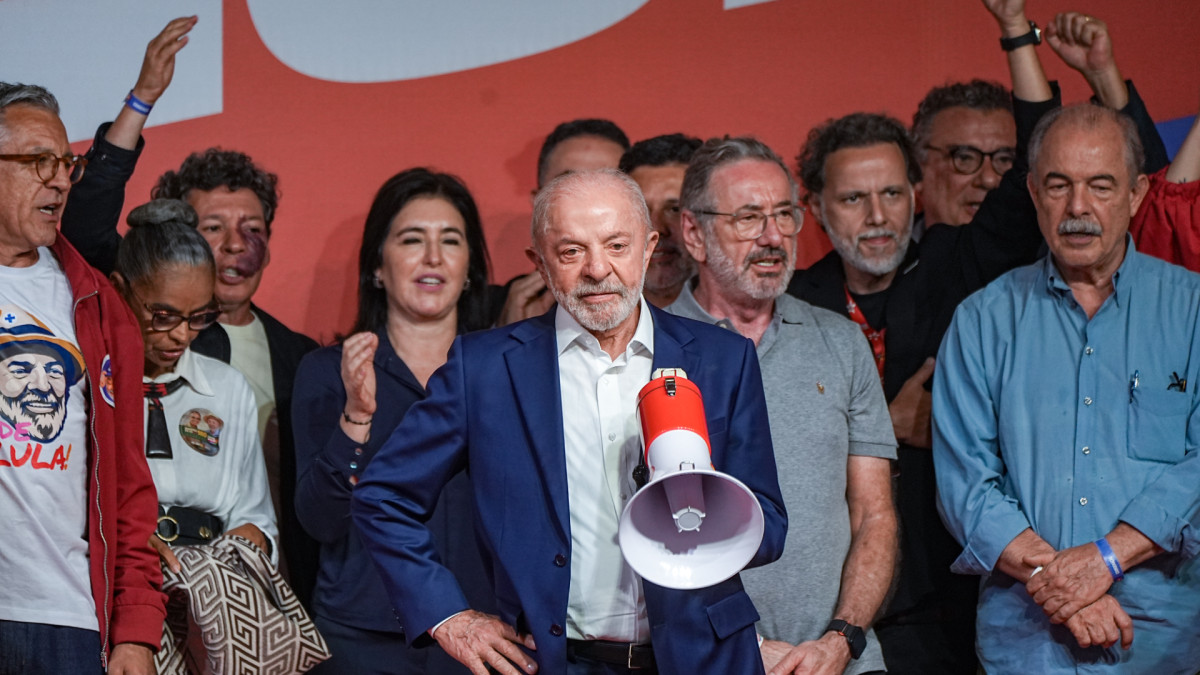
Yesterday, more than 158 million voters were called to the polls and the result of the democratic exercise already compels Brazilians to choose their next president in a second round, scheduled for October 25. Predictions before the vote gave a slight edge to the historic leader of the Workers’ Party and presidential candidate Lula da Silva: between four and five percentage points was the difference. However, Flávio Bolsonaro, son of the former president and ardent political rival of Lula, managed an unexpected turn, winning 47% of the votes — against Lula’s 44% —, which stalled the election, condemning it to a second round. The rest, practically insignificant, went to minor parties.
“Flávio Bolsonaro, son of the former president and ardent political rival of Lula, managed an unexpected turn, winning 47% of the votes — against Lula’s 44% —”
Lula ran a campaign designed to be memorable: he reminded voters of years of macroeconomic growth, years of exaggerated consumption, and the historic social mobilizations of his people. In short, it was a campaign of memory and moderation. And, far from appearing as that incendiary leader who sent the markets into a tremor at the start of the century, he now presents himself as a leader capable of betting on stability in turbulent times. He has advocated the reduction of unemployment, the control of inflation, and the social policies that continue to be his principal political legacy. It should be noted that he has attempted to broaden the historical coalition of the Workers’ Party toward centrist sectors which, although they no longer see him as the undisputed leader, still regard him as a less risky option than the alternative.
In stark contrast lies Flávio Bolsonaro, who has run a campaign closer to a paradox: to resemble his father without becoming him. Jair Bolsonaro — who is currently serving a twenty-seven-year house arrest sentence for attempting a coup d’état —, considered one of the early ultraliberal leaders of South America, remains an emotional reference for millions of Brazilians, but, at the same time, he is also the one who divides the country ferociously — ideologically and economically. His son tries to follow his path, without reproducing all his excesses. And his campaign pillars have been the fight against insecurity and militarization, the rejection of traditional and ossified political elites, the promotion of cultural and family conservatism, as well as the defense of religious values (remember that one of the evangelical pastors —evangelical votes are typically with the Bolsonaro family— was one of the most influential allies of Jair Bolsonaro). The great difference with his father’s political path lies in the nuances: the son promises a less explosive, more decisive praxis. But, here, the question is not whether he can win, but whether he can turn his father’s project into something more durable, less scandalous, and above all, whether he can achieve independence from Washington. Regarding the latter issue, all signs indicate that this is not the case.
Because the fracture that runs through Brazil is not only ideological: it is socio-economic, it is territorial, it is fiscal and even emotional. Lula retains much of his strength in the Northeast, a traditionally poorer region, where the ghost of the best years being under his mandate still lingers. On the other hand, Bolsonaro controls broad swaths of conservative middle and upper classes, the agribusiness, evangelical movements (although there are nuances due to recent dissents and distancing among some religious leaders and the heir to Bolsonarismo) and, above all, those who see the State more as a problem than as a solution — and, in this, the discourse and the Trump-like money are key.
“The fracture running through Brazil is not only ideological: it is socio-economic, it is territorial, it is fiscal and even emotional”
However, the novelty is weariness and fatigue. The years of polarization have worn people down. Politics has become a show that resembles more a Netflix series, one in which two traditional and well-known families face off with speeches at the polls, while insecurity, organized crime and the deterioration in quality of life and the economy cannot be halted. The news, in this case, is that the judge who jailed Lula has now become governor of Paraná state.
Por eso mismo es que estas elecciones son algo más que una simple disputa política para ver quién se sienta en el Palacio de Planalto. Son, sin más, un escrutinio para redefinir la nueva identidad de un país que, siendo tan particular y tan diferente al resto de sus vecinos, ya muestra la necesidad de reconformarse y de componer, de nuevo, una identidad propia. Y sucede lo mismo que en países como Argentina, Chile o México: la gente se está viendo obligada a decidir entre el camino conocido, que tuvo tanto glorias como decepciones, o apostar por un sendero que, ante todo, tiene como meta desafiar las reglas políticas y retar al concepto mismo del Estado. Brasil sigue siendo un país imposible (al menos, para los que no vivimos allí); por eso, este mes, los brasileños están ante la disyuntiva de seguir en esa imposibilidad o de virar el rumbo hacia una construcción de lo posible.
Así quedaría el mapa geopolítico en América Latina (y Trump no quita la vista de encima)
If there is one thing that the Trump Administration 2.0 has been characterized by, it is the peculiar fascination with turning the geopolitical board on its head. Latin America, the uncomfortable neighboring region for him, proves to be a playground of allies where, perhaps in no other region, the maxim “if you’re not with me, you’re against me” is expressed. And Brazil is one of his favored territories.
“Latin America, the uncomfortable and neighboring region for him, proves to be a playground of allies where, perhaps in no other region, the maxim ‘if you’re not with me, you’re against me’ is expressed”
During the recent Brazilian vote, the news broke that Andrei Rodrigues, the head of the Federal Police, was investigating a possible United States interference in the elections. Obviously, to favor the candidate aligned with his regional project, i.e., Flávio Bolsonaro. However, the president of the Superior Electoral Court, Kassio Nunes Marques, stated that no concrete evidence has been found of any foreign interest being present to alter the results or affect the course of the democratic process. It is curious: it was the same margin that gave Lula the lead before the elections that finally gave Flávio the edge ahead of the run-off.
Antes de la cita a las urnas, medios como Le Monde Diplomatique o The New Yorker ya advertían de la sombra de Washington que siempre se hace presente en las elecciones brasileñas. Claro, una administración obsesionada con hacerse del control de los recursos naturales del sur del continente, ¿por qué se perdería la oportunidad de controlar al gigante de Sudamérica, es decir, al país más rico de la región?
No obstante, por el momento, solo son sospechas; no hay pruebas que demuestren que Estados Unidos metió mano a favor de Flávio Bolsonaro. Ahora bien, el dinero sucio tiene maneras inimaginables de hacerse presente en la política, porque tanto ella como el mismo capital, cuando son oscuros, no tienen patria.
“Por el momento, solo son sospechas: no hay pruebas que demuestren que Estados Unidos metió mano a favor de Flávio Bolsonaro”
Ahora bien, ¿qué esperar hacia la segunda vuelta? The favorite, after the October 4 elections, is Flávio Bolsonaro. Psychologically, he is the favorite. And it is so because he managed to overturn the lead with which the former union leader arrived. However, it is important to note that there was a considerable level of abstention, though steady, and that would favor Lula, since many of the places where abstention was high are traditionally aligned with him. It is also worth noting that, for example, Buenos Aires —a known Peronist stronghold and a city with 13,000 Brazilian citizens eligible to vote— gave Lula a clear advantage. In other words, the overseas vote is also counting.
So, if in three weeks the Bolsonarist project consolidates, Washington —a very diplomatic way to refer to Donald Trump— would gain a key territory in its furious meddling in the south of the continent. It already has it, of course, in Argentina, but also in Colombia, Chile, Ecuador, El Salvador, Paraguay, and the Dominican Republic.
“If the Bolsonarist project consolidates, Washington —a very diplomatic way to refer to Donald Trump— would gain a key territory in its furious meddling in the south of the continent”
Brazil has entered the final stretch to, as the saying goes, “put all the meat on the grill.” What course will it take? Will it lean toward Lula’s progressivism, an eighty-year-old leader who promises stability, or will it tilt toward the ultraliberal revolution of the Bolsonarist heir who, beyond his rhetoric, in his own words always echoes the White House? We are a few weeks away from knowing.
