
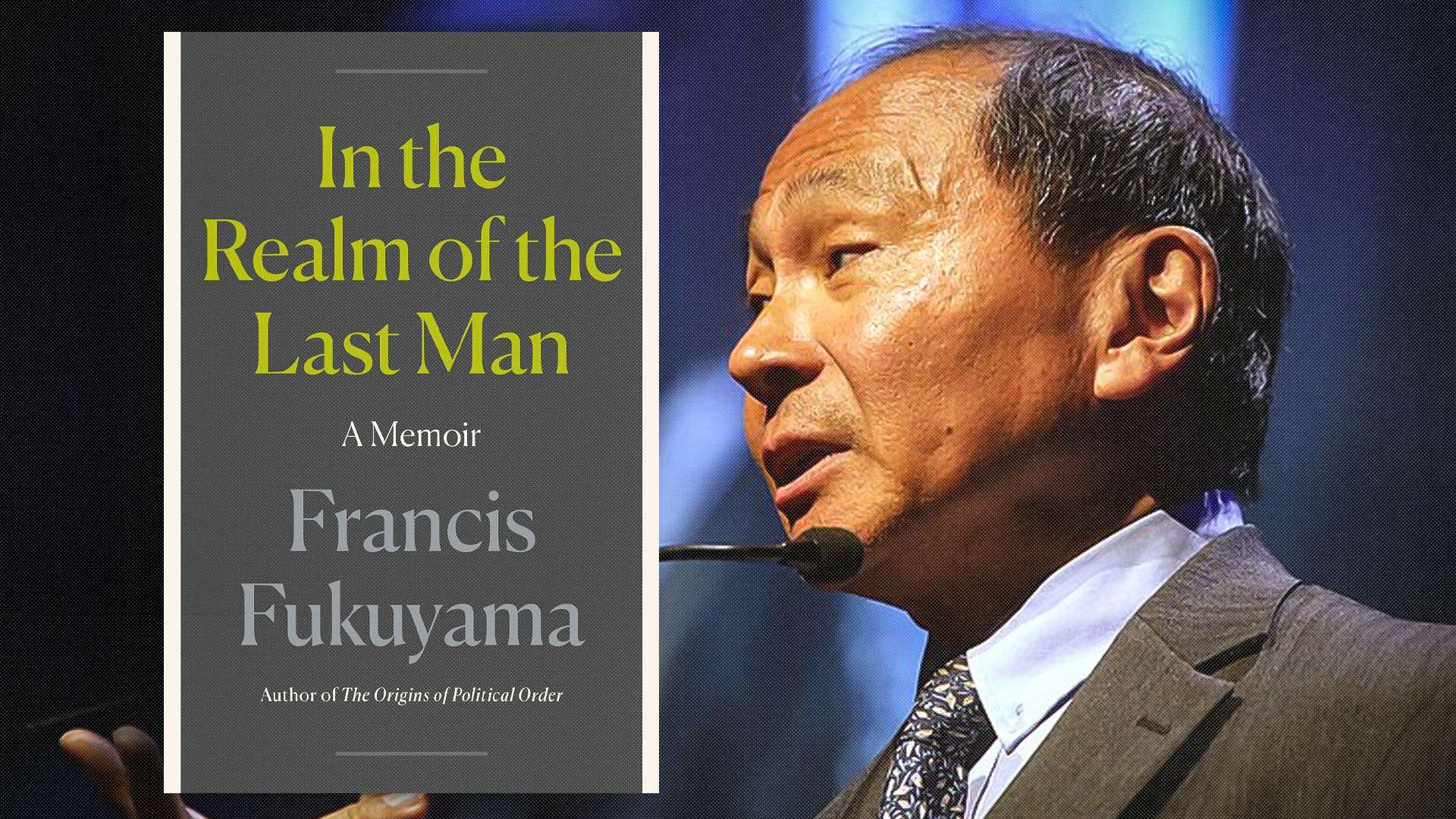
Francis Fukuyama’s latest work confronts transhumanism, the impulse to contend, and what unfolds when people willingly plunge back into the murky swamps of history.
In The Realm of the Last Man: A Memoir, by Francis Fukuyama, Farrar, Straus and Giroux, 304 pages, $29
During his thirties, Fukuyama was cultivating a steady, unobtrusive career as an analyst at the RAND Corporation and as a State Department official concentrating on the Soviet Union. His public break came in the summer of 1989, when his essay “The End of History?” appeared in The National Interest.
At the moment I was producing PBS’s foreign affairs program American Interests. As someone shaped by the Cold War era, I was exhilarated by the claim that we might be witnessing “the end point of mankind’s ideological development and the universalization of Western liberal democracy as the ultimate form of government.” That bold assertion seemed confirmed by the fall of the Berlin Wall later that year and the subsequent dissolution of the Soviet Union a couple of years afterward.
Ever since, Fukuyama has stood among America’s foremost public intellectuals. Now he has produced a thoughtful and engaging memoir, In the Realm of the Last Man. The book traverses topics from his grandparents’ World War II-era internment to his break with prominent neoconservatives over the ill-fated invasion of Iraq; the arc it reveals shows how a rigorous liberal education can sharpen a mind that relentlessly pursues big questions. He credits his encounter with classical thinker Allan Bloom for fueling his passion to ask the big questions: “What is the best way to live, what constitutes the highest form of human happiness, what is the nature of justice, what is natural and what is conventional in human affairs.” Fukuyama’s point is well taken that “a genuine grasp of philosophical thought is a priceless gift that stays with you for a lifetime.”
Yet even as the memoir canvasses all of these topics, it continually circles back to ideas Fukuyama began sketching in his 1989 essay and has developed in numerous works since.
Fukuyama’s contention that humanity had reached the end of history rested on his reading of the French philosopher Alexandre Kojève, who argued that the engine of history is humanity’s pursuit of recognition, dignity, and respect. In his rendering of Kojève, Fukuyama reinterprets Plato’s tripartite view of the soul into logos (reason), eros (desire), and thymos (spiritedness). He argues that thymos is the true psychological driver of history, distinct from mere physical survival or economic calculation. People are unique in willingly risking death to defend abstract ideals.
The “end of history”, in Fukuyama’s sense, is achieved when every person is accorded equal dignity as the core ideal upon which liberal democracies are built. In Realm, liberal societies are described as offering “universal recognition by granting citizens equal rights; the rights to speak, to associate, to believe, and to hold political influence through participation in elections.”
Not ready to subscribe to dialectical metaphysics? In their sharp 2009 work Violence and Social Orders, Nobel laureate Douglas North and two colleagues approached the evolution of political life along a more empirical track. They argued that the primary challenge for any society larger than a few hundred people is how to manage male aggression. Humanity’s earliest fix was a “natural state” built on patron–client networks, with strongmen and their retainers running protection schemes: in exchange for a slice of earnings, the rulers attempted to safeguard people from one another’s predations.
The onset of the nineteenth century, North noted, brought about “open access orders” where the rule of law replaced elite domination. Individuals who had once answered to aristocratic figures became citizens with equal rights. These precursors of today’s liberal democracies proved more effective at restraining social violence while allowing greater flourishing through market-driven growth. By the end of the twentieth century, the number of people living within such systems had grown substantially.
Back in 1989, Fukuyama observed that some societies remained mired in history. In other words, some people remained trapped in backward natural-state tyrannies (Russia being a contemporary example). Yet he predicted that these societies would eventually join the post-historical world by the “unabashed triumph of economic and political liberalism.”
North and his colleagues don’t appear to have contemplated the possibility that bored citizens might rebel against open-access orders and revert to autocratic natural states. Fukuyama, by contrast, did.
In the concluding paragraph of his 1989 essay, Fukuyama warned that “the end of history will be a very sad time.” Why sad? Because “boldness, imagination, courage, and idealism will be displaced by economic calculation, the endless solving of technical problems, concerns for the environment, and the satisfaction of sophisticated consumer demands.” The peace and plenty created by liberal orders may not suffice to satisfy some people’s thymotic drives. “Perhaps the very prospect of centuries of boredom at the end of history will push history to begin anew,” he concluded.
Fukuyama expanded on that line of thought in his 1992 book The End of History and the Last Man. He took the label “the Last Man” from Friedrich Nietzsche’s description of the complacent beneficiaries of bourgeois peace and prosperity. “We have been living in the realm of the Last Man for some time now,” Fukuyama writes in his memoir. “But the problem is that the peace and prosperity produced by a liberal order based on equal recognition is not enough for many people.”
In Realm, Fukuyama reminds readers that the final chapters of The End of History and the Last Man contained a clear foreshadowing of the rise of demagogic populism observed from the mid-2010s onward. To quote the older work directly: if people cannot fight for a just cause because that cause has already triumphed, they will stuggle against the cause itself. They will fight for the sake of fighting—they will fight, in other words, out of a sense of boredom: they cannot imagine living in a world without struggle. And if most of the world lives in peaceful, prosperous liberal democracy, they will resist that peace and oppose democracy itself.
Forty years after that forecast, Fukuyama notes, “We see this today on both the far right and the far left.” Moreover, would-be autocrats have been rising by tapping into populist anger, generating “a persistent pressure” to return to clientelism and patronage that centers on the ruler’s friends and family.
In fact, the V-Dem Institute’s latest annual assessment shows more nations succumbing to that pressure, with autocracy spreading across the globe. Alarmingly, the report also notes that “the United States has lost its long-standing status as a liberal democracy for the first time in more than fifty years, sliding into the lower tier of electoral democracies.”
Fukuyama ends Realm by outlining three challenges that he believes liberal democracy must confront today.
The first is a “fetish for proceduralism.” When rules multiply without restraint, social trust erodes, giving rise to a system of governance where any new project is blocked by a maze of red tape. He warns that such hyper-detailed regulations can leave ordinary citizens tempted to back authoritarian figures who promise to slice through the bureaucratic knot.
The second challenge is transhumanism, a debate Fukuyama has long labeled “the world’s most dangerous idea.” In Realm, he recalls a 2003 exchange on the topic—an argument with the science editor of a libertarian magazine who celebrated longevity breakthroughs with unbridled enthusiasm.
That debate is summarized by the commentator: he argued then, as he does now, that “the defining conflict of the twenty-first century will be the struggle over life and death. On one side are those who advocate accepting mortality and passing into the night; on the other are the advocates of extending healthy life for as many people as possible, for as long as possible.” Fukuyama remains a defender of the latter stance. When asked in 2004 whether a government has the right to compel citizens to die, he replied, “Yes, absolutely.”
In his account of that exchange, Fukuyama recalls telling me that he did not look forward to a century from now hearing the same glib libertarian talking points repeated. I don’t recall that precise retort, and perhaps memory is a bit unruly here. In any case, biomedical progress has progressed more slowly than Fukuyama feared or that I hoped, so he probably won’t have to endure hearing me spout libertarian dogma for another century.
Given Fukuyama’s uneasy sadness about history’s end, it may seem puzzling that he remains so firm in opposing the transhumanist program. Transhumanists are animated by the same thymotic impulse he worries was tamed by bourgeois comfort. As tech investor Marc Andreessen put it in his Tech Optimist Manifesto, after declaring his belief in deliberate, systematic self-transformation to enable technological progress, his “enemy is Friedrich Nietzsche’s Last Man.”
Fukuyama’s central concern about transhumanism is that biotechnological progress could erase the limits inherent in human nature. He fears that using biotechnology to enhance capacities could undermine the principle of equal rights and thereby restart the historical process. I (for my part) am inclined to think liberal democracy will prove capable of preserving social and political peace. As I have argued before, political and moral equality does not depend on biology. In liberal societies the law applies equally to all, regardless of wealth, power, brilliance, or enhanced status, or lack thereof.
The third enduring challenge Fukuyama identifies for liberal democracy is the thymotic drive to struggle—to seek recognition through sacrifice for presumptively just causes. This impulse today nourishes Islamism, Russia’s revanchism, and a range of left- and right-wing authoritarian movements that plague many rich nations. And, truth be told, it also underpins transhumanism.
At the end of The End of History and the Last Man, Fukuyama likened historical progress to a long wagon train headed toward the same destination. Some wagons arrive earlier at liberal democracy, but eventually most travelers reach the destination. Yet, in his final sentence, he wonders whether the travelers, having safely reached their destination, might find their surroundings unsatisfying and set out on a fresh, more distant journey.
Now, after thirty-four years, Fukuyama concludes, “No one has yet devised a new architecture capable of housing the Last Man at history’s end, but the aspiration endures.”
