
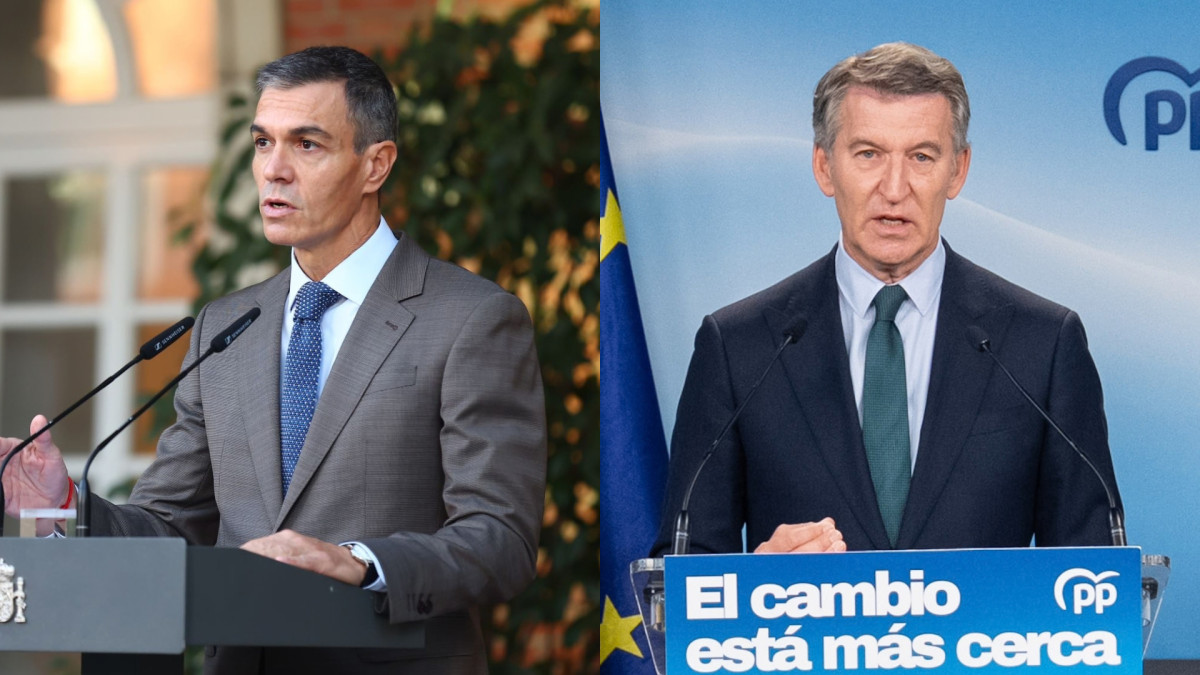
Spain will go back to the polls on November 29. Pedro Sánchez announced on Monday the early general elections after the government lost in the Congress on Friday the vote on the two housing decrees. The decision cuts short a legislature that the president had repeatedly said he intended to run out until 2027.
The first appearances by Sánchez and Alberto Núñez Feijóo have also served to set out the terms in which PSOE and PP want to contest the campaign. The president has presented the elections as an opportunity to broaden the progressive majority and continue with his government’s agenda, while the opposition leader has placed the focus on the legislature’s exhaustion and has presented the call as the moment to open a new political era.
They are two opposing explanations about why Spain returns to voting, but also two different takes on the past few years and two attempts to define what will be at stake at the end of next month. Agenda Pública has asked Ruth Ferrero-Turrión, Anna López Ortega and Joan López Alegre the same three questions to compare how they interpret the first clash of the campaign.
How does each leader interpret the reasons behind the early election and where do they place responsibility?
Ruth Ferrero-Turrión
Ruth Ferrero-Turrión, professor of Political Science at the Complutense University of Madrid (UCM):
Pedro Sánchez presents the early call as a consequence of parliamentary gridlock and the exhaustion of the majority that sustained the legislature. Following the defeat of the housing decrees, she contends that the Government no longer possesses enough strength to drive the pending reforms. While acknowledging “own errors,” she shifts much of the responsibility toward an opposition that she accuses of mounting the blockage, toward certain economic powers, and, more implicitly, toward the former parliamentary partners who have stopped supporting the Government. Her argument is: to continue governing and deepen the social agenda, it is necessary to renew and widen the progressive majority.
Alberto Núñez Feijóo constructs an interpretation that is practically the inverse. For him, the elections are not the result of the blockage caused by the opposition but of the political fatigue of the Government itself: loss of parliamentary majority, incapacity to push its policies, problems like housing, and especially the corruption cases affecting the PSOE and the government environment. According to Feijóo, Sánchez would have artificially prolonged a legislature already unviable and now would call elections to try to escape that deterioration.
Sánchez interprets the early call as the need to unlock the legislature with a new majority; Feijóo, as the acknowledgment of the failure and exhaustion of the previous majority. The campaign’s narrative axis will be for Sánchez to discuss what majority Spain needs to tackle social problems, while Feijóo tries to turn the elections into a referendum on eight years of Sánchez.

Anna López Ortega
A battle over the narrative of responsibility begins here.
Sánchez tries to ensure the early call is not interpreted as a government defeat but as the consequence of a blocked Congress. His argument is: we have tried to govern, we have made mistakes, but we have also advanced many policies; now we need a broader majority to do more.
And that matters because he is acknowledging part of the responsibility: he does not deny the dissatisfaction, but instead tries to turn it into a demand for greater capacity to govern.
Feijóo does exactly the opposite: he absolves the Parliament and explicitly blames Sánchez. His frame is that we are not facing a problem of governance, but the exhaustion of a political era and the need to replace the president.
Joan López Alegre
Sánchez, like other leaders such as Trump, deliberately mixes institutional communication and politics. It is a trend of perverse instrumentalization of institutions. Feijóo, paradoxically, offers a more institutional discourse even though he does so from a party headquarters.
What balance does each one make of the legislature and where do their diagnoses clash?
Ruth Ferrero-Turrión
Present two incompatible narratives. Sánchez delivers a largely reformist balance. He presents these three years as the continuation of the transformation cycle begun in 2018: economic growth, job creation, reduced precariousness, strengthened social policies and advances in rights, all amid an international context particularly adverse. His thesis is that Spain is objectively better off, although he concedes that serious problems persist—especially housing, inequality and public services—and that precisely the difficulty in pushing further in those areas demonstrates the need for a broader progressive majority.
Feijóo builds precisely the opposite diagnosis. He describes the legislature as a period of institutional fatigue, parliamentary blockage and deterioration in living conditions. He highlights the absence of budgets, the loss of purchasing power, the housing crisis, the decline of some public services and, especially, corruption cases connected to the PSOE and the government environment. Hence his characterization of the Government as “politically exhausted, Parliamentarily blocked and ethically unfit.”
For Sánchez, the problem is ultimately the insufficient parliamentary majority to continue a social agenda; for Feijóo, that lack of a majority is not the cause of the problem but proof that Sánchez’s political project has run its course.
Anna López Ortega
Sánchez advocates for a legislature of transformation: growth, employment, social rights, the energy transition, reduced inequality and progress in housing. But he introduces an important novelty: he concedes that there is dissatisfaction and that the Government has also made mistakes. That allows him to attempt to reconnect with a progressive voter who may be tired or disillusioned.
Feijóo offers the opposite diagnosis: focuses on the deterioration of public services, housing, the lack of budgets and the dependence on parliamentary partners. And he turns all of that into an argument for change.
But there is something interesting from political science: citizens do not vote solely by tallying up the past. They also vote by expectations. This is what we call a prospective vote: what do I think each candidate will do if they win?
That is why the balance matters, but perhaps as much or more matters which future each candidate can imagine.
Joan López Alegre
They present two diametrically opposed readings. The triumphalism of Sánchez clashes with a first undeniable fact: he calls early elections, and that is a first failure in itself, especially since he promised to go until 2027. For his part, Feijóo is torn between an outright amendment to the Sánchezismo, which would put him on par with Vox, and the moderation that recently yielded poor results for Merz in Germany. Guessing, beyond the noise, whether Spain wants a complete change of course and a reduction of tension while maintaining that tone without clashing with a potential ally is the challenge.
What framework is each leader trying to impose for the elections and how do they define the choice faced by voters?
Ruth Ferrero-Turrión
Both present the elections as a country-wide crossroads from radically different positions. Sánchez tries to impose the frame of “advance versus backward steps.” He does not present the elections as a judgment on his personal continuity, but as a decision about what social model Spain wants for the coming years. His speech shifts the center of gravity toward housing, inequality, public services and the expansion of rights.
From there his call for a “much broader progressive majority” that allows deepening reforms and, in his words, “to bend the elites” who block those advances. He tries to move the campaign’s playing field away from the issues that dominated the last months—corruption, Ceuta, amnesty or parliamentary fragility—and toward the material and the social, especially housing.
The election Sánchez proposes would therefore be a choice between continuing and deepening social transformation or allowing a rollback in rights and social policies.
Feijóo tries to impose a very different frame: “continuity versus change,” but mainly “Sánchezism versus regeneration.” His rhetoric aims to turn the elections into a referendum on Sánchez and on his eight years in government. That is why he uses a very explicit sequence of dichotomies: “decay or change,” “lie or change,” “incompetence or change,” “division or change” and “corruption or change.” And he raises the tone even higher by arguing that what is at stake is not a simple alternation, but a “national reconstruction.”
The initial battle of the campaign will precisely be to decide which of those two questions voters believe they are answering on November 29.
Anna López Ortega
For me, this is the central battle of the campaign: who manages to define what is being voted on.
Sánchez has built a very clear frame: two models for Spain. He is not presenting simply PSOE against PP. He is presenting continuity against a wave of reactionary forces—right-wing radicalism—and, within that frame, he is trying to define what he understands as progress: a democratic socialism based on a new social contract.
And what does that social contract mean? That politics must once again guarantee very concrete matters: affordable housing—which today is probably the biggest inequality issue—salaries, high-quality and efficient public services, and social protection.
Feijóo tries to break that frame and bring the election to a much more personal terrain: Sánchez yes or Sánchez no. That rests on a frame built for years around Sánchez as someone who divides, who betrays or who leads the country to the limit.
Hence, the battle will not be solely ideological; it will be a fight over the frame: who can get citizens to interpret these elections as a vote on housing and the welfare state or as a judgment on Sánchez.
That connects with affective polarization: we do not only vote for what we want or for affinity, we also vote against what we perceive as an existential threat. The great challenge for Sánchez will be to ensure the progressive vote is mobilized not only against the right but in favor of a future project.
Joan López Alegre
Sánchez remains above one hundred seats, but at the cost of devouring his allies, preserving the fiction that he can win but will be left with no one to bargain with. Will Sánchez in these elections be the Feijóo of 2023? Sánchez showed us that elections are not about who wins, but about who can form a majority.
Can Sánchez move closer to the PP? Perhaps, but then he would be in the same situation as Feijóo in 2023, i.e., a hollow victory because there is no possible majority. Can Feijóo tie or lose but still become president? Yes. With Vox near 20%, Feijóo would have a partner who is not a crutch but a fundamental pillar with support in other ministries, such as the Italian one and, who knows, perhaps the French one soon.

Natalie Foster
I’m a political writer focused on making complex issues clear, accessible, and worth engaging with. From local dynamics to national debates, I aim to connect facts with context so readers can form their own informed views. I believe strong journalism should challenge, question, and open space for thoughtful discussion rather than amplify noise.