
International identity of a country usually changes first in the gaze of others than in its own self-consciousness. New Zealand learned this in 1985, when the Labour government of David Lange denied entry to the American destroyer USS Buchanan in protest at the refusal to declare whether it carried nuclear weapons. The decision sprang from a sovereignist current in the Pacific opposed to American atomic tutelage and to mutual assured destruction. In March, in Oxford, a student reproached him for rejecting those weapons while his country rested under Washington’s strategic umbrella. Lange replied that he could smell the uranium on the breath of his interlocutor. Closing the ports to American ships dismantled de facto the ANZUS Treaty, revoking its defensive guarantees and consigning the country to diplomacy in the open air. He paid the price of a sharp moral identity with voluntary isolation that reconfigured the map of the southern hemisphere.
I think of that when a foreigner asks me about Pedro Sánchez, a matter that has lately become quite common in my hallway conversations. They begin with Madrid’s stance on Israel or the NATO budgetary demands, but continue with corruption, migratory pressure in Ceuta, or whether we will have budgets at any point. I find myself explaining a country that my interlocutor knows in fragments, just as I know his country through chronicles. Between us we try to discover how much of Spain is in the Spain that has reached him. Thus, we draw a cartographic exercise to stitch together fragmented perceptions, attempting to discern where the data ends and where the narrative begins.
The question blends issues that tend to travel together but do not mean the same thing. My interlocutor may be interested in Sánchez or celebrate a Spanish decision without necessarily implying greater trust in Spain. To understand external reception, one must distinguish what is attributed to the president and what to the country, and in what domains there is willingness to count on Spain. They are separate matters: a foreign organization may admire an intervention by Sánchez and, at the same time, consider the country irrelevant. On the other hand, a Government may disagree with the president and yet trust a Spanish embassy, its military, or its cooperation to carry out a specific task.
“To understand external reception, one must distinguish what is attributed to the president and what to the country, and in what domains there is willingness to count on Spain”
The change runs along those lines. Spanish soft power, traditionally based on language, culture, tourism, football, gastronomy and a gentle view of life, is changing. Brand Finance placed Spain in 2025 at 13th place out of 193 countries, highlighting culture, heritage and tourist appeal, a image also reflected in our Spain Image Barometer. The political Spain has not yet replaced the Spain of sun, but is starting to sit atop it, and it is in this contemporary image of Spain that certain audiences could recognize an alternative to the course of their governments.
The formula of a soft power based on the “progressivism antiestablishment” projected in recent mandates allows examining that image by separating its components. The progressive part refers to expanding rights and social protection, such as the reproductive rights and LGBTI reforms of 2023 or the regularization of immigrants promoted in 2026. According to V-Dem, 74% of the world population live under autocratic regimes and the deterioration also affects Western democracies. Spain is not immune to democratic wear; although certain rights-expansion policies contrast with the course of other governments, that contrast may increase its foreign appeal.
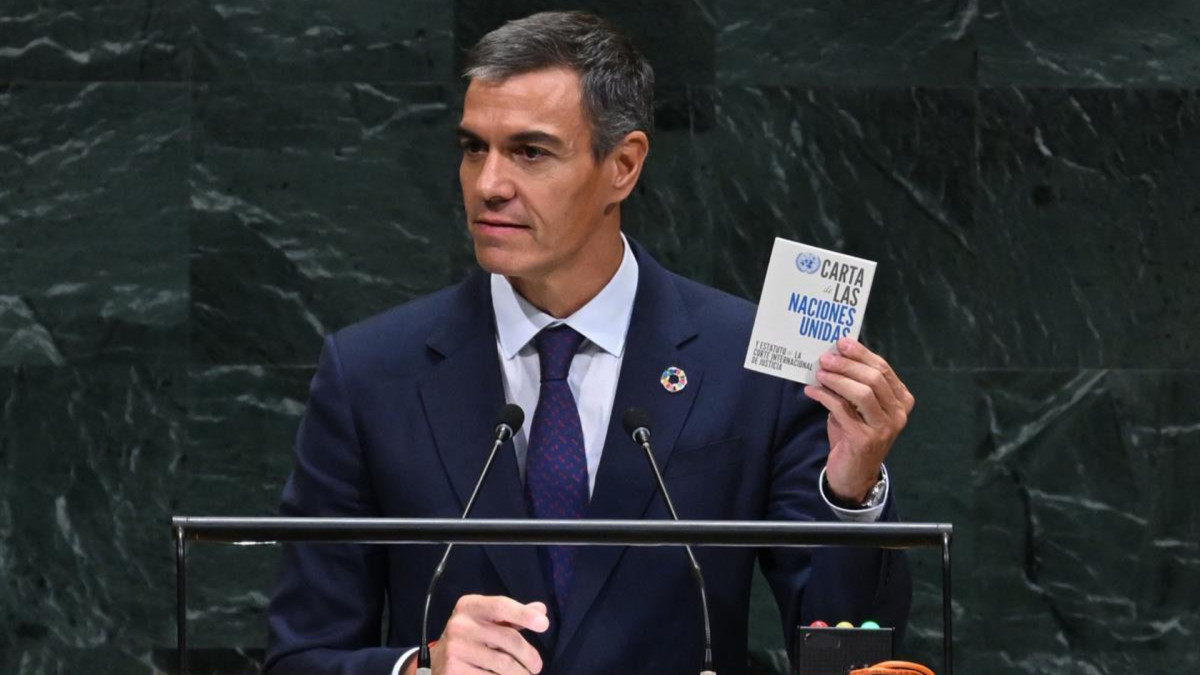
The antiestablishment part points to an image of challenge from within institutions. By rejecting the NATO spending target of 5%, the Government invoked the protection of social spending, while the Alliance argued for defensive needs against Russia. Spain and Ireland also asked in February 2024 to review the EU-Israel association agreement for its human rights clauses. These episodes can project the image of a country willing to dissent before there is a consensus perceived as unjust. For foreign left-wing sectors that disagree with their governments’ foreign policy, Spain can be a reference where to recognize their demands, championed by someone with institutional capacity. That sympathy arises from both the content of those positions and the audacity to sustain them: Spain offers those publics the proof that the decisions of its own governments were not inevitable.
“For foreign left-wing sectors that disagree with their governments’ foreign policy, Spain can be a reference where to recognize their demands”
Julia Bader and Neil Loughlin distinguish between the strategy of the attractor, the receiver’s preferences and the resulting behavior. In March 2026, AFP documented Spanish flags and memes of a bull with a wolf on Turkish networks after Sánchez’s rejection of using the Spanish bases to attack Iran. Pacifism, religious solidarity or sovereignty could find room in a gesture, preserving disagreements about how to organize a society. Each audience would incorporate “Spain” into its political vocabulary in a different way. How much of it contained identification with Spain, how much opposition to Washington and how much recognition of a cause of its own in the voice of a foreign leader? The sympathy expands thanks to that indeterminacy, because it allows feeling represented without sharing too much, even though turning it into power requires a subsequent test: that someone changes a conduct, facilitates an alliance or grants Spain a function. Between applause and influence there is a long road ahead.
To explore that distance, one can look to Costa Rica and Norway. Costa Rica’s constitutional prohibition of a standing army in 1949 took on an international dimension that UNESCO links to the credibility of its pacifism, sustained through international law and social investment. Meanwhile, Norway developed a professional mediation capacity supported by resources, specialists and continuity between governments, having intervened in more than forty conflicts since 1990. Both cases are clear examples that allow studying how principles relate to access, information and diplomatic capital when sustained by practices that others recognize. Transferred to Spain, it would remain to identify which interlocutors count on it thanks to the trust generated by its positions.
Spain is interested in developing a deeper line of its own beyond sun and football. Tourism aims to please everyone, while a stance on Palestine, immigration or rearmament selects its audience. This soft power can be more intense, but less universal: it attracts progressives, pacifists and supporters of greater European autonomy, and can provoke backlash among allied governments, conservative voters or societies that interpret it as disloyalty. Its effectiveness should be measured by the depth of trust in concrete communities, not only by the country’s average rating. A narrow political prestige can be more useful than broad tourist appeal if it allows forming coalitions, bringing issues onto the agenda or being accepted as an interlocutor.
“A narrow political prestige can be more useful than broad tourist appeal if it allows forming coalitions, bringing issues onto the agenda or being accepted as an interlocutor”
A recognizable reputation can open dialogues where other European partners encounter resistance, facilitate variable coalitions, improve access to Latin America and the Mediterranean and grant Madrid a specialization within alliances dominated by larger powers. For a middle power, differentiation pays off when it turns a position into a function. The question thus is about weighing the benefits of acting with the bloc, leading a small group, or speaking alone, choosing in each case the option that expands Spain’s capacity rather than confusing autonomy with volume.
Turning that profile into state policy would require distinguishing three elements: objectives, instruments and narrative. PSOE and PP could share a common goal, but disagree on means and later explain the agreement through opposing stories. That plurality would open a possibility of continuity compatible with different priorities. Delimited commitments, multiannual resources, consultations with the opposition before irreversible decisions and periodic reviews would provide mechanisms to examine it. Institutionalizing it would also entail costs, reducing the margin of the current Government and slowing certain changes. The most important would be to know what predictability each commitment provides and what capacity for revision remains with those who inherit a policy from the adversary. Each party would thus maintain its own narrative about commitments whose scope would have to be defined beyond the photograph.
Palestine offers the clearest candidate. In 2014, under the Rajoy government, the Congress approved by 319 votes a pact agreed by PSOE and PP that urged recognizing the Palestinian state, linking it to negotiation, Israel’s security and European coordination. In May 2025, 78% of Spaniards supported that European states proceed with recognition already, a result limited to that question and that moment, rather than a general endorsement for sanctions or diplomatic ruptures. The shared minimum could bring together a two-state solution, humanitarian aid, international law and a sustained Mediterranean interlocution.
The decisive question is to know how much of this stance is political opportunism and how much could become national doctrine. The defense of sovereignty, of autonomy vis-à-vis the great powers or of a rules-based order can today be identified with a certain progressivism, but its usefulness goes beyond that label. The great powers can afford a world without limits because they trust in imposing them themselves; the middle powers, by contrast, need that limits exist. For Spain, international law is not merely a moral preference: it is a way to compensate for what cannot be obtained by force. A truly mature foreign policy should learn to distinguish between the positions that express a Government and those that, in protecting the country’s margin of action, deserve to survive it. There would also be the willingness of those on the other side of the table, because diplomatic relations are inherited with their expectations and those who approached Spain for certain positions could reassess that trust when Madrid’s priorities changed.
“The shared minimum could include the two-state solution, humanitarian aid, international law, and a sustained Mediterranean interlocution.”
That continuity would also require abandoning habits that make any promise of coherence precarious, as shown by Sánchez’s shift on Western Sahara in 2022, when he backed the Moroccan autonomy plan without previously building parliamentary consensus, shifting Spain’s position on self-determination through a presidential decision whose consequences will be inherited by his successors. Hardly can others be asked to trust a state policy when its orientation changes without a state-wide agreement. Corruption investigations, even while distinguishing political responsibilities, suspicions and proven crimes, threaten to restore the old stereotype of a Mediterranean Europe where institutions serve as shortcuts for private interests. Defending principles outward requires taking care of procedures inside, because international credibility feeds as much on the causes Spain sustains as on the way it decides and the diligence with which it demands accountability from those who represent it.
The soft power reaches its true depth when a country stops merely being known and begins to be recognized. Principles and rights create a different sympathy, less epidermal and more demanding than sun and football, because they bring closer those who see in another State’s conduct a worldview compatible with their own. From that affinity arise relationships that accumulate memory, trust and mutual obligations until they become part of the country’s external patrimony. For a middle power, that depth matters because it expands its ability to find allies, retain interlocutors and assert its position when weight alone is not enough. It also compels rethinking alternation. Turn-taking makes state sense when each Government receives relations that were built by another and understands that some deserve to be continued precisely because they no longer belong to it. Perhaps that is where the fiercest form of influence begins, when a principle supported for long enough ends up becoming a relationship that no change of majority can treat as if it had just been born.
“Turn-taking makes state sense when each Government receives relations that were built by another and understands that some deserve to be continued precisely because they have ceased to belong to it”
Let us return to Lange. His refusal became law and, later, the National Party found its own reasons to preserve it; that journey allows us to observe how a decision survives the speaker and changes ownership in political terms. In the face of an Spanish alternation, some of Sánchez’s positions would reach his successor’s desk still wrapped in the rhetoric of the contest, leaving to be seen which remain, which are modified, and which relationships continue to function. What the PP repeals may have belonged to a Government; what it preserves may have begun to belong to Spain. Soft power reaches its most perfect form when even the adversary ends up administering your legacy and the foreigner, who knows nothing of our quarrels, simply learns that it can count on us.
