
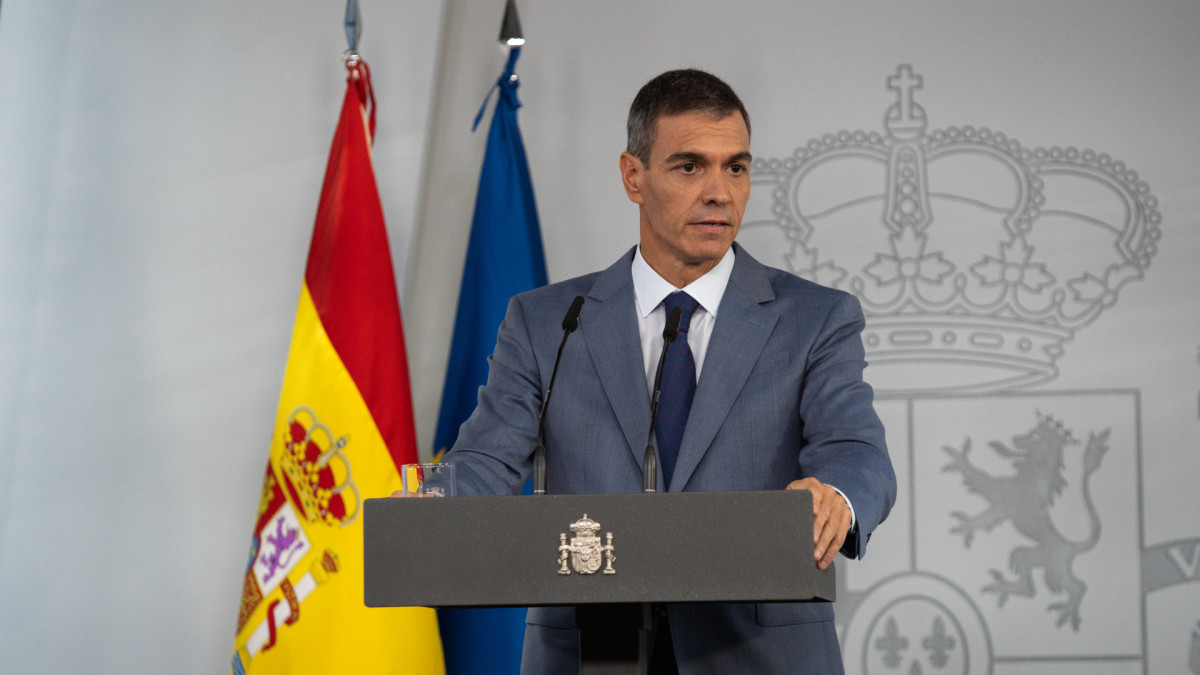
At nine o’clock in the morning last Monday, on the steps of the Council of Ministers building, Pedro Sánchez announced the call for general elections for November 29, after cooking the decision over the weekend. The rush of events follows the Friday vote in Congress, in which PP, Vox and Junts blocked the validation of the two housing decrees born from Maricarmen’s eviction. The immediate takeaway is that the Prime Minister has dissolved the General Courts at the best possible moment foreseen up to July 2027. The housing protests and electoral tension enrich a window of opportunity for the progressive bloc to mobilize an electorate that until now has shown itself “asleep” in the polls.
That a vote be held on blocking social policies
The discontent generated among progressive sectors by the rejection of the two housing decrees makes it possible to focus on this issue as an example of the two competing models, the one of the right-wing bloc and the one of the current coalition government. Moreover, it prevents the elections from revolving solely around the government’s management and the wear it may have accumulated after eight years. In this sense, November 29 functions differently, for the reasons below. The first is the chosen moment, defined by housing. It is not only the events of the past weeks: this problem has topped the CIS barometer for almost two years. In January it was cited by 42.6% of respondents and in May it rose to 48.8%, its historical high. Fifteen years ago, unemployment was the foremost concern; today it is owning a home, and among young people the concern is even greater. No other issue gathers as much concern, as much street mobilization, and a recently held parliamentary vote that represents it.
“No other issue brings together so much concern, so much street mobilization, and such a recently held parliamentary vote that represents it”
The second reason is ownership of the issue. Campaigns tend to win them when they manage to mobilize voters to vote on the issues on which they are deemed more credible, closer to their positions, and better at handling those problems. Housing is one of the issues where the Government’s position — protection against evictions, containment of rents, limits on funds — coincides with the social majority that has been evident in the streets and in the data in recent weeks. The PP’s alternative, with less taxes and more market supply, does not respond to the urgency of someone who has an eviction order for next month. By contrast, on immigration or the Ceuta crisis, the conversation favors the right.
The third reason is the attribution of responsibilities. Splitting the package into two decrees aimed to secure the approval of the first, with the most basic measures, after the impact of Maricarmen’s eviction and the Sol encampment. The final rejection of both, propelled by Junts in a nominal vote, offers a record of who voted against protection against evictions until 2030 and against limits on speculative purchases. What happened last Friday in Congress allows the Government to pose a retrospective choice about the opposition, by attributing to them responsibility for the lack of housing measures. Thus, the question becomes who prevented it.
Additionally, the Government’s decision to re-approve the two decrees in the Council of Ministers so that they take immediate effect and can be validated by the Permanent Deputation, whose arithmetic, with the Cortes dissolved, does not require Junts’ support, opens up a scenario in which housing not only inaugurates the campaign but will be voted on again in the midst of it, while protests and the Sol encampment continue to unfold.
A race still open
Polls published before the call show a highly mobilized right, which would translate into a clear parliamentary majority. That said, it is worth analyzing all the data on offer, because the picture is not as straightforward as it seems at first glance. The progressive bloc has not lost ground because its voters have shifted to the right. It is not so much that the electorate that in 2023 leaned toward PSOE or Sumar now intends to vote for PP or Vox, but that a portion of it is reluctant to go to the polls. It is worth recalling at this point that these are barometers conducted before the election announcement, and therefore the question did not have a fixed date.
“The progressive bloc has not lost ground because its voters have shifted to the right”
The proof that the formations that make up the Government retain the ability to reverse the polls lies in the raw data these surveys provide. When respondents are asked directly about their voting intention, the PSOE holds up much better than what the headlines or the pollsters’ own estimates reflect. The left’s problem, therefore, is not a matter of preference but one of intensity.
That is precisely the terrain the call seeks to transform in the context of the housing protests. The right’s advantage in the polls, built on the opponent’s abstention, may be much more fragile than one built on converting its own voters, because it depends on demobilization. In that line, the collapse of the housing decrees, with the issue that most concerns Spaniards defeated by the sum of PP, Vox and Junts, is exactly the kind of episode capable of generating in the voter the stimulus to go to the polls so that their participation influences the country’s political and social reality.
The precedent invites not to take anything for granted. In July 2023, Sánchez called early elections after losing the regional and municipal elections, with the polls predicting a clear defeat, an almost written and inevitable future, and the Socialists ended up higher than what almost all polls had given them. On that occasion, the idea of change was reversed. That result is not explained by voters switching from left to right, but rather by their own voters deciding to participate again and back the Government parties. The question of these weeks remains, essentially, the same: whether housing manages to mobilize and engage those who still call themselves progressive to participate as such on November 29. If they do, the electoral race will be open.
“The right’s advantage in the polls, built on the opponent’s abstention, may be much more fragile than one built on converting its voters”
There is, moreover, a variable at stake beyond Spain. Twenty-six days before November 29, the United States holds its midterm elections, in which the Democrats arrive several points ahead in the intent to vote for Congress and with Donald Trump’s approval rating below 40%. A clear defeat of Trumpism would break the sense of an inevitable reactionary wave on which much of the conservative narrative relies, and would demonstrate that wave can be slowed at the ballot box. There is another possibility: that the president refuses to acknowledge an adverse result, which, with the Capitol riot of January 2021 as a precedent, would bring the democratic axis back to the center of the debate, which continues to mobilize the progressive electorate. For a bloc whose problem is that intensity, November could bring from outside another aggregating stimulus.
Calling elections while there is still a choice
None of the above guarantees the left’s victory, but the contest will unfold on the most favorable ground available. The alternatives ranged from budgets that would have to rely on Junts or nine months of parliamentary deadlock to push through sweeping social policies. Against those scenarios, Sánchez has chosen to vote on the issue that most concerns Spaniards, housing, with an opponent depicted in a nominal vote, with the street still mobilized and with right-wing parties whose tempo the decision changes. For all of this, the moment responds to the idea that the election still centers on something more than the wear of governing. It remains to be seen whether those who have mobilized in favor of housing, in the streets and in their homes, in response to the eviction of Maricarmen and the Sol encampment, will also fill the urns. What seems clear is that Sánchez has seen the opportunity of the moment.
