
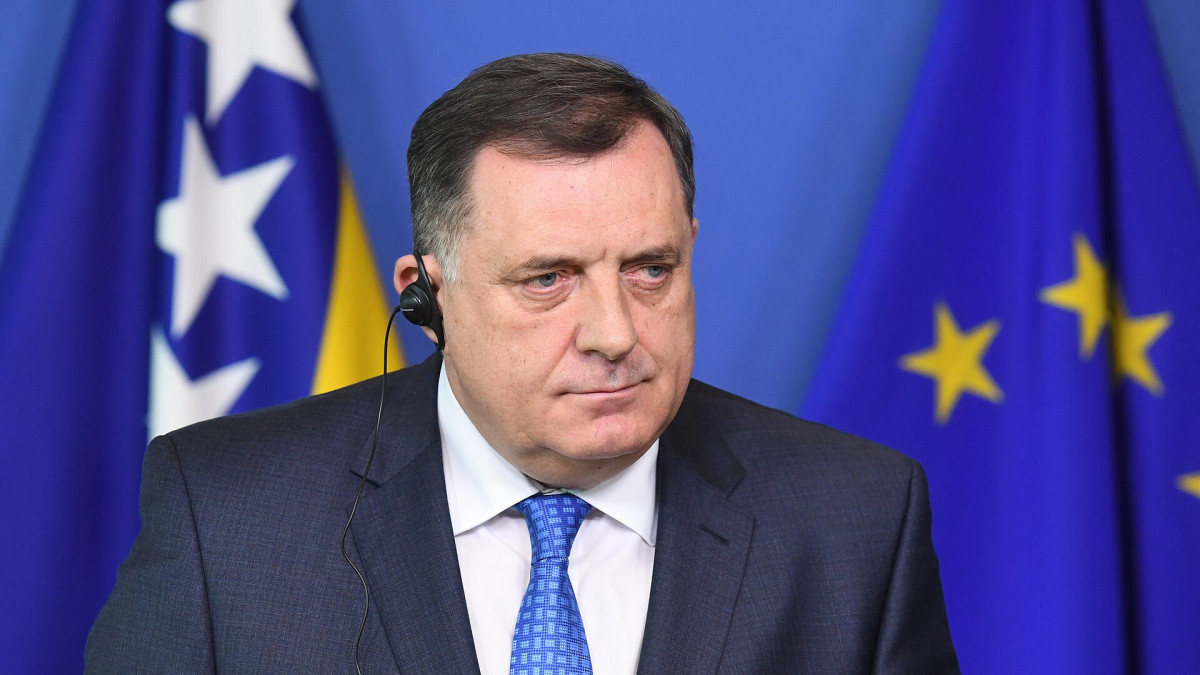
The elections held this Sunday in Bosnia and Herzegovina leave an uncomfortable conclusion for those who hoped the political crisis of recent years could open a window of opportunity to unlock the country. It has happened more to the contrary. The ballots have again reproduced much of the ethnonational balances that have kept Bosnia trapped for three decades and, above all, they have confirmed Milorad Dodik’s ability to maintain political control of the Republika Srpska even after being formally sidelined from the institutions.
This is the main paradox of these elections. Although he did not appear on the ballots, Dodik has been one of its main protagonists. Condemned for challenging the decisions of the High Representative and sidelined from public office, he has managed to turn his institutional exclusion into a rallying cry for political mobilization. His party, the Alliance of Independent Social Democrats (SNSD), has kept its dominant position in the Republika Srpska; Željka Cvijanović has clearly won the Serb seat in the country’s tripartite Presidency and Savo Minić has prevailed in the race for the presidency of the Serb-Bosnian entity.
“Condemned for challenging the decisions of the High Representative and sidelined from public office, Dodik has managed to turn his institutional exclusion into a rallying cry for political mobilization”
Dodik has thus shown that one can lose office without losing power. And this raises a problem that goes far beyond his personal future. In recent years, the international strategy toward the Bosnian Serb leader had been based on the idea that a combination of sanctions, judicial decisions and political isolation would end up constraining his room for action. However, the electoral result shows that this is a strategy with certain limits. External pressure has not fragmented his power structure and, in some respects, has even allowed him to reinforce the narrative that the Republika Srpska is subjected to the impositions of Sarajevo and to an international community that would not respect the will of the Bosnian Serbs.
It is not by chance that Dodik publicly thanked both Donald Trump and Vladimir Putin for the new international context. A few days before the elections he had travelled to Moscow to meet the Russian president. His message is clear: the Bosnian question goes beyond the country’s borders and is part of a broader geopolitical competition over the future of the Western Balkans.
“The Bosnian question goes beyond the borders of the country and is part of a broader geopolitical competition over the future of the Western Balkans”
The second notable datum is participation. A little over 42% of eligible voters cast ballots, around eight points lower than in 2022. This figure perhaps says as much about Bosnia as the distribution of seats. Three decades after Dayton, a growing portion of society seems disconnected from a political system that offers few real chances for transformation, while another significant portion has emigrated from the country. While the elites compete around national identities and the institutional distribution of power, daily concerns revolve around wages, public services, corruption, housing or simply the possibility of building a future without having to leave the country.
Today the Bosnian problem is no longer only nationalism. It is also the capacity of that nationalism to function as a mechanism for reproducing political elites who find few incentives to modify the statu quo. The Dayton Accords achieved something extraordinarily important: to end a war that had left more than 100,000 dead. But, at the same time, they designed an extraordinarily complex institutional framework that turned ethnic identity into the organizing principle of the State. Bosnia was divided between the Federation of Bosnia and Herzegovina and the Republika Srpska, with a tripartite Presidency and multiple veto and communal representation mechanisms. What began as an architecture for peace ended up becoming an architecture highly favorable to blocking.
In the current context, these results also have a European derivative. Bosnia and Herzegovina has been a candidate for accession since December 2022 and in March 2024 the European Council gave the green light to open negotiations. Yet the process itself remains conditioned on progress in fundamental reforms related to the rule of law, the functioning of institutions, and the fulfillment of the Commission’s priorities. The European Union acknowledged still in May of this year that the reform dynamic that had allowed the 2024 step forward had stalled. And in that frame, the elections are unlikely to ease that stalemate.
The problem is not that there is no European perspective for Bosnia. There is. The problem is that European conditionality demands precisely what the Bosnian political system has the most difficulty producing and that is institutional cooperation, shared reforms and strengthening of the central state. For Dodik, moreover, part of these reforms clash head-on with his political project, which is based on increasing the autonomy of the Republika Srpska and reducing Sarajevo’s competencies.
“The conditionality of Europe demands precisely what the Bosnian political system has the most difficulty producing and that is institutional cooperation, shared reforms, and strengthening the central state”
In this way, Bosnia finds itself in a vicious circle where the European Union offers integration in exchange for reforms; the reforms require agreements among actors who gain electoral returns from confrontation; and the lack of progress, in turn, reduces the credibility of the European perspective before a society increasingly tired of waiting. But, moreover, that blockage has regional consequences. Bosnia remains one of the most fragile points in the Western Balkans and any weakening of its institutions immediately reverberates in a space where national and territorial issues remain open. Serbia maintains a particularly close relationship with the Republika Srpska, while Russia has historically used its ties to Dodik as one of its main instruments of regional influence. Likewise, the EU keeps on the table a framework of possible restrictive measures against those who threaten sovereignty, territorial integrity or the constitutional order of Bosnia, extended until March 2027.
All of this occurs while enlargement has regained geopolitical centrality that it had not enjoyed for years. Ukraine and Moldova have changed the political meaning of enlargement. It is no longer solely about transforming candidates through European conditionality, but also about preventing spaces situated between the EU and other powers from becoming permanent zones of strategic competition. And there Bosnia represents a particularly difficult test for Brussels.
The Union can reiterate—as it has done—its commitment to a sovereign, united and territorially indivisible Bosnia and Herzegovina. It can maintain EUFOR Althea, use financial instruments, offer gradual integration and even resort to sanctions. But none of these tools alone resolves the fundamental contradiction: the EU needs interlocutors committed to building a functional state, while some of the decisive actors in the system obtain their political power precisely by preventing that state from functioning. In this sense, the 2026 elections did not trigger a new Bosnian crisis, but they normalized the existing crisis.
“Ukraine and Moldova have changed the political meaning of enlargement. It is no longer solely about transforming candidates through European conditionality”
Dodik emerges strengthened without having to stand for election. Nationalisms preserve their ability to order the political space. Participation continues to fall. And the European perspective remains formally open while the country continues to struggle to advance toward it.
Thirty years after Dayton, Bosnia is no longer confronting the problem of how to end a war. It faces another problem, perhaps less dramatic, but politically far harder to solve: the institutional blockade into which institutions designed to avert conflict have led, yet which have ended up making change extraordinarily difficult.
